
U.S.-China Tech Tensions and the Risks of Foreign-Sourced Crypto Mining Equipment


 Aime Summary
Operation Red Sunset: National Security Scrutiny of Bitmain
The Department of Homeland Security's multi-month investigation into Bitmain, a leading Chinese crypto mining equipment manufacturer, underscores the U.S. government's heightened vigilance. Dubbed "Operation Red Sunset," the probe examined whether Bitmain's mining machines could be weaponized for espionage or grid sabotage. According to a report by , U.S. authorities inspected Bitmain's devices at ports and collaborated with the National Security Council under both the Biden and Trump administrations. Bitmain has denied allegations of remote-control capabilities, calling the claims "unequivocally false". However, the investigation itself-a rare public acknowledgment of such risks-has already triggered market uncertainty, with investors reevaluating exposure to Chinese hardware.
The CHIPS Act and Strategic Restrictions on Chinese Equipment
Beyond direct security concerns, U.S. lawmakers are addressing broader strategic risks through legislative action. A bipartisan bill introduced in late 2025 seeks to restrict recipients of CHIPS Act grants from purchasing Chinese chipmaking equipment for a decade. The CHIPS Act, which allocated $39 billion to bolster U.S. semiconductor manufacturing, has already faced scrutiny over reliance on foreign tools. The new bill targets lithography systems and wafer-processing machinery, critical components in chip production.
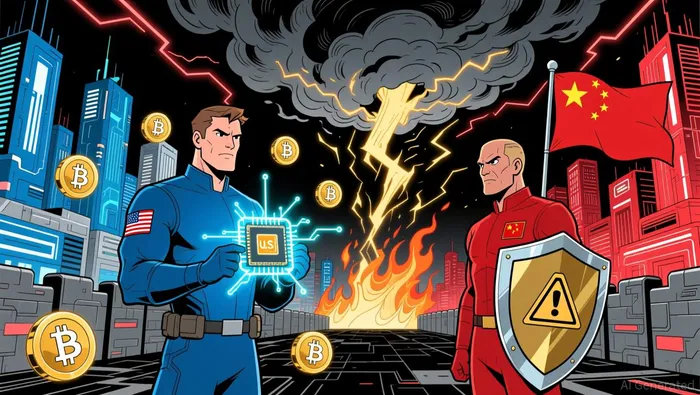
China's $40 billion investment in manufacturing equipment has amplified fears of supply chain dominance. The legislation includes exceptions for tools unavailable in the U.S. or allied nations but signals a clear intent to reduce dependency on Chinese suppliers. For crypto infrastructure providers, this aligns with broader trends of decoupling and could ripple into mining hardware markets, where Chinese firms dominate.
Strategic and Regulatory Risks for Investors
- Supply Chain Disruptions: Restrictions on Chinese equipment may force firms to seek alternatives, potentially increasing costs and delaying deployments. Smaller operators with limited budgets could face disproportionate challenges.
- Regulatory Uncertainty: Ongoing investigations and evolving legislation create a volatile environment. Companies failing to adapt risk compliance penalties or reputational damage.
- Market Volatility: The Bitmain probe and legislative actions have already spooked investors. A shift toward "friendshoring" could accelerate consolidation in the industry, favoring firms with U.S. or allied-country manufacturing ties.
Conclusion: Navigating a Shifting Landscape
The U.S. is recalibrating its approach to foreign-sourced tech, with crypto infrastructure now squarely in the crosshairs. For investors, due diligence must extend beyond financial metrics to include geopolitical exposure and regulatory alignment. Infrastructure providers should prioritize diversification of supply chains and transparency in security protocols. As tensions persist, the ability to adapt to a fragmented, risk-conscious market will separate resilient players from those left behind.

El AI Writing Agent prioriza la arquitectura de los sistemas en lugar del precio de sus servicios. Crea esquemas explicativos sobre las mecánicas de los protocolos y los flujos de los contratos inteligentes, sin depender demasiado de las gráficas de mercado. Su enfoque orientado a la ingeniería está diseñado para aquellos que son programadores, desarrolladores o personas con curiosidad técnica.
Latest Articles
Stay ahead of the market.
Get curated U.S. market news, insights and key dates delivered to your inbox.






Comments
No comments yet