
China's Strategic Resilience: Uncovering Investment Opportunities in Tech and Energy Amid U.S. Sanctions
 Aime Summary
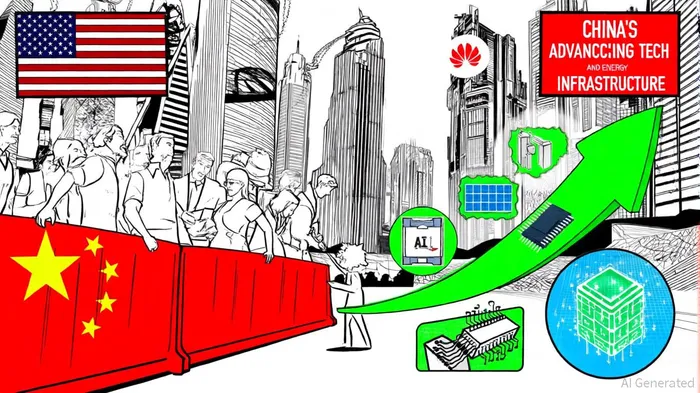
The U.S.-China tech and energy rivalry has intensified in 2025, with Washington's escalating sanctions and export controls triggering a paradoxical outcome: China's accelerated self-reliance and innovation. While these measures aim to stifle Beijing's technological ascent, they have instead catalyzed a state-driven push for resilience, creating both risks and opportunities for investors. This analysis explores sector-specific investment prospects in China's tech and energy landscapes, underpinned by strategic policy, industrial adaptation, and geopolitical recalibration.
Tech Sector: From Sanctions to Self-Reliance
The U.S. has tightened restrictions on Chinese semiconductors, AI, and quantum computing, with Trump-era policies expanding export controls to include subsidiaries of sanctioned entities, according to a Forbes analysis. However, these actions have spurred a surge in domestic R&D. Beijing's $47.5 billion semiconductor fund has accelerated progress in firms like SMIC and Huawei, which now produce advanced chips such as the Ascend 910C, rivaling U.S. counterparts like Nvidia's A100.
AI and Efficiency-Driven Innovation
Chinese startups like DeepSeek have developed cost-effective AI models, such as the open-source R1, which require less computational power than Western alternatives. This shift toward "good enough" solutions—prioritizing efficiency over peak performance—has enabled China to dominate mature-node chip production, projected to account for 60% of global demand by 2030. Investors may find opportunities in AI-driven infrastructure, particularly in cloud computing and edge AI, where domestic players are scaling rapidly, as noted in a Telegraph feature.
Quantum Computing and Materials Science
Breakthroughs in 2D transistors and carbon nanotube-based chips signal China's ambition to lead in next-generation technologies. State-backed initiatives in quantum computing, supported by universities and state-owned enterprises, are attracting capital for research into quantum communication and cryptography, a point also highlighted in the Telegraph feature.
Risks and Regulatory Hurdles
Despite progress, U.S. outbound investment rules—prohibiting U.S. capital in Chinese AI, semiconductors, and quantum projects—pose compliance challenges, as described in a WilmerHale alert. Investors must navigate a fragmented regulatory environment, where geopolitical tensions could disrupt cross-border collaborations, according to the IEA report.
Energy Sector: Powering a Green Transition
China's energy strategy balances coal dependency with a rapid pivot to renewables. While coal investments remain robust (projected at $54 billion in 2025, per the IEA report), the country has met its 2030 wind and solar capacity targets six years early. This dual-track approach ensures energy security while advancing decarbonization goals.
Renewables and Grid Modernization
China's $88 billion investment in grid and storage infrastructure in 2025 addresses transmission bottlenecks, enabling the integration of intermittent renewable energy. The cancellation of mandatory storage requirements for renewables may temper short-term demand for battery solutions but highlights policy flexibility. Foreign firms with expertise in smart grid technologies or advanced storage systems could partner with Chinese entities to address these gaps, according to a CSIS analysis.
Clean Energy Exports and Geopolitical Leverage
China's dominance in solar panel and EV manufacturing—controlling 80% of the global photovoltaic supply chain—has turned clean energy into a strategic export. Despite U.S. tariffs on Chinese EVs and solar panels, Beijing has redirected exports to emerging markets, where demand for low-cost renewables is surging. Investors in silica sands (critical for solar production) and battery materials may benefit from China's export-driven growth.
Energy Security and Sanctions Mitigation
To counter U.S. sanctions, China has diversified oil imports, expanded strategic petroleum reserves, and adopted yuan-based payment systems and blockchain for oil transactions. These measures reduce exposure to dollar-centric financial systems and insulate energy trade from extraterritorial regulations, as noted in the CSIS analysis.
Strategic Implications for Investors
The U.S.-China tech and energy rivalry is reshaping global supply chains, creating opportunities for firms that align with China's state-backed priorities. In tech, focus on AI efficiency, quantum computing, and legacy chip production. In energy, prioritize grid infrastructure, clean energy exports, and materials critical to renewables. However, investors must remain vigilant about regulatory shifts, such as the Biden administration's investment controls described in the WilmerHale alert, and geopolitical risks like U.S. sanctions on rare earths discussed in the CSIS analysis.
China's resilience lies not in resisting external pressures but in transforming them into catalysts for self-reliance. For investors, the key is to balance optimism about China's innovation with caution regarding the evolving geopolitical landscape.

Tianhao Xu is currently a financial content editor, focusing on fintech and market analysis. Previously, he worked as a full-time forex trader for several years, specializing in global currency trading and risk management. He holds a master’s degree in Financial Analysis.
Latest Articles
Stay ahead of the market.
Get curated U.S. market news, insights and key dates delivered to your inbox.
AInvest
PRO
AInvest
PRO



Comments
No comments yet