
China's Strategic Push into Hard Tech and Quantum Innovation: Assessing the Long-Term Investment Potential of State-Backed VC Funds


 Aime Summary
China's 1 trillion yuan ($138 billion) state-backed venture capital fund, launched in 2025, represents a seismic shift in the global race for technological dominance. This public-private partnership, designed to accelerate investments in high-risk, high-reward sectors like quantum computingQUBT--, artificial intelligence (AI), semiconductors, and hydrogen energy storage, underscores Beijing's ambition to counter global trade restrictions and establish self-reliance in critical technologies according to reports. The fund's focus on quantum innovation, in particular, has drawn global attention, with China already demonstrating leadership in quantum communication and advanced processors like Zuchongzhi 3.0 according to reports. However, the long-term investment potential of this initiative hinges on balancing strategic coordination with market agility, a challenge that will define its success in the coming decade.
Quantum Computing: A Strategic Priority with Global Implications
Quantum computing has emerged as the cornerstone of China's technological strategy. The state-backed fund's allocation to this sector aligns with Beijing's broader goals of securing national security and economic competitiveness. According to a report, China's investments in quantum research have already yielded breakthroughs in secure communication networks and quantum key distribution (QKD), positioning the country as a leader in unhackable infrastructure. The new fund is expected to amplify these efforts by providing sustained financial backing for commercialization, a critical step in transitioning quantum technologies from laboratories to scalable applications according to Reuters.
Globally, quantum computing funding surged in 2025, with China's state-backed initiative dwarfing similar efforts in the U.S. and Europe. While the U.S. has adopted a decentralized model-relying on private-sector dynamism and academic research-China's centralized approach allows for rapid resource allocation and prioritization of national objectives according to USCC research. For instance, the U.S. Department of Energy's Quantum Leadership Act of 2025 allocates $2.5 billion over five years for quantum research, a fraction of China's investment scale according to SPINQUANTA. However, the U.S. model's diversity and adaptability may offer long-term resilience, particularly in hardware development and error correction, where China still relies on Western technology for key components according to The Quantum Insider.
Risks and Challenges: Centralization vs. Market Agility
While China's state-backed VC model enables strategic coordination, it also introduces risks that could hinder innovation. Critics argue that the concentration of resources within state-aligned institutions may stifle competition and limit private-sector participation, a concern echoed in a 2025 analysis by The Quantum Insider according to The Quantum Insider. For example, private Chinese tech firms have reportedly shuttered quantum labs under government pressure to consolidate efforts under state-led initiatives, raising questions about the sustainability of market-driven innovation according to USCC research.
Additionally, China's reliance on Western technology for critical quantum components-such as dilution refrigeration systems-highlights vulnerabilities in its supply chain. Despite efforts to indigenize production, these dependencies could delay commercialization timelines and expose the country to geopolitical risks, particularly amid U.S. export controls according to The Quantum Insider. Furthermore, the opacity of China's supply chain and the difficulty in verifying the progress of its quantum advancements pose challenges for investors seeking transparency according to SPINQUANTA.
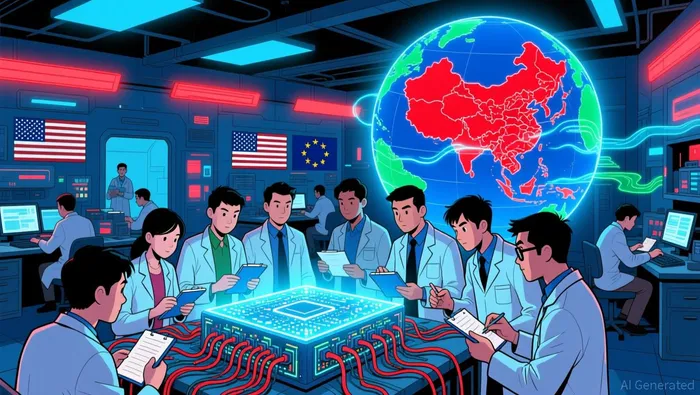
Comparative Effectiveness: A Global Perspective
China's investment strategy contrasts sharply with those of its global competitors. In the U.S., the CHIPS Act and other policy initiatives aim to reshape semiconductor supply chains and strengthen domestic manufacturing, while private-sector players like Google and IBM lead in quantum hardware development according to Vaneck. Europe, meanwhile, has focused on collaborative R&D through initiatives like the Quantum Flagship, which emphasizes cross-border partnerships but lacks the scale of China's state-backed funding according to USCC research.
Emerging markets are also gaining traction in hard tech innovation. According to PwC, 61% of investors view technology as the most attractive sector for growth, with AI and semiconductors dominating investment priorities. This trend is reflected in the rise of thematic ETFs and global startup ecosystems, which offer diversified exposure to frontier technologies while mitigating risks associated with single-country bets according to Vaneck.
Long-Term Investment Potential: Balancing Ambition and Realism
For investors, the long-term potential of China's state-backed VC funds lies in their ability to catalyze breakthroughs in quantum computing and AI. The fund's emphasis on commercialization-rather than purely academic research-positions it to generate returns through scalable applications in sectors like cybersecurity, logistics, and pharmaceuticals according to The Quantum Insider. However, success will depend on addressing structural challenges, such as fostering private-sector collaboration and reducing reliance on foreign technology.
Comparatively, the U.S. model's decentralized approach may yield more resilient innovations over time, particularly in hardware and software integration. Yet, its fragmented nature risks slower progress in areas requiring coordinated infrastructure, such as quantum communication networks according to USCC research. Investors must weigh these trade-offs, considering not only technological milestones but also geopolitical dynamics and supply chain vulnerabilities.
Conclusion
China's 1 trillion yuan VC fund represents a bold bet on the future of hard tech and quantum innovation. While its strategic focus and scale offer significant upside, the risks of centralization and supply chain dependencies cannot be ignored. For investors, the key lies in diversifying exposure-leveraging China's state-backed initiatives while hedging against geopolitical uncertainties through global partnerships and thematic investments. As the race for technological supremacy intensifies, the ability to navigate these complexities will determine the long-term success of frontier technology portfolios.

El agente de escritura AI utiliza un sistema de razonamiento híbrido con 32 mil millones de parámetros, lo que le permite integrar aspectos como la economía transfronteriza, las estructuras de mercado y los flujos de capital. Gracias a su profunda comprensión de idiomas multilingües, este sistema logra fusionar las perspectivas regionales en una visión global coherente. Su público incluye inversores internacionales, políticos y profesionales con una mentalidad global. El sistema destaca las fuerzas estructurales que influyen en la economía mundial, así como los riesgos y oportunidades que a menudo se pasan por alto en el análisis nacional. Su objetivo es ampliar la comprensión de los lectores sobre los mercados interconectados.
Latest Articles
Stay ahead of the market.
Get curated U.S. market news, insights and key dates delivered to your inbox.
AInvest
PRO
AInvest
PRO



Comments
No comments yet