
China's Strategic Leverage in the Global Chip Ecosystem: A Dual-Track Path to Semiconductor Resilience
 Aime Summary
The global semiconductor industry is at a crossroads. As the U.S. and China deepen their technological rivalry, Beijing's strategic recalibration of its chip ecosystem has emerged as a critical battleground for long-term dominance. By blending state-led investment, selective open innovation, and geopolitical diversification, China is not merely reacting to U.S. pressure—it is redefining the rules of the game. For investors, understanding this evolving landscape is key to navigating both risks and opportunities in a fractured global supply chain.
State-Led Investment: Building the Infrastructure of Self-Reliance
China's third National Integrated Circuit (IC) Industry Investment Fund, launched in 2023, underscores its commitment to reshaping the semiconductor ecosystem. With $47.1 billion allocated, this fund targets core technologies like lithography equipment, advanced manufacturing processes, and indigenous design tools. Companies such as Yangtze Memory Technologies (YMTC) and ChangXin Memory Technologies (CXMT) have already made strides in 3D NAND flash memory, reducing reliance on Western firms.
While Semiconductor Manufacturing International Corporation (SMIC) faces U.S. export restrictions, its recent advancements in 7nm processes highlight the potential for domestic innovation. Investors should monitor firms benefiting from state-backed R&D, but remain cautious about overcapacity risks in mature nodes.
Selective Open Innovation: Leveraging Global Partnerships
Despite U.S. export controls, China is strategically expanding collaborations with non-U.S. allies. Partnerships with Japanese and Dutch firms for lithography equipment, and adoption of open-source RISC-V architectures, demonstrate a pragmatic approach to bypassing Western bottlenecks.
This “open innovation” model allows China to access critical technologies while reducing dependency on proprietary systems. For investors, this trend signals opportunities in firms like Alibaba's Pingtouge Semiconductor, which is developing RISC-V-based AI chips.
Geographic Clustering: The Rise of Regional Hubs
China's semiconductor industry is increasingly concentrated in specialized clusters, such as Shanghai, Shenzhen, and Suzhou. These hubs benefit from localized ecosystems that integrate fabless design, manufacturing, and talent pipelines. However, local governments' competitive investments have led to redundancies, such as overlapping foundry projects.
Investors should prioritize companies with strong ties to these clusters but watch for signs of overinvestment. Firms like Hua Hong Semiconductor, which operates in Suzhou, may offer exposure to regional growth while mitigating systemic risks.
Geopolitical Diversification: Beyond the U.S.-China Divide
China's push to diversify supply chains into India and Vietnam reflects a broader strategy to insulate its semiconductor ambitions from U.S. pressure. By establishing manufacturing partnerships in these regions, Beijing aims to create alternative supply chains and reduce its exposure to geopolitical shocks.
This shift could benefit Indian firms like Tata Electronics and Vietnamese manufacturers like Saigon Technology, which are positioning themselves as key nodes in China's globalized but fragmented ecosystem.
Investment Implications: Balancing Risk and Resilience
China's hybrid model—combining self-sufficiency with selective integration—offers both opportunities and challenges. For investors, the key is to identify firms that align with Beijing's strategic priorities while avoiding overexposure to politically sensitive sectors.
- Long-Term Bets: Focus on companies advancing in memory chips (e.g., YMTC) and AI-specific architectures (e.g., Pingtouge).
- Diversification: Hedge against geopolitical risks by investing in firms with cross-border partnerships (e.g., SMIC's collaborations with Dutch equipment suppliers).
- Caution Zones: Avoid overinvesting in mature-node foundries, where capacity gluts and pricing pressures could erode margins.
Conclusion: A New Era of Semiconductor Geopolitics
China's semiconductor strategy is a masterclass in ecosystem design—leveraging state power, global partnerships, and regional specialization to counter U.S. pressure. While full self-sufficiency remains a distant goal, the country's hybrid approach ensures it will remain a dominant force in the global chip industry. For investors, the path forward lies in understanding this duality: a race for resilience, not just dominance.
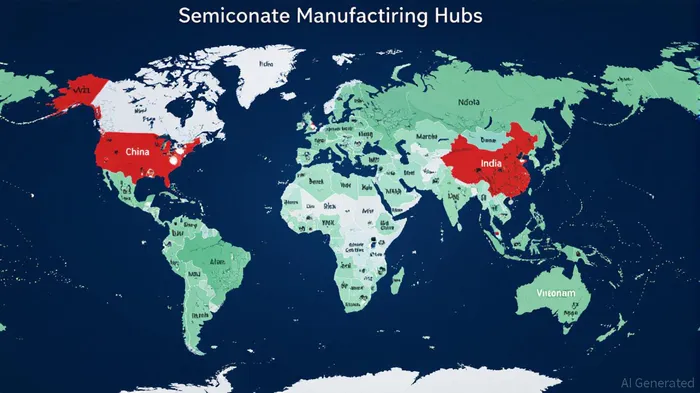
As the world's two largest economies continue to reshape the semiconductor landscape, the winners will be those who adapt to the new rules of the game. China's ecosystem-driven strategy is not just about chips—it's about redefining the future of technology itself.

Stay ahead of the market.
Get curated U.S. market news, insights and key dates delivered to your inbox.






Comments
No comments yet