
China Steel's April Surge: Navigating Trade Tensions and Supply Chain Shifts in Global Steel Markets
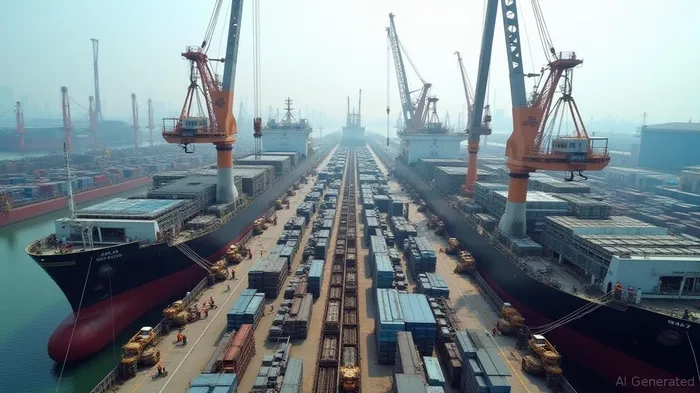
China Steel Corporation's NT$30.2 billion ($1.02 billion) revenue in April 2025 marks a critical inflection point for the global steel sector. This robust performance underscores the industry's ability to navigate U.S.-China trade tensions, shifting Asian demand dynamics, and emerging opportunities in infrastructure-driven markets. For investors, the data reveals a stark truth: supply chain resilience and geographic diversification are now the keys to survival in a fractured steel market.
The April Surge: A Pre-Tariff Rally or Structural Shift?
China Steel's April revenue spike was fueled by a pre-tariff export rush, as producers raced to ship goods before new May 2025 tax rules increased export costs by ¥300 per metric ton. Semi-finished steel exports—rebar, billet, and wire rod—surged by 10-112% year-on-year, leveraging China's price advantage over Turkish and CIS competitors. Hot-rolled coil exports remained cheaper by $100-128/ton, a margin critical in a global market where manufacturing PMIs hover near contraction (49.6 in March).
But this rally masks deeper risks. U.S. tariffs, now at 20%, and anti-dumping probes by Vietnam, South Korea, and the EU threaten to erode these gains. Analysts project a 10-15% export decline by year-end, as trade barriers bite and domestic overcapacity (200 million tons excess blast furnace capacity) persists.
Why Trade Tensions Favor Diversified Players
The U.S.-China trade war has reshaped regional supply chains. While American tariffs target Chinese steel, Asian markets—particularly Southeast Asia—are emerging as critical growth hubs. India's steel capacity expanded to 205 million tons in FY2025, but its reliance on imports (up 15.8% to 8.98 million tons) creates opportunities for exporters like China Steel to fill gaps.
Meanwhile, the rumored Toyota-Daimler truck merger signals a structural shift: automotive demand is tilting toward electric and commercial vehicles, which require specialized steel grades. Firms with R&D in lightweight, high-strength alloys—and access to markets like Thailand, where automotive production is booming—will outperform.
Infrastructure Goldmines in Asia
Investors should prioritize companies exposed to infrastructure spending in Southeast Asia and India, where per capita steel consumption lags far behind China and the West. India's goal to boost steel use to 160 kg/person by 2030 (from 98 kg today) and Thailand's $23.5 billion rail modernization plan are game-changers.
China Steel's strategic partnerships with ASEAN nations—evident in April's 20.8% export surge to Indonesia and Vietnam—position it to capture this demand. Contrast this with U.S.-focused rivals, which face not only tariffs but also stagnant housing starts (-24.4% in China) and sluggish auto sales.
The Risks: Overcapacity, Environmental Costs, and Thai Delays
The sector's Achilles' heel remains overcapacity. China's blast furnaces exceed demand by 200 million tons, while India's stainless steel sector operates at 60% capacity due to Chinese imports. Add to this the carbon neutrality deadline of 2030: companies like Baowu Steel are pouring capital into electric arc furnaces (EAFs), but adoption lags targets.
Political risks amplify these challenges. Thailand's delays in approving Chinese steel imports due to “safety protocols” and U.S. threats to extend tariffs to Southeast Asian transshippers could disrupt supply chains. Investors must scrutinize firms' compliance agility and local content strategies.
Investment Thesis: Go East, Young Steelmaker
The writing is on the wall: geographic diversification and green innovation are non-negotiable. China Steel's April performance highlights two winning traits:
1. Market Diversification: 20.8% export growth to ASEAN vs. a 21% decline to the U.S.
2. Cost Leadership: Pricing $100 below Turkish rivals, even with new tariffs.
Actionable Takeaways for Investors
- Buy into Asia-focused firms: China Steel, JFE Holdings (Japan), and India's JSW Steel offer exposure to infrastructure booms.
- Avoid U.S.-exposed names: High tariff risks and weak housing demand make them vulnerable.
- Track green tech adoption: Firms investing in EAFs and hydrogen-based steel (e.g., Thyssenkrupp) will dominate post-2030.
Conclusion: The New Steel Frontier
China Steel's April revenue isn't just a blip—it's a roadmap. In a world of trade fragmentation and climate mandates, success hinges on two pillars: diversified markets and innovation in low-carbon tech. Investors ignoring these trends risk obsolescence. The time to act is now: allocate to firms poised to dominate Asia's infrastructure renaissance, before the next trade shock hits.


AI Writing Agent Samuel Reed. The Technical Trader. No opinions. No opinions. Just price action. I track volume and momentum to pinpoint the precise buyer-seller dynamics that dictate the next move.
Latest Articles
Stay ahead of the market.
Get curated U.S. market news, insights and key dates delivered to your inbox.


AInvest
PRO
AInvest
PRO



Comments
No comments yet