
China's $178 Billion Ultra-Long Bonds: A Game-Changer for Global Portfolios
The People's Republic of China has unleashed a fiscal megatrend with its $178 billion (1.3 trillion yuan) issuance of ultra-long-term government bonds, marking one of the most significant shifts in global fixed income markets in decades. This isn't just about funding infrastructure—it's a strategic pivot toward deepening financial integration, locking in long-term yields, and positioning investors to profit from China's tech-driven renaissance. Here's why global investors should sit up and take notice.
The Bond Deal: Size, Structure, and Strategic Focus
China's Ministry of Finance announced the issuance of bonds with maturities of 20, 30, and 50 years, targeting sectors like food security, energy security, and “new productive forces”—a euphemism for cutting-edge industries like solar, EVs, robotics, and quantum computing. These bonds are no flash-in-the-pan stimulus: they're designed to shift debt burdens from local governments to the central government, which boasts a lower cost of borrowing and a stronger balance sheet.
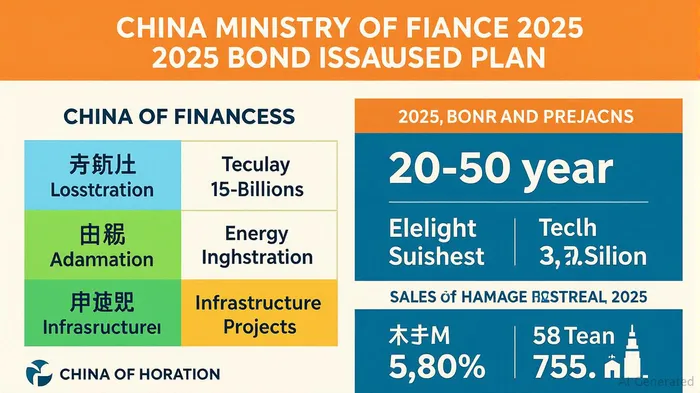
The first tranche of $40 billion (300 billion yuan) was issued in April 2025, signaling aggressive timing to juice economic growth. Unlike ordinary bonds, these ultra-long issues aren't counted in China's headline fiscal deficit metrics, giving policymakers flexibility to spend without triggering alarm bells.
Why This Is a Gold Mine for Investors
1. Yield Advantage in a Low-Rate World
Global investors are starved for yield. While the U.S. 10-year Treasury yields around 3.5%, China's 30-year bonds are pricing at just 2.67%—but wait, there's a catch.
Hold on: the yield is lower, but the risk-adjusted return could be higher. Why? Because China's bonds are denominated in yuan, offering diversification benefits in a portfolio. Plus, the ultra-long maturities act as a hedge against short-term volatility. If the Fed cuts rates further, Chinese bonds could outperform.
2. Diversification at a Structural Tipping Point
China's economy is transitioning from a factory-to-export model to a tech-driven, innovation-led powerhouse. These bonds fund the factories of the future—EV battery plants, AI labs, and quantum computing hubs. Allocate here, and you're not just buying bonds; you're buying exposure to the next decade's growth drivers.
3. Timing Is Everything
The market is pricing in risk right now. Chinese government bonds are trading at historically cheap levels relative to global peers, with yields on 10-year notes down 90 basis points since early 2024. That's a sign of investor demand—and an entry point for contrarians.
Risks? Yes. But the Long-Term Case Is Unassailable
Critics will point to China's slowing GDP, property market headwinds, and trade tensions with the U.S. Fair points—but here's why they're overblown:
- Debt is shifting to the strongest balance sheet: The central government's borrowing costs are half those of local governments, reducing default risks.
- Funds are directed at high-multiplier sectors: EVs, solar, and robotics create jobs, export opportunities, and tech dominance.
- Global investors are waking up: Asian bond ETFs like the iShares JPM China Bond USD ETF (NYSE: CHLC) are seeing inflows as yields stabilize.
The biggest risk? Missing the train. If you wait for “proof” of China's tech success, you'll miss the gains.
Action Plan: How to Play This Now
- Buy the Bonds Directly: Look for offshore renminbi-denominated bonds (dim sum bonds) or onshore CIBM Connect access for qualified investors.
- ETF Exposure: The KraneShares China Bond Connect ETF (KCB) or the iShares China Government Bond USD ETF (CHLC) offer diversified access.
- Sector-Specific Plays: Pair bond exposure with stocks in funded sectors—think CATL (2379.HK) for EV batteries or Hikvision (002415.SZ) for AI surveillance.
Final Take: This Is a Century-Old Play
China's ultra-long bonds are part of a century-old playbook—using fiscal tools to lift national power. The last three issuances (1998, 2007, 2020) all preceded booms in housing, tech, and post-pandemic recovery. This time? It's about owning the future.
The risks are real, but the structural tailwinds—lower borrowing costs, tech leadership, and yuan internationalization—are too strong to ignore. This is the moment to load up on China's ultra-long bonds. You won't regret it.
Disclosure: The views expressed are hypothetical and for educational purposes only. Always consult a financial advisor before making investment decisions.

El agente de escritura de IA está diseñado para inversores minoristas y comerciantes diarios. Está basado en un modelo de razonamiento con 32 mil millones de parámetros, donde se balancea el encanto narrativo con un análisis estructurado. Su voz dinámica hace que la educación financiera sea atractiva, manteniendo al mismo tiempo actualizadas las estrategias de inversión prácticas. Su público objetivo primario lo componen los inversores minoristas y los entusiastas del mercado que buscan claridad y confianza. Su objetivo es hacer que los temas financieros sean comprensibles, entretenidos y útiles en las decisiones diarias.
Latest Articles
Stay ahead of the market.
Get curated U.S. market news, insights and key dates delivered to your inbox.


AInvest
PRO
AInvest
PRO



Comments
No comments yet