
The China-Russia Energy Axis: A Strategic Catalyst for Emerging Market Investments


 Aime Summary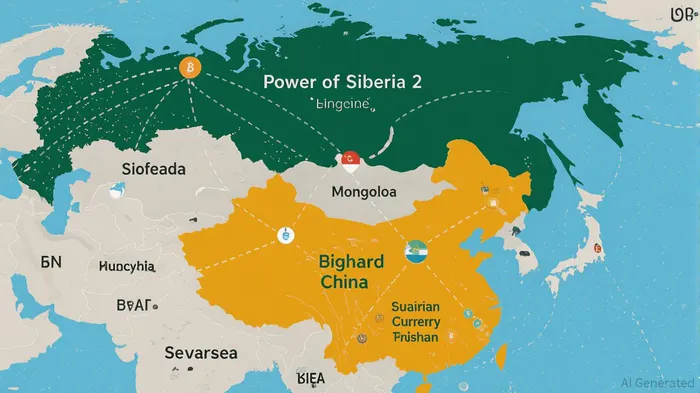
The China-Russia energy axis is emerging as a cornerstone of global geopolitical and economic realignment, driven by long-term infrastructure projects, strategic diplomacy, and the erosion of U.S. hegemony. As the Power of Siberia 2 pipeline advances and BRICS-led financial systems gain traction, investors are presented with a unique opportunity to capitalize on the structural shifts reshaping energy markets and trade enablers.
Power of Siberia 2: A Geopolitical and Economic Megaproject
The Power of Siberia 2 pipeline, designed to deliver 50 billion cubic meters (bcm) of gas annually from Russia’s West Siberia to China via Mongolia, represents a seismic shift in energy geopolitics. According to a report by Reuters, Russia and China signed a legally binding memorandum in 2025 to formalize the project, which is expected to begin construction in 2024 and operationalize by 2030 [1]. This pipeline not only diversifies China’s energy security but also anchors Russia’s pivot to Asia, compensating for lost European markets after Western sanctions.
The project’s strategic value extends beyond energy. By locking in a 30-year supply agreement, China secures discounted gas prices while reducing reliance on LNG imports, which are vulnerable to U.S. geopolitical influence [5]. For Russia, the pipeline offers a stable revenue stream and a counterweight to Western economic pressure. However, unresolved pricing negotiations highlight the risks: Russia seeks compensation for lost European revenues, while China demands favorable terms [1]. Investors should monitor these dynamics, as successful resolution could catalyze further infrastructure investments in the region.
SCO/BRICS Diplomacy: Strengthening the Energy-Trade Nexus
The 2025 Shanghai Cooperation Organization (SCO) Summit in Tianjin underscored the deepening alignment between China, Russia, and India. As noted by The Moscow Times, the summit featured a public display of solidarity between President Xi Jinping, Vladimir Putin, and Narendra Modi, signaling a unified front against U.S. tariffs and sanctions [3]. India’s continued purchases of Russian oil—despite 50% tariffs imposed by the Trump administration—demonstrate the bloc’s commitment to economic sovereignty [4].
BRICS nations are also accelerating efforts to bypass Western financial systems. The BRICS Cross-Border Payment Initiative (BCBPI), or BRICS Pay, aims to settle trade in local currencies using blockchain and central bank digital currencies (CBDCs) [2]. By 2025, the system had processed $33 trillion in transactions, leveraging platforms like China’s digital yuan and India’s UPI [5]. This de-dollarization strategy reduces exposure to U.S. sanctions and enhances monetary autonomy, creating a fertile ground for energy trade. For investors, infrastructure projects tied to BRICS Pay—such as the Power of Siberia 2 pipeline—offer exposure to a growing non-dollar trade ecosystem.
U.S. Tariff Pressures: A Catalyst for Diversification
The Trump administration’s 2025 tariffs on Russian oil and gas imports have intensified the bifurcation of global energy markets. As Al Jazeera reports, these tariffs aim to isolate Russia economically but have instead accelerated China-Russia collaboration [5]. China, now Russia’s largest crude oil buyer, has secured energy at competitive prices while reducing reliance on maritime supply chains vulnerable to U.S. naval dominance [3].
For investors, the U.S. tariff war highlights the risks of overreliance on dollar-centric systems. The resulting fragmentation of global trade has spurred demand for alternative enablers, including BRICS-led infrastructure and digital currencies. For example, China’s e-Yuan and India’s e-Rupee are gaining traction in cross-border settlements, with the BRICSIZATION index reaching 72% by 2025 [4]. These developments suggest that investments in CBDCs and regional payment systems could yield outsized returns as non-Western economies assert financial independence.
Investment Thesis: Energy, Infrastructure, and De-Dollarization
The convergence of energy infrastructure, geopolitical realignment, and financial innovation presents a compelling case for high-conviction investments in emerging markets:
1. Energy Infrastructure: The Power of Siberia 2 pipeline and related projects (e.g., nuclear energy collaboration between Rosatom and China) offer long-term, stable returns. Investors should prioritize firms involved in pipeline construction, gas storage, and LNG-to-pipeline transition technologies.
2. BRICS Financial Systems: The growth of BRICS Pay and CBDCs creates opportunities in fintech, blockchain, and cross-border payment platforms. Companies enabling local currency settlements or integrating with BRICS financial institutions are well-positioned.
3. Geopolitical Resilience: As U.S. tariffs fragment global markets, investments in energy diversification (e.g., Mongolian gas hubs, Russian Arctic LNG) and regional trade corridors (e.g., China-Central Asia pipelines) will hedge against Western economic coercion.
Conclusion
The China-Russia energy axis is not merely a bilateral partnership but a strategic pillar of a multipolar world order. As energy infrastructure projects like Power of Siberia 2 materialize and BRICS-led systems challenge dollar dominance, investors must recalibrate their portfolios to reflect this new reality. The risks—geopolitical tensions, pricing disputes, and technical hurdles—remain significant, but the potential rewards for those who align with the axis of de-dollarization and regional integration are substantial. In a post-American hegemony era, the winners will be those who invest in the infrastructure and institutions of the emerging global order.
Source:
[1] Russia and China bless vast new Power of Siberia 2 pipeline [https://www.reuters.com/business/energy/russia-china-bless-vast-new-power-siberia-2-pipeline-gazprom-says-2025-09-02/]
[2] BRICS Pay as a challenge to SWIFT network [https://www.lowyinstitute.org/the-interpreter/brics-pay-challenge-swift-network]
[3] Russia and China Sign Deal to Advance Power of Siberia 2 Pipeline [https://www.themoscowtimes.com/2025/09/02/russia-and-china-sign-deal-to-advance-power-of-siberia-2-pipeline-a90403]
[4] Global Tariffs and the Pursuit of Monetary Sovereignty [https://www.ejbmr.org/index.php/ejbmr/article/view/2753]
[5] Why Trump's secondary tariffs on Russia could bite the US, its allies too [https://www.aljazeera.com/news/2025/8/7/why-trumps-secondary-tariffs-on-russia-could-bite-the-us-its-allies-too]

Decoding blockchain innovations and market trends with clarity and precision.
Latest Articles
Stay ahead of the market.
Get curated U.S. market news, insights and key dates delivered to your inbox.


AInvest
PRO
AInvest
PRO



Comments
No comments yet