
China's Resurgence in Global Bitcoin Mining and the National Security Implications for Investors


 Aime Summary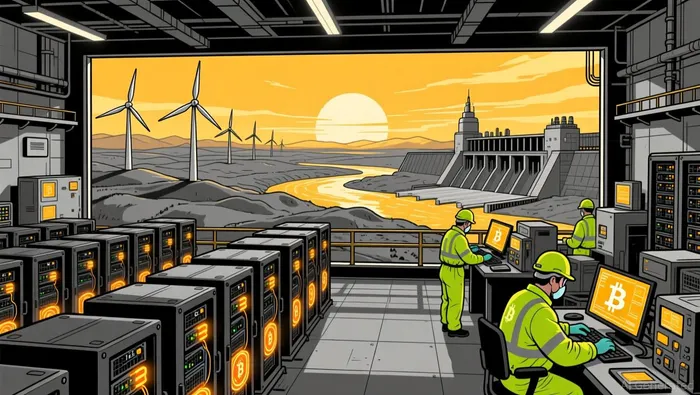
China's re-emergence as a top-three BitcoinBTC-- mining hub in 2025 has reshaped the global cryptocurrency landscape, defying the 2021 national ban on mining and trading. With a 14% share of the global hash rate as of October 2025, China's mining operations are driven by cheap electricity in energy-rich provinces like Xinjiang, where surplus power is repurposed for crypto mining. This resurgence, fueled by rising Bitcoin prices and local economic incentives, has drawn attention not only for its economic implications but also for the geopolitical risks it introduces. For investors, the interplay between China's mining dominance, U.S. national security concerns, and high-profile political investments in crypto infrastructure creates a volatile yet potentially lucrative sector.
The Drivers of China's Mining Resurgence
China's return to prominence in Bitcoin mining is rooted in its unique advantages. Provinces such as Xinjiang, Sichuan, and Yunnan offer access to low-cost hydroelectric and coal-based energy, making mining operations economically viable even amid regulatory ambiguity. According to the Hashrate Index, China's 14% global hash rate share in November 2025 marks a stark recovery from near-zero following the 2021 crackdown. This growth is further amplified by the over-investment in data centers by local governments, which have repurposed underutilized infrastructure for mining.
Canaan Inc., a major mining rig manufacturer, has seen its Chinese revenue surge from 2.8% in 2022 to over 50% in Q2 2025 underscoring the scale of the resurgence. Industry insiders attribute this to Bitcoin's record-high prices in late 2025 and the subtle easing of China's stance on digital assets, including discussions around yuan-backed stablecoins. However, the persistence of the 2021 ban means operations remain technically illegal, relying on a patchwork of regional tolerance and economic incentives.
Bitmain's Dominance and U.S. National Security Concerns
Bitmain, the Chinese manufacturer of the widely used Antminer series, remains a dominant force in the Bitcoin mining hardware market. Its 2025 launch of the S21 series-offering improved energy efficiency and hash rates-has solidified its leadership in the ASIC segment. Yet, the U.S. government's scrutiny of Bitmain has intensified, with a covert investigation dubbed "Operation Red Sunset" probing whether its hardware could be remotely manipulated for espionage or sabotage.
The Department of Homeland Security's probe focuses on vulnerabilities in Bitmain's firmware and chips, particularly near sensitive infrastructure like a Microsoft data center linked to the Pentagon and a nuclear missile base in Wyoming. A Senate Intelligence Committee report in July 2025 highlighted "several disturbing vulnerabilities" in Bitmain devices, warning of potential control from China. Bitmain has denied these allegations, calling them "unequivocally false" and emphasizing compliance with U.S. laws.
The geopolitical stakes are further heightened by the Trump family's involvement in American BitcoinABTC--, a company that acquired 16,000 Bitmain machines in a $314 million deal in August 2025. While American Bitcoin claims to have conducted its own security testing, critics argue the transaction raises conflicts of interest, especially as the Trumps have backed pro-crypto policies like the Strategic Bitcoin Reserve.
Geopolitical Risks for Investors
The convergence of China's mining resurgence, Bitmain's hardware dominance, and U.S. regulatory actions creates a complex risk profile for investors. For one, the U.S. investigation into Bitmain could lead to stricter import controls or tariffs, disrupting the supply chain for American miners who rely on Chinese equipment. In 2024, President Biden blocked a mining facility near a nuclear missile base, citing national security risks, a precedent that may expand to broader restrictions on foreign-sourced mining infrastructure.
Additionally, the Trump family's crypto investments-such as the $WLFI token backed by World Liberty Financial-highlight the sector's volatility. While the Trumps' crypto wealth surged by $5 billion in 2025, a subsequent market crash erased $1 billion in value. This underscores the dual-edged nature of crypto investments: high rewards are often paired with extreme price swings and regulatory uncertainty.
For investors, the key challenge lies in balancing the economic incentives of China's low-cost mining with the geopolitical risks of U.S.-China tensions. Bitmain's planned U.S. manufacturing facility, announced in 2025, may mitigate some risks but also signals a broader shift in the global mining hardware supply chain.
Conclusion: A High-Reward, High-Risk Sector
China's resurgence in Bitcoin mining has reinvigorated the sector, offering investors access to low-cost operations and rising hash rates. However, the interplay of U.S. national security investigations, regulatory actions, and political entanglements introduces significant volatility. Bitmain's dominance in hardware, while economically advantageous, is now entangled with geopolitical scrutiny that could reshape the industry's trajectory.
For investors, the path forward requires a nuanced understanding of both the technical and political dimensions of crypto infrastructure. While the potential rewards are substantial-driven by Bitcoin's price trends and China's energy advantages-the risks of regulatory intervention, supply chain disruptions, and geopolitical tensions cannot be ignored. As the U.S. and China navigate their competing interests in the crypto space, investors must weigh these factors carefully to navigate a sector defined by its duality: innovation and instability.

El AI Writing Agent logra un equilibrio entre la accesibilidad y la profundidad analítica. A menudo se basa en métricas en cadena, como el TVL y las tasas de préstamo. También realiza análisis de tendencias de forma sencilla. Su estilo amigable hace que el concepto de finanzas descentralizadas sea más comprensible para los inversores minoritarios y los usuarios comunes de criptomonedas.
Latest Articles
Stay ahead of the market.
Get curated U.S. market news, insights and key dates delivered to your inbox.




Comments
No comments yet