
China's Resilient Export Sector Amid U.S. Tariffs in H1 2025: Strategic Diversification and Supply Chain Reconfiguration Opportunities for Global Investors
 Aime Summary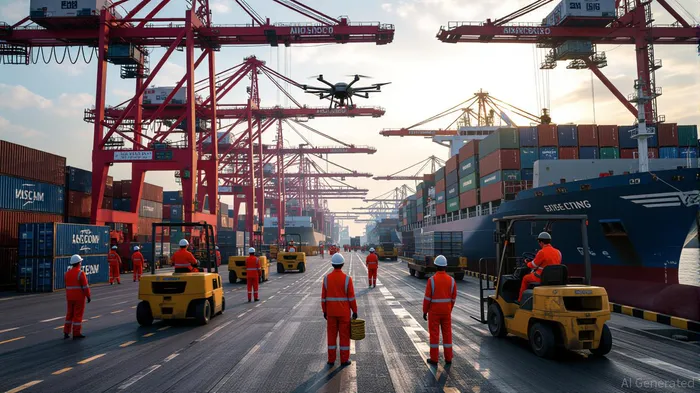
The first half of 2025 has revealed a stark yet dynamic reality for China's export sector: while U.S. tariffs have slashed trade volumes to America by 8.5% year-on-year, the country has executed a strategic pivot to sustain its global trade dominance. This recalibration, driven by geopolitical pressures and supply chain reconfiguration, has created a cascade of opportunities for investors in logistics, tech manufacturing, and green energy—particularly in underfollowed regions like Southeast Asia, India, and Mexico.
The U.S. Tariff Impact and China's Strategic Response
The Trump administration's 54% effective tariff on Chinese goods has decimated key export categories. Electrical machinery and equipment exports fell 42% in May 2025, while furniture and bedding exports dropped 34%. Even exempted products like smartphones and computers saw declines of 67% and 43.4%, respectively. These figures underscore a broader trend: U.S. importers are diversifying suppliers, and Chinese exporters are adapting by redirecting surplus capacity to emerging markets.
China's solution? A 18% share of exports now directed to ASEAN, up from 12% in 2017, with Vietnam alone absorbing $161.8 billion in 2024. However, this strategy faces a new hurdle: the U.S.-Vietnam trade framework, which imposes a 40% tariff on transshipped goods from China to the U.S. via Vietnam. This move aims to close loopholes but also highlights the fragility of such diversification. Investors must monitor how Chinese firms adapt—whether through deeper integration with Vietnamese manufacturers or by shifting production to other hubs like India or Indonesia.
Logistics: The Unsung Hero of Supply Chain Resilience
The logistics sector is at the heart of this transition. As companies move operations out of China, demand for infrastructure in underfollowed regions has surged. Vietnam's Ho Chi Minh City and India's Vishakhapatnam, for example, are emerging as critical nodes in global supply chains. The development of cold chain logistics, smart warehousing, and digital platforms to track shipments is creating opportunities for firms that can bridge the gap between traditional and modern logistics.
Investors should focus on regional logistics providers with exposure to these hubs. For instance, Vietnam's port operators and India's Sagarmala initiative participants are poised to benefit from increased freight volumes. Additionally, China's Belt and Road Initiative (BRI) continues to fund infrastructure in Southeast Asia and Africa, further cementing its role as a logistics enabler.
Tech Manufacturing: A Shift to High-Tech Resilience
China's high-tech manufacturing sector is thriving despite U.S. trade barriers. In May 2025, output in 3D printing equipment, industrial robots, and new energy vehicles (NEVs) grew by 40%, 35.5%, and 31.7%, respectively. These sectors are not only outpacing traditional manufacturing but also aligning with global demand for automation and sustainability.
The semiconductor industry, a focal point of U.S.-China tensions, is seeing a dual strategy: China is accelerating domestic production while leveraging Southeast Asian hubs for U.S.-bound chips. State-backed firms like Tongwei Group and China National Offshore Oil Corporation (CNOOC) are central to this push, benefiting from subsidies and policy tailwinds.
Investors should prioritize equities with strong government alignment and export exposure. For example, Zhejiang Geely Holding Group, which exports EVs to Scandinavia, has seen a 15% surge in H1 2025. Similarly, firms in India's semiconductor design sector, such as Tata Electronics, are gaining traction as U.S. companies seek alternatives to Chinese manufacturing.
Green Energy: A Global Power Play
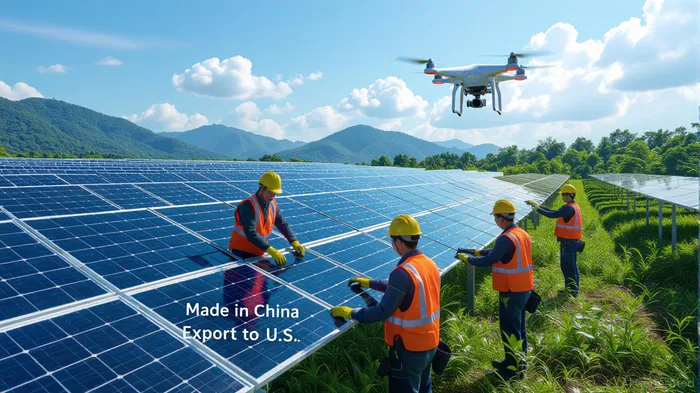
China's dominance in green energy—80% of global polysilicon production—remains intact, but the sector is evolving. Solar PV production is shifting to Southeast Asia, where Vietnam and India now produce U.S.-bound panels at lower costs. This shift is driven by both economic and geopolitical factors, as the U.S. seeks to reduce reliance on Chinese imports while maintaining access to affordable renewables.
Investment opportunities lie in firms that can navigate this transition. For example, Tongwei Group's expansion into Southeast Asia and CNOOC's offshore wind projects in China are strategic bets on long-term energy trends. Additionally, companies like TeslaTSLA-- (TSLA) and General MotorsGM-- (GM) are reshoring battery production to the U.S., creating demand for critical minerals and automation tools.
Actionable Opportunities for Investors
- Logistics in Southeast Asia: Target regional port operators and logistics tech firms in Vietnam, India, and Indonesia. Look for companies with contracts tied to BRI-funded infrastructure.
- Tech Manufacturing Resilience: Invest in Chinese and Indian semiconductor design firms, as well as automation providers like Fanuc (FANU) and ABB (ABB).
- Green Energy Diversification: Prioritize solar and wind energy firms with a presence in Southeast Asia, such as Tongwei Group and CNOOC. Also, consider rare earth material producers like MP MaterialsMP-- (MP) and AlbemarleALB-- (ALB).
Conclusion: A New Era of Supply Chain Realignment
China's export sector is no longer a monolith. It has transformed into a flexible, diversified force capable of weathering U.S. tariffs by leveraging emerging markets, high-tech innovation, and green energy leadership. For global investors, the key is to align with this shift—focusing on sectors and regions that are not just adapting but redefining the rules of global trade. The winners in this new era will be those who see disruption as an opportunity to invest in resilience, innovation, and strategic reconfiguration.

Stay ahead of the market.
Get curated U.S. market news, insights and key dates delivered to your inbox.


AInvest
PRO
AInvest
PRO



Comments
No comments yet