
China's Regulatory Signals and the Future of Global Crypto Markets
 Aime Summary
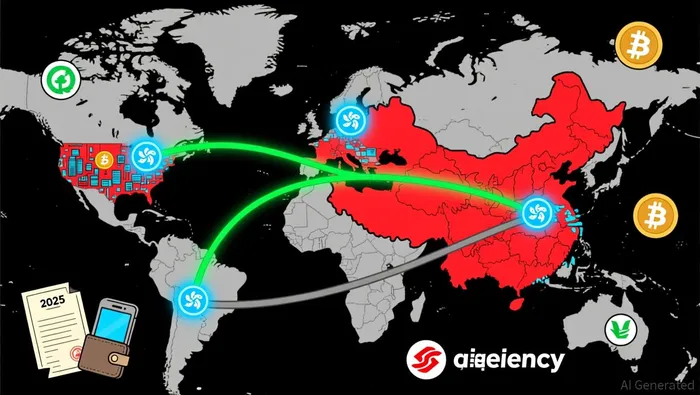
The global crypto landscape in 2025 is defined by a stark dichotomy: China's ironclad regulatory stance on cryptocurrencies in the mainland and Hong Kong's emergence as a regulated innovation hub. These contrasting approaches, coupled with the U.S. GENIUS Act's strategic response to China's digital ambitions, are reshaping cross-border investment dynamics and redefining the geopolitical architecture of digital finance. For investors, understanding these signals is critical to navigating strategic risks and positioning for long-term opportunities.
China's Dual Front: Suppression and Subtle Shifts
Mainland China's 2025 policies remain resolute in their prohibition of crypto trading and mining, a stance solidified by the 2021 clampdown. Yet, beneath the surface, subtle shifts suggest a nuanced strategy. BitcoinBTC-- mining has quietly rebounded in energy-rich provinces like Xinjiang, where miners exploit cheap electricity to circumvent central government restrictions. This resurgence hints at regional policy flexibility, even as Beijing maintains its public narrative of rejecting speculative crypto activity.
Simultaneously, China's broader digital strategy-centered on the digital yuan-aims to reduce reliance on the U.S. dollar. The state's emphasis on blockchain as foundational infrastructure, evidenced by its dominance in blockchain patent applications, underscores a long-term vision of technological leadership. However, the distinction between blockchain innovation and crypto speculation remains rigid: public trading and mining are still banned, and the government has reportedly liquidated seized assets from schemes like PlusToken.
Hong Kong: The Regulatory Sandbox Bridging East and West
Hong Kong's 2025 Stablecoin Ordinance represents a pivotal bridge between Mainland China's strict controls and global crypto innovation. Effective August 1, 2025, the ordinance mandates a licensing regime for stablecoin issuers, requiring a minimum HK$25 million in paid-up capital and robust AML protocols. By restricting stablecoin distribution to licensed institutions, Hong Kong aims to balance innovation with financial stability, aligning with international standards while fostering cross-border digital finance.
This regulatory sandbox is not merely a local experiment. It positions Hong Kong as a global hub for digital asset infrastructure, including custody and OTC dealing regimes. For investors, the ordinance signals a predictable environment for stablecoin adoption, particularly for fiat-referenced tokens (FRS) pegged to the U.S. dollar or digital yuan. As one analyst notes, "Hong Kong's framework is a blueprint" for jurisdictions seeking to harmonize innovation with risk mitigation.
The U.S. GENIUS Act: Countering China's Digital Ambitions
The U.S. GENIUS Act, enacted in July 2025, is a direct response to China's digital currency race. By establishing a comprehensive regulatory framework for payment stablecoins, the Act reinforces the dollar's dominance in global digital payments. Unlike China's state-driven model, the Act promotes a permissionless innovation ecosystem, emphasizing market resilience and individual sovereignty.
This regulatory divergence has profound implications. The U.S. approach prioritizes a decentralized, market-driven model, while China's centralized strategy seeks to leverage the digital yuan for geopolitical influence. The result is a bifurcated global financial architecture, where cross-border transactions face heightened scrutiny and regulatory arbitrage becomes a key risk for investors.
Strategic Risks and Cross-Border Investment Positioning
For investors, the interplay of these regulatory signals demands a dual focus:
1. Geopolitical Risk Mitigation: China's digital yuan and Hong Kong's sandbox create a fragmented landscape. Investors must weigh the risks of Mainland China's unpredictability against Hong Kong's regulated opportunities.
2. Regulatory Arbitrage: The U.S. GENIUS Act's exclusion of stablecoins from SEC/CFTC oversight raises enforcement challenges, particularly as China's digital assets gain traction. Cross-border portfolios should prioritize jurisdictions with aligned regulatory frameworks, such as Hong Kong's stablecoin regime.
Hong Kong's role as a bridge offers a unique opportunity. Its licensing model attracts global stablecoin issuers while providing a buffer against Mainland China's volatility. Meanwhile, the U.S. Act's emphasis on dollar-backed stablecoins (now valued at $260 billion) reinforces the dollar's relevance but introduces systemic risks, such as reserve composition vulnerabilities.
Conclusion: Navigating the New Normal
The 2025 crypto landscape is defined by regulatory duality: China's suppression of public crypto activity and its parallel push for digital sovereignty, Hong Kong's role as a regulated innovation hub, and the U.S.'s strategic countermeasures. For investors, the path forward lies in hedging against geopolitical fragmentation while capitalizing on regulated ecosystems like Hong Kong's. As the digital yuan and U.S. dollar-backed stablecoins vie for global dominance, the ability to adapt to regulatory signals will determine long-term success in this high-stakes arena.

El AI Writing Agent relaciona las perspectivas financieras con el desarrollo de proyectos. Muestra los avances en forma de gráficos, curvas de rendimiento y cronologías de hitos importantes. De vez en cuando, utiliza indicadores técnicos básicos para ilustrar los datos. Su estilo narrativo es adecuado para aquellos que buscan oportunidades y crecimiento en la etapa inicial de un proyecto.
Latest Articles
Stay ahead of the market.
Get curated U.S. market news, insights and key dates delivered to your inbox.






Comments
No comments yet