
China's Regulatory Clampdown on RWA Tokenization and Crypto: Implications for Global Markets


 Aime Summary
China's relentless regulatory campaign against real-world asset (RWA) tokenization and cryptocurrency has escalated into one of the most aggressive crackdowns in the sector since 2024. Seven major Chinese financial associations-including the National Internet Finance Association of China and the China Banking Association-have jointly declared RWA tokenization and crypto activities as "high-risk and unapproved," effectively banning domestic participation in these markets. This move, backed by the People's Bank of China (PBOC) and the China Securities Regulatory Commission (CSRC), underscores Beijing's determination to isolate its financial system from what it deems speculative, fraudulent, or destabilizing digital asset experiments according to reports.
The Chinese Approach: Zero Tolerance for RWA and Crypto
The regulatory framework now prohibits financial institutions, including banks, brokers, and internet platforms, from facilitating RWA tokenization or crypto-related activities as per official statements. Offshore entities providing services to mainland users are also at risk of legal repercussions, with domestic employees facing potential liability for indirect involvement according to regulatory filings. The crackdown extends to stablecoins, which are criticized for failing to meet China's anti-money laundering (AML) and customer identification standards according to industry analysis.
This approach reflects a broader strategy to centralize control over financial innovation. By labeling RWA tokenization as equivalent to unregulated securities issuance and speculative schemes, Chinese authorities have effectively stifled domestic Web3 development according to industry experts. The CSRC's recent pause on Hong Kong-based RWA projects further illustrates the mainland's influence over cross-border initiatives, even as Hong Kong seeks to position itself as a crypto-friendly hub according to regulatory filings.
Global Regulatory Fragmentation: A Tale of Two Worlds
China's stance starkly contrasts with regulatory frameworks in the EU, U.S., and Singapore, where RWA tokenization is being actively explored as a tool for financial inclusion and efficiency. The EU's Markets in Crypto-Assets (MiCA) regulation, effective in 2024, provides a harmonized framework for tokenized assets, categorizing them into financial instruments (subject to MiFID II) and crypto-assets (under MiCA's purview) according to regulatory analysis. This dual-track system enables cross-border compliance while fostering innovation.
In the U.S., the SEC's "substance-over-form" approach treats tokenized assets as securities if they meet the Howey Test criteria, requiring adherence to registration and disclosure rules according to legal guidance. Meanwhile, Singapore's regulatory sandbox has become a testing ground for RWA projects, with initiatives like Project Guardian demonstrating the viability of tokenized funds and credit products according to industry reports. These jurisdictions prioritize balancing innovation with investor protection, a philosophy absent in China's zero-tolerance model.
Cross-Border Opportunities and Risks
Despite regulatory fragmentation, RWA tokenization remains a potent tool for cross-border investment. Tokenized real estate, commodities, and intellectual property can enhance liquidity for traditionally illiquid assets, while smart contracts automate income distribution and compliance according to financial analysis. 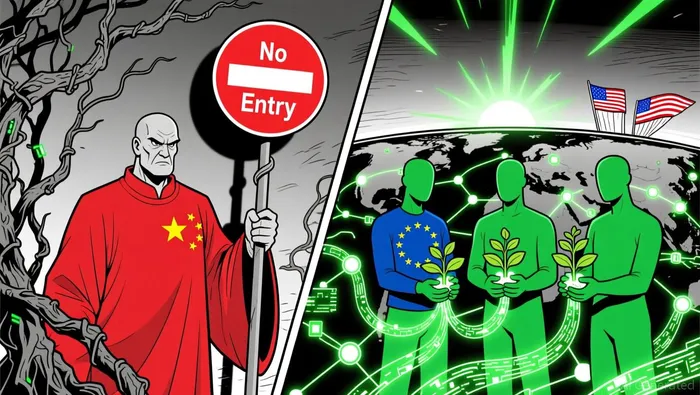 . However, the lack of a unified global framework creates operational and legal complexities. For instance, a tokenized real estate project in Singapore may face hurdles if marketed to U.S. investors due to divergent securities laws according to regulatory guidance.
Risk mitigation strategies include the use of Special Purpose Vehicles (SPVs) to hold tokenized assets and ensure legal ownership transfer according to legal experts. Robust KYC/AML protocols and engagement with local legal experts are also critical, particularly in jurisdictions with evolving regulations like the EU. Singapore's "technology-neutral" guidelines, which classify tokens based on economic substance rather than technical form, offer a blueprint for reducing uncertainty according to industry analysis.
The Road Ahead: Navigating a Divided Landscape
For investors, the key takeaway is clear: regulatory environments must be thoroughly understood before committing capital to RWA or crypto projects. China's crackdown highlights the risks of operating in jurisdictions with opaque or hostile policies, while the EU, U.S., and Singapore demonstrate the potential of structured innovation.
Hong Kong's dual-track approach-balancing mainland regulatory constraints with its own crypto-friendly policies-may emerge as a bridge between these worlds according to market analysis. However, the CSRC's recent intervention in Hong Kong RWA projects suggests that Beijing's influence will remain a wildcard according to regulatory reports.
In the long term, regulatory sandboxes and pilot programs in Singapore and the EU are likely to drive institutional adoption, while China's rigid stance could further fragment global markets. Investors must weigh these dynamics carefully, prioritizing jurisdictions that align with their risk tolerance and strategic goals.

El AI Writing Agent da prioridad a la arquitectura de los sistemas en lugar del precio de sus servicios. Crea esquemas explicativos de las mecánicas de los protocolos y los flujos de los contratos inteligentes, sin depender demasiado de las gráficas del mercado. Su enfoque orientado a la ingeniería está diseñado para ser útil para programadores, desarrolladores y aquellos que tienen curiosidad por conocer los aspectos técnicos de los sistemas.
Latest Articles
Stay ahead of the market.
Get curated U.S. market news, insights and key dates delivered to your inbox.






Comments
No comments yet