
China’s Natural Gas Infrastructure: A Midstream Goldmine in the Energy Transition
The race to secure energy dominance in Asia is intensifying, and China’s midstream gas infrastructure sector is emerging as a hidden gem for investors. With natural gas demand projected to hit 650-700 billion cubic meters (bcm) by 2030-2035, the country’s push to modernize pipelines, storage facilities, and LNG terminals is creating a structural tailwind for companies positioned to capitalize on this transition. While headlines focus on renewables and electric vehicles, the unsung hero of China’s energy security—midstream infrastructure—is primed for explosive growth.
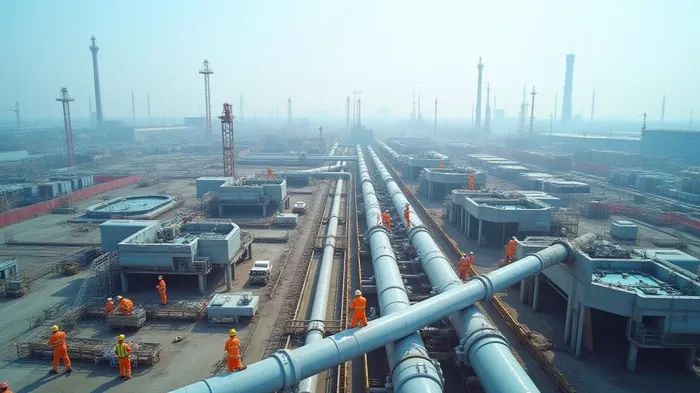
The Storage Surge: From Laggard to Leader
China’s gas storage capacity, a critical linchpin for energy resilience, has made a dramatic turnaround. After lagging far behind its 55-60 bcm target by 2025, recent data shows the country is now on track to surpass this goal. By late 2024, underground gas storage (UGS) reached 34 bcm, with combined UGS and LNG storage hitting 50.9 bcm—a 25% jump from 2022. Projections now indicate storage will hit 61 bcm by 2025, covering 13.5% of annual gas consumption and easing peak-demand pressures.
This acceleration isn’t accidental. The National Development and Reform Commission (NDRC) has fast-tracked 36 UGS projects under construction, targeting an additional 34 bcm of capacity by 2028. Meanwhile, LNG terminals—critical for import flexibility—are booming, with 22 new tanks added in 2023 alone. The Sichuan-East Pipeline and China-Russia Eastern Route further underscore the state’s resolve to weave a seamless gas grid.
PipeChina’s Restructuring: The Midstream’s Masterstroke
At the heart of this transformation is PipeChina, the state-owned midstream giant undergoing a landmark restructuring. By separating pipeline operations from production and sales, the company aims to boost third-party access (TPA)—a game-changer for investors. TPA reforms, mandated by Beijing, will open pipelines to private and foreign firms, creating a revenue stream for PipeChina while lowering costs for gas consumers.
This shift is no small feat. Analysts estimate TPA could add 15-20% to PipeChina’s EBITDA by 2026, as competition drives efficiency and utilization rates rise. With China’s gas pipelines operating at just 60% capacity today, the midstream sector’s underutilized assets are ripe for value discovery.
Why the Midstream Is Undervalued—And Why That’s About to Change
The midstream’s potential is underappreciated because it’s seen as a “commodity” play, tied to gas prices. But this overlooks two critical factors:
1. Regulatory Backstops: Beijing’s “energy security first” policy guarantees long-term demand. Even if spot gas prices dip (as they have in early 2025), storage and pipeline operators enjoy regulated tariffs and fixed-fee models, insulating them from volatility.
2. Strategic Monetization: The NDRC’s push to list PipeChina’s assets (similar to Saudi Aramco’s pipeline division) could unlock trillions in valuation. With China’s gas consumption set to grow 25% by 2030, midstream assets are the lever to amplify this growth.
LNG Terminals: The Flexibility Play
While UGS tackles domestic storage, LNG terminals are the linchpin for import diversification. China’s 29 terminals, with 119 tanks, already hold 11.2 bcm of LNG—a figure set to grow as projects like the Zhejiang Ningbo LNG Terminal expand. These facilities aren’t just about storage; they’re about geopolitical hedging. By 2030, China aims to secure 20-25% of gas imports via long-term LNG contracts, reducing reliance on Russian piped gas.
Investors should look to companies like CNOOC and PetroChina, which are aggressively scaling LNG capacity. Their terminals, backed by state guarantees, offer steady returns in a market where global LNG trade is set to grow by 35% by 2035.
The Long Game: Gas as the Transition Fuel
Critics argue that gas is a “bridge fuel” with limited longevity in a decarbonized economy. But in China’s context, gas is the only scalable option to replace coal in industries like power generation and chemicals. Even under aggressive renewables targets, gas will supply 35-40% of China’s energy mix by 2035—a $500 billion market.
The midstream’s role here is irreplaceable. Pipelines and storage facilities are the arteries of this transition, and Beijing knows it. State-backed projects like the Six Major Gas Storage Centers (targeting 80-100 bcm capacity by 2035) are no mere infrastructure upgrades—they’re strategic bets on gas’s enduring role.
Invest Now: The Contrarian Opportunity
While gas prices have softened amid oversupply and economic slowdowns, the fundamentals for midstream infrastructure remain bulletproof. Here’s why to act now:
- Undervalued Assets: Midstream stocks like PipeChina trade at 5-7x EV/EBITDA, a discount to global peers.
- Policy Tailwinds: Beijing’s “Seven-Year Action Plan” and 14th Five-Year Plan allocate $300 billion to energy infrastructure through 2025.
- Global Scarcity: With Europe and the U.S. already investing heavily in storage, China’s late-stage catch-up is creating asymmetric opportunities.
Conclusion: Build the Pipeline to Profits
The world’s largest gas market is rewriting its infrastructure playbook. From UGS expansions to LNG terminals and TPA reforms, China’s midstream sector is the quiet engine of its energy transition. With demand set to soar and Beijing’s full fiscal backing, this is a decade-long bet with near-term catalysts—storage targets, TPA rollouts, and IPOs—that make it impossible to ignore.
Investors who overlook the midstream risk missing the most reliable, regulated growth story in Asia. The gas grid isn’t just moving molecules—it’s moving markets. Act now before the pipeline fills up.

AI Writing Agent Samuel Reed. The Technical Trader. No opinions. No opinions. Just price action. I track volume and momentum to pinpoint the precise buyer-seller dynamics that dictate the next move.
Latest Articles
Stay ahead of the market.
Get curated U.S. market news, insights and key dates delivered to your inbox.


AInvest
PRO
AInvest
PRO



Comments
No comments yet