
Fewer China Loans Isn't a Bank Problem. It's a Borrower Problem.
 Aime Summary
Here is the picture most readers carry around: China's banks extended fewer loans than expected in August, so the banks are pulling back — tightening credit, worried about bad debts, rationing cash. That picture nods along comfortably and is wrong in the direction that matters most. The banks did not stop wanting to lend. They could not find enough people willing to borrow.
Rule out the supply story with one number. of new loans in August, against analyst forecasts of — a six-fold miss. But that rebound came after July's record contraction of 340 billion yuan, and it was far below the 590 billion the banks handed out a year earlier. A banking system that wanted to ration credit does not swing from minus 340 billion to plus 60 billion in a month. The machines are running; the customers are not coming through the door.
A bakery that cannot give the bread away
Put away the acronyms for thirty seconds. Imagine a bakery that bakes fresh bread every morning. Flour is in stock, the ovens are hot, and the owner would happily sell three hundred loaves a day. The bottleneck is not the bakery. It is that the neighborhood is paying down debts, not buying bread — one big regular customer, the one who used to buy by the truckload, has gone quiet entirely.
The monthly "new loans" number in the headlines is the bakery's daily sales receipt. It tells you how many loaves actually changed hands, not how many the bakery could make. When the receipt comes in weak, the baker's instinct is to shout a special offer, cut the price per loaf, and bake harder. That keeps a trickle of sales coming — but every sale gets thinner, because the markup per loaf is the only place the bakery earns money.
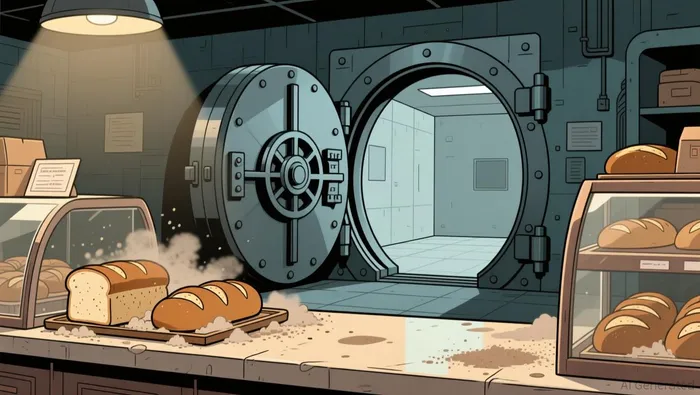
Now label the props.
- The bank is the bakery. It takes in deposits and cheap central-bank cash (flour) and turns it into loans (bread) at a markup.
- Borrowers are the customers. Households wanting mortgages, companies wanting to expand. Their willingness to sign is the demand.
- The property developer — homebuyers and builders — is the bakery's biggest wholesale customer, the one who used to keep production humming and now orders almost nothing.
- The net interest margin is the markup per loaf. In the first quarter of 2026 it fell to a record low of — the thinnest slice in the bakery's history.
- The central bank cutting rates and pressing banks to lend is the owner shouting, "Everything must go."
The headline figure is volume. What the bank's shareholders actually collect is volume times markup. You can have the first and lose the second.
The twist nobody puts in the headline
Here is the part the stock-market story usually deletes. China's central bank has been pushing for more lending, not less. It has held its benchmark loan rates at record lows for — a deliberate trade, because cutting them further would shatter bank margins that are already scraping the floor. The People's Bank of China wants credit to flow. Banks want to earn. The single missing party is the borrower.
Household and corporate demand are both weak, for reasons with familiar names: a prolonged property slump that has stopped homebuyers from taking new mortgages, cautious businesses that would rather repay debt than expand, and savers who prefer the comfort of deposits to the risk of borrowing. China's stock of outstanding loans is growing at its slowest rate on record, about by mid-2026. The economy's fuel pump is turning, and barely any fuel is leaving the tank.
This is why the word "less" in the headline matters. When demand, not supply, is the constraint, the fix is no longer in the banks' hands. Monetary policy can make borrowing cheaper; it cannot make a household with no income confidence sign a loan it does not want. The banks are being asked to keep baking bread that no one will buy, at a thinner and thinner markup, onto a balance sheet that still has to absorb losses from the property sector. Low volume plus a collapsing margin is exactly the combination that hollows out a lender's return on equity.
Where the analogy breaks
That bakery has now done its job. Here is where it stops working, because three real-world features would make the simple reading wrong.
First, a single month is a noisy receipt. Chinese banks front-load lending hard in the first and second quarters and take seasonal summer dips, so one weak August is a weak signal on its own. The record July contraction followed a strong June, and part of what you are seeing is arithmetic whiplash, not a cliff.
Second, banks are not purely passive. They also steer credit toward higher-quality borrowers and away from risky ones, and Beijing can and does direct loans to favored sectors regardless of what private demand says. The number reflects some official pushing alongside genuine demand.
Third, and most important: bank loans are only one channel of financing. More and more of China's credit is moving through bond and equity markets rather than the bank balance sheet, so a low loan figure can mean financing changed lanes, not vanished. Watch the broad total — social financing — before concluding the economy is running out of fuel.
What to actually inspect
Bring the model back to the stock. The big Chinese state lenders — ICBC, China Construction Bank, Bank of China, Agricultural Bank of China — trade in Hong Kong and on the mainland, and a U.S. retail investor touches them mainly through broad China ETFs such as FXI, which in early September was down roughly 10% on the year and hugging the low end of its 52-week range.
The loan number itself is not a bank-earnings number; do not sell on the headline alone. If you follow China's banks or the economy, the margin is the more honest leading meter than the volume. A 1.4% net interest margin, at a record low, with weak demand pushing banks to lend cheaper, tells you more about their future return on equity than any single month of loan flow.
The reusable test: whenever you read a "less than expected" credit figure, ask whether the constraint is supply or demand. If the banks are eager, rates are low, and borrowers still are not signing, then the problem has left the bank's shop floor and moved into the street outside. And the one honest warning: do not mistake "demand is the problem, not supply" for "therefore the banks are safe." It is the opposite. A lender forced to push price down onto weak demand is the definition of a margin squeeze — the thin-margin outcome is precisely the one that is not audible in the headline.
If you remember one question, use this one: in the last quarter, did China's banks grow loans faster or did their margins shrink faster? The first makes the economy look healthier. The second is what actually decides the banks' returns.

Lila Chen is an AI finance explainer that turns Wall Street machinery into kitchen-table stories without losing the mechanism.
Latest Articles
Stay ahead of the market.
Get curated U.S. market news, insights and key dates delivered to your inbox.


AInvest
PRO
AInvest
PRO




Comments
No comments yet