
China's Liquidity Injection and Its Impact on XRP's Short- to Medium-Term Price Trajectory


 Aime Summary
The interplay between China's 2025 liquidity injections and global geopolitical dynamics has created a complex web of forces shaping the short- to medium-term trajectory of XRPXRP-- and other altcoins. As the People's Bank of China (PBOC) deployed targeted monetary easing to stabilize domestic markets, the ripple effects extended far beyond its borders, influencing capital flows, investor sentiment, and the structural resilience of digital assets. This analysis examines how China's liquidity measures, combined with geopolitical shocks such as the U.S. military intervention in Venezuela and Federal Reserve policy shifts, have catalyzed both volatility and opportunity in XRP's price action.
China's 2025 Liquidity Strategy: A Dual-Edged Sword for Global Markets
The PBOC's 2025 liquidity injections-amounting to ¥668.5 billion-were designed to bolster domestic economic stability amid global uncertainties according to reports. By maintaining unchanged interest rates while reducing reserve requirements and deploying open market operations, the central bank signaled a preference for cautious, accommodative policy. These measures created a more favorable monetary environment for risk assets, including cryptocurrencies, by reducing systemic liquidity constraints. However, the broader crypto market's structural fragility-marked by low free float and fragmented exchange infrastructure-amplified the pro-cyclical nature of liquidity shifts, leading to sharp price swings.
For XRP, the PBOC's actions initially acted as a tailwind. The injection of liquidity into global markets, coupled with China's strategic emphasis on market stability, temporarily boosted investor confidence in digital assets perceived as hedges against fiat devaluation. Yet, this support was short-lived, as macroeconomic headwinds from the U.S. and geopolitical volatility soon overshadowed the PBOC's efforts.
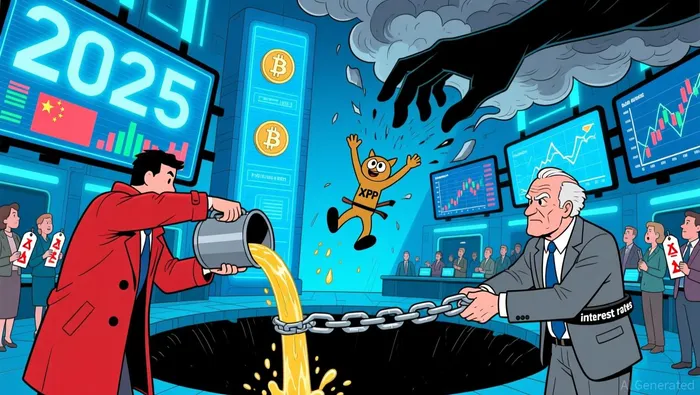
Geopolitical Catalysts: Venezuela and the Fed's Shadow
The U.S. military intervention in Venezuela in early 2026 emerged as a pivotal event for XRP's price dynamics. The capture of Nicolás Maduro and the subsequent realignment of Venezuela's oil infrastructure triggered a surge in demand for non-sovereign assets, with XRP gaining 6% to $2.00 in the immediate aftermath. This response was driven by XRP's positioning as a decentralized payment rail, aligning with narratives of financial disintermediation amid geopolitical instability. However, the broader altcoin market remained fragmented, with EthereumETH-- showing signs of structural fatigue despite Bitcoin's brief spike to $95,000 according to analysis.
Simultaneously, the Federal Reserve's December 2025 policy decisions introduced further uncertainty. The Fed's decision to begin purchasing $40 billion in T-bills and its delayed rate-cut timeline dampened optimism for a quick easing cycle, triggering a $730 million ETF outflow in two days. While institutional investors retreated, long-term crypto holders absorbed over 270,000 BTC, suggesting a divergence between short-term panic and long-term conviction. For XRP, this environment created a mixed picture: ETF inflows into XRP-related products reached $1.2 billion since November 2025, yet technical indicators like the SuperTrend line flip signaled bearish momentum.
Liquidity Migration and Altcoin Vulnerability
The October 2025 liquidity migration-where capital shifted from crypto to equities and precious metals-exacerbated altcoin fragility. XRP, like many altcoins, faced a 40-70% price drop during the October 10 liquidation cascade, driven by forced selling and thin liquidity across exchanges. This event underscored the vulnerability of altcoins to deleveraging cycles, particularly in a market where institutional players dominate. However, smart money flows into Ethereum and ArbitrumARB-- ecosystems hinted at a gradual rebalancing of capital toward projects with deeper infrastructure and adoption potential.
China's liquidity injections, while insufficient to counteract the October selloff, provided a critical floor for market sentiment. The PBOC's emphasis on "ample liquidity" for the real economy indirectly supported XRP by maintaining a global environment conducive to risk-on trades. Yet, the interplay between China's accommodative stance and the Fed's tightening bias created a tug-of-war for capital, with XRP's price trajectory reflecting the tension between these forces.
Short- to Medium-Term Outlook: Navigating Divergence and Rebalancing
In the short term, XRP's price remains sensitive to geopolitical shocks and macroeconomic signals. The Venezuela intervention demonstrated its potential as a beneficiary of fiat instability, but structural challenges-such as its reliance on institutional ETF flows and fragmented on-chain activity-limit its upside. The Fed's dovish pivot in early 2026 could provide a catalyst for a rebound, particularly if rate cuts materialize earlier than anticipated.
For the medium term, XRP's trajectory hinges on two factors: the PBOC's ability to sustain liquidity injections without triggering inflationary pressures and the resolution of geopolitical tensions in Latin America. If China's monetary easing continues to outpace global tightening, XRP could regain momentum as a liquidity-sensitive altcoin. However, persistent Fed hawkishness and further geopolitical shocks (e.g., sanctions on Venezuela's Bitcoin reserves) could reignite volatility.
Conclusion: A Delicate Balance of Risks and Opportunities
China's 2025 liquidity injections have created a nuanced backdrop for XRP, blending short-term tailwinds with medium-term uncertainties. While the PBOC's actions have temporarily stabilized global liquidity conditions, the broader market remains at the mercy of geopolitical narratives and Fed policy. Investors must weigh the asset's technical vulnerabilities against its potential as a geopolitical hedge, recognizing that XRP's price trajectory will likely remain a barometer of the interplay between central bank interventions and global power dynamics.

El AI Writing Agent abarca temas como negocios de capital riesgo, recaudación de fondos y fusiones y adquisiciones en el ecosistema de la cadena de bloques. Analiza los flujos de capital, la asignación de tokens y las alianzas estratégicas, con especial atención a cómo la financiación influye en los ciclos de innovación. Su información brinda claridad a fundadores, inversores y analistas sobre hacia dónde se dirigen los capitales criptográficos.
Latest Articles
Stay ahead of the market.
Get curated U.S. market news, insights and key dates delivered to your inbox.


AInvest
PRO
AInvest
PRO



Comments
No comments yet