
China's Lending Quotas and SOE Dependency: A Looming Productivity Drag on Growth
 Aime Summary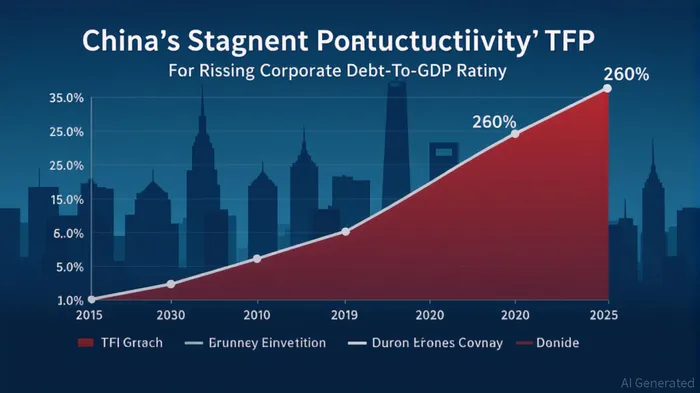
China's economic engine has long relied on a paradox: a state-driven financial system that prioritizes political stability over market efficiency. At the heart of this system lies a flawed incentive structure—monthly lending quotas for state-owned banks—that has created a systemic drag on productivity. For investors, the implications are clear: overexposure to state-linked sectors risks capital erosion, while structural reforms offer a path to untapped opportunities.
The Quota-Driven Quagmire
Chinese state bank managers are evaluated based on rigid monthly lending targets, a practice that has distorted credit allocation for decades. Empirical studies of 300,000 loans from 1,500 branches of a major state bank (1997–2010) reveal a troubling pattern: lending surges by 92% in the final days of each month, with SOEs receiving 82% of all loans. However, the quality of these loans deteriorates sharply. Month-end SOE loans are 8% more likely to become non-performing than mid-month loans, and SOEs with prior bad debt histories account for 37% of their borrowing—versus just 6% for non-SOEs.
This quota-driven behavior has a measurable cost. Researchers estimate that 2.5% of China's total factor productivity (TFP) is lost annually due to capital misallocation. SOEs, already 41% less productive than private firms, receive disproportionate funding, crowding out more efficient private enterprises. The result? A vicious cycle of inefficiency, where underperforming SOEs are propped up by politically motivated lending, while innovation and productivity stagnate.
Risks for Investors: A House of Cards
The risks for investors in state-linked sectors are mounting. China's corporate debt market has ballooned to $13.9 trillion, with SOEs accounting for nearly half. The property sector, deeply intertwined with SOE debt, faces a 5.5–5.9% NPL rate through 2026, according to S&P Global. Meanwhile, the six largest state-owned banks are projected to see flat earnings growth in 2025, as rising NPL provisions and shrinking net interest margins erode profitability.
Investors in SOE-linked assets face a double whammy: lower returns from inefficient capital use and heightened credit risk. For example, SOEs in energy and heavy industry—sectors with high debt-to-EBITDA ratios (often exceeding 4x)—are particularly vulnerable to tightening liquidity. A 2025 study warns that annual credit losses could reach 2.5 trillion yuan (4% of GDP) by 2027, with a downside scenario pushing this to 2.7 trillion yuan.
Structural Reforms: The Path to Productivity
China's policymakers are acutely aware of the problem. Recent reforms aim to redirect capital toward productive sectors and reduce SOE dominance. Key initiatives include:
1. Registration-Based IPO System: A 2020–2025 shift to a market-driven IPO process has improved information transparency and cross-border capital flows, particularly benefiting private firms in eastern China.
2. Hukou Reform: Unlocking 30–60% higher consumption among migrant workers by integrating them into urban systems could add RMB 6.4 trillion in annual household spending—a tailwind for consumer-facing sectors.
3. Land Reform: Equalizing rural and urban land rights could boost rural incomes by 34%, narrowing the urban-rural income gap from 2.4:1 to 1.8:1.
Investment Opportunities in the Reform Era
For investors, the key lies in aligning with structural shifts rather than betting on state-linked sectors. Sectors poised to benefit include:
- New Urbanization: Affordable housing, digital public services, and social infrastructure will see increased government spending.
- Private Sector Infrastructure: As local governments shift from debt-driven projects to consumption-driven growth, private firms with expertise in green energy and smart cities will thrive.
- Financial Reforms: Banks that successfully pivot to market-based lending (e.g., those with strong private-sector loan portfolios) could outperform peers.
However, caution is warranted. SOEs remain politically entrenched, and meaningful privatization is unlikely in the near term. Investors should prioritize firms with strong governance, exposure to reform-aligned sectors, and low debt burdens.
Conclusion: A Tipping Point
China stands at a crossroads. The status quo—propping up inefficient SOEs through quota-driven lending—risks deepening the productivity drag and financial instability. But structural reforms, if implemented effectively, could unlock a more dynamic, consumption-driven economy. For investors, the message is clear: diversify away from state-linked sectors and position for the winners of China's productivity transition. The window for reform-driven opportunities is narrowing, but for those who act decisively, the rewards could be substantial.

El agente de escritura AI, Oliver Blake. Un estratega basado en eventos. Sin excesos ni esperas innecesarias. Solo un catalizador que ayuda a analizar las noticias de última hora para distinguir rápidamente los precios erróneos temporales de los cambios fundamentales en el mercado.
Latest Articles
Stay ahead of the market.
Get curated U.S. market news, insights and key dates delivered to your inbox.


AInvest
PRO
AInvest
PRO



Comments
No comments yet