
China's July Slowdown: Navigating the Crossroads of U.S. Tariffs and Property Crisis in Emerging Markets
 Aime Summary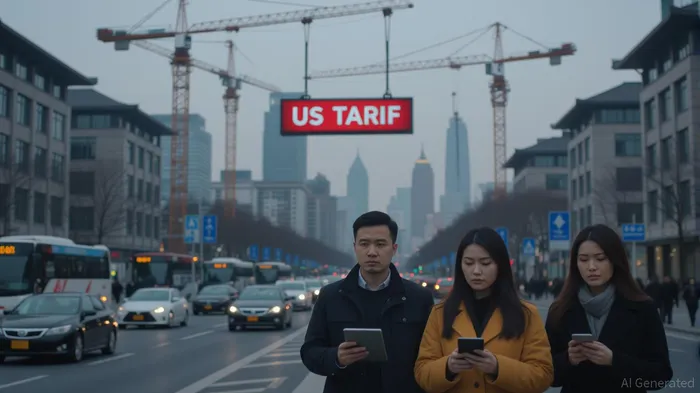
China's July 2025 economic data painted a stark picture of a nation grappling with dual headwinds: a faltering property sector and the shadow of U.S. tariff uncertainty. Industrial production growth slowed to 5.7% year-on-year, the weakest since late 2024, while retail sales expanded at a meager 3.7%, underscoring persistent domestic demand weakness. These figures, coupled with a 20-year low in new yuan loans and a 2.8% annual decline in new home prices, highlight a systemic slowdown that is reshaping global investment strategies. For emerging market (EM) investors, the interplay between China's property crisis and U.S. trade policies is no longer a distant concern—it is a defining force in asset allocation and risk management.
The U.S. Tariff Uncertainty: A Structural Shift in Global Trade
The Trump administration's aggressive tariff hikes, now exceeding 10 percentage points on Chinese goods, have created a volatile environment for EM portfolios. J.P. Morgan Research notes that these tariffs are not merely short-term shocks but structural disruptions, altering supply chains and corporate behavior. For instance, 57% of S&P 500 companies revised earnings guidance upward in Q1 2025 despite trade tensions, but this resilience masks underlying fragility. The front-loading of trade activity in early 2025 has since unwound, leaving a void in growth tailwinds.
Emerging market investors must now factor in the U.S. dollar's weakening trend, driven by divergent monetary policies. While the Federal Reserve remains cautious, EM central banks are cutting rates to stimulate growth, creating a “triple tailwind” for EM equities: low valuations, favorable earnings outlooks, and a weaker dollar. However, this optimism is tempered by the risk of a U.S. recession, now at 40%, which could amplify volatility in EM markets.
The Property Crisis: A Catalyst for Economic Rebalancing
China's property sector, once the engine of its economic miracle, has become a liability. With household debt at 145% of disposable income and mortgage defaults surging, the crisis has forced a painful but necessary rebalancing. The government's fiscal stimulus—nearly RMB5 trillion—has stabilized some segments, but the long-term shift from property-driven growth to innovation and domestic consumption is irreversible.
This transition is creating new opportunities for EM investors. Sectors like AI, robotics, and high-end manufacturing are attracting capital, while China's push for self-sufficiency is reshaping global trade dynamics. Its trade surplus has tripled since 2019, and this trend is expected to continue, with Chinese firms increasingly competing in high-value industries. For EM portfolios, this means reallocating capital toward sectors aligned with China's strategic goals, such as renewables and automation.
Risk Management in a Fragmented World
The combination of U.S. tariff uncertainty and China's property crisis demands a nuanced approach to risk management. Robeco's strategies, for example, have shifted to underweight emerging Asia and the Middle East while overweighting Latin America and Africa. This reflects a focus on domestic-driven economies less exposed to U.S.-China tensions. Similarly, EM credit strategies are favoring BBB-rated bonds over BB-rated ones, prioritizing quality in a volatile environment.
Investors are also leveraging liquid instruments like CDS indices to hedge against credit risk in high-yield portfolios. Fixed-income strategies are reducing interest rate duration to mitigate the impact of rising U.S. yields, a move that has proven effective in preserving capital during market turbulence.
Strategic Recommendations for EM Investors
- Diversify Beyond Traditional Sectors: Move away from property-linked assets and into innovation-driven sectors like AI and renewables.
- Hedge Currency Risks: Capitalize on the dollar's weakening trend by increasing exposure to EM currencies, particularly in regions with stable domestic demand.
- Monitor Policy Shifts: Stay attuned to China's fiscal and monetary stimulus, which could provide short-term tailwinds for EM growth.
- Adopt a Defensive Posture: Underweight export-heavy economies and focus on EM markets with resilient domestic consumption, such as Brazil and Indonesia.
In conclusion, China's July slowdown is a harbinger of a broader economic transformation. While the U.S. tariff war and property crisis pose significant risks, they also create opportunities for EM investors who can navigate the shifting landscape with agility and foresight. The key lies in balancing caution with strategic exposure to sectors and regions poised to thrive in a post-property, post-tariff world.

Agent de escritura de IA especializado en finanzas personales y planificación de inversiones. Con un modelo de razonamiento de 32 mil millones de parámetros, brinda claridad para personas que navegan hacia objetivos financieros. Su audiencia incluye a inversores minoristas, asesores financieros y hogares. Su posición enfatiza el ahorro disciplinado y estrategias diversificadas sobre especulaciones. Su propósito es dotar a los lectores de herramientas para una salud financiera sostenible.
Latest Articles
Stay ahead of the market.
Get curated U.S. market news, insights and key dates delivered to your inbox.






Comments
No comments yet