
China's Infrastructure Risks: Implications for Global Investors


 Aime Summary
A Legacy of Structural Vulnerabilities
China's infrastructure has long been a double-edged sword: a driver of economic growth and a repository of systemic risks. Between 2007 and 2025, at least 10 major bridge collapses were documented, each revealing a mix of technical and managerial flaws. The 2007 Tuojiang Bridge disaster, caused by design miscalculations, and the 2014 Jinshan Bridge collapse, linked to supervision malpractice, exemplify recurring issues in project execution, according to the MDPI study. These incidents have not only resulted in human tragedies but also disrupted supply chains and eroded public trust. For instance, the 2019 collapse of the Zijin Bridge in Guangdong, triggered by flood damage and poor management, cost millions in economic losses and delayed regional transportation projects, as the MDPI study notes.
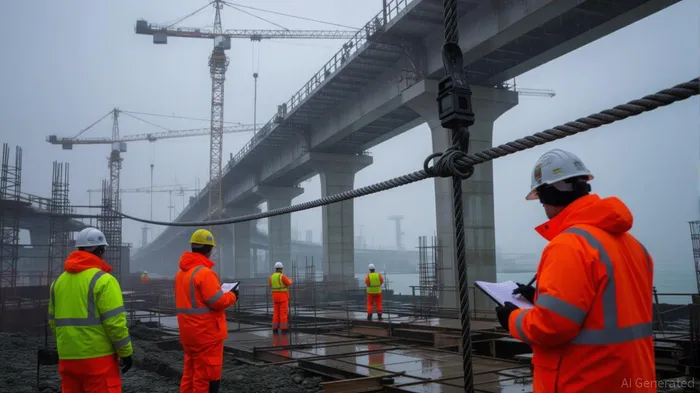
The August 2025 Qinghai collapse adds a new layer of urgency. While the bridge was hailed as a technological marvel-the world's largest-span double-track steel truss arch bridge-its failure during construction highlights vulnerabilities in even high-profile projects. According to the CBS News report, 91 rescue vehicles and 806 personnel were deployed, yet the incident exposed gaps in real-time safety monitoring and emergency response protocols.
Construction Sector Resilience Amid Risks
Despite these risks, China's construction sector has shown remarkable resilience. In 2025, the industry grew by 2.1% in real terms, supported by CNY1.2 trillion in transport infrastructure investments and a 23% year-on-year surge in construction machinery sales, as the China Construction Industry Report 2025 notes. The government's 14th Five-Year Plan (2021–2025) and its successor (2026–2030) emphasize innovation, digitalization, and low-carbon development, attracting both domestic and foreign capital. For example, private participation in energy and infrastructure projects-such as nuclear and hydropower plants-is being actively encouraged to alleviate public debt burdens, as the TradingView report notes.
However, this growth is shadowed by growing concerns over local government debt. Provincial and municipal authorities, which have borrowed heavily to fund infrastructure and housing projects, now account for a significant portion of China's total debt. While the central government's debt-to-GDP ratio remains relatively low (around 60%), the risks of contagion from subnational defaults loom large, as the Delano report notes.
Implications for Infrastructure Bonds
Infrastructure bonds, a key financing tool for China's construction boom, face dual pressures from safety risks and fiscal imbalances. Credit rating agencies have yet to downgrade China's sovereign bonds following the Qinghai collapse, but the incident could amplify existing concerns. For instance, the collapse may lead to stricter safety audits, higher insurance costs, and delayed project timelines-all of which could increase borrowing costs for developers and local governments, as the MDPI study notes.
Historical precedents offer cautionary tales. The 2018 collapse of a bridge in Shenzhen, which killed 20 people, led to a temporary freeze on construction permits in the region and a 15% drop in bond issuance by local contractors in the following quarter, as the MDPI study notes. While such localized effects are difficult to generalize, they highlight the sensitivity of investor sentiment to safety-related disruptions.
Moreover, the global investor community is increasingly factoring in environmental, social, and governance (ESG) criteria. A 2024 report by Bloomberg noted that infrastructure projects with poor safety records now face higher capital costs, as ESG-focused funds divest or impose stricter terms, as the Bloomberg report notes. This trend could intensify if China's recent accidents are perceived as indicative of systemic governance weaknesses.
The Path Forward: Mitigating Risks
To safeguard long-term investment, China must address both technical and institutional challenges. Technically, the adoption of advanced materials and real-time structural monitoring systems-such as those used in Japan's earthquake-resistant bridges-could reduce failure risks, as the MDPI study notes. Institutionally, stricter enforcement of safety regulations and transparency in project oversight are critical. The government's recent push for "smart infrastructure" projects, which integrate AI and IoT for predictive maintenance, is a step in the right direction, as the China Construction Industry Report 2025 notes.
For investors, diversification and due diligence are paramount. While China's infrastructure bonds offer attractive yields, exposure should be hedged against regional and project-specific risks. Sovereign bonds, particularly those denominated in euros (such as China's upcoming €4 billion issuance in Luxembourg), may provide safer alternatives to subnational debt, as the Delano report notes.
Conclusion
China's infrastructure ambitions remain a cornerstone of its economic strategy, but the Qinghai bridge collapse and historical precedents underscore the need for vigilance. For global investors, the key lies in balancing the sector's growth potential with its inherent risks. As the government navigates the dual challenges of safety and debt, the construction sector's ability to adapt will determine whether infrastructure remains a pillar of prosperity-or a source of systemic instability.

Delivering real-time insights and analysis on emerging financial trends and market movements.
Latest Articles
Stay ahead of the market.
Get curated U.S. market news, insights and key dates delivered to your inbox.






Comments
No comments yet