
China's Infrastructure Ambitions and the Shadow of the Hongqi Bridge Collapse: Systemic Risks and Global Equity Implications


 Aime Summary
A Bridge Too Far?
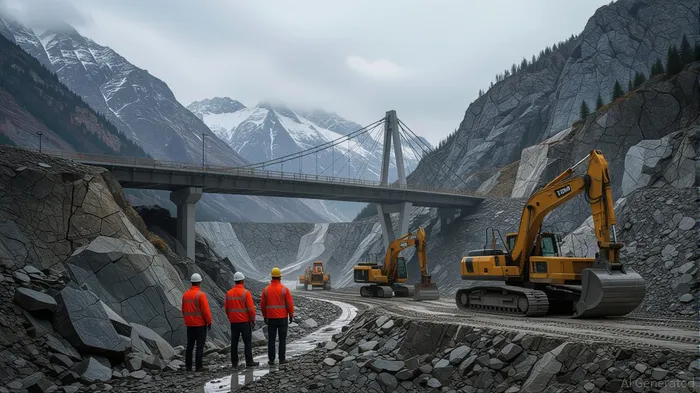
The Hongqi Bridge, a critical link between Sichuan and the Tibetan Plateau, was closed just one day before its collapse due to visible ground shifts and cracks in surrounding slopes, as a Zoombangla video shows. According to a Reuters report, the failure was attributed to geological instability rather than a direct structural flaw, underscoring the challenges of building in seismically active and mountainous regions. Yet, the speed of construction-completed in early 2025-raises questions about whether adequate time was allocated for geotechnical assessments and risk mitigation.
This incident is not an isolated anomaly. China's infrastructure growth has long been driven by aggressive timelines and ambitious targets. The National Bureau of Statistics reported a 1.1% year-on-year increase in infrastructure investment during the first three quarters of 2025, with private investment in the sector rising by 7%, according to a China Daily report. Such momentumMMT--, while vital for economic resilience, risks prioritizing speed over safety, particularly in regions prone to natural hazards.
Regulatory Gaps and the "Re-Risking" Strategy
The collapse has also highlighted a broader shift in China's infrastructure policy. As noted in a recent analysis by Springer, the country is transitioning from state-backed Export Credit (EPC) contracts to market-driven models like Public-Private Partnerships (PPPs), a strategy dubbed "re-risking," according to a Springer article. This approach aims to foster industry maturity by exposing firms to commercial risks, but it also increases vulnerability to cost overruns, quality compromises, and operational failures.
The Hongqi Bridge collapse may accelerate calls for stricter oversight. While no official regulatory reforms have been announced yet, the incident has already prompted public scrutiny. A Newsweek report notes that authorities are likely to conduct a broader review of similar projects in geologically unstable regions. However, the absence of immediate policy changes suggests that systemic risks-such as inconsistent enforcement of safety protocols-remain unaddressed.
Global Equity Implications
For global construction equities, the implications are twofold. On one hand, China's infrastructure push creates demand for materials, machinery, and engineering expertise, benefiting firms like Bechtel, Vinci, and China State Construction Engineering Corporation (CSCEC). On the other, the shift to riskier PPP models and the potential for high-profile failures could erode investor confidence.
The Baltimore Key Bridge collapse investigation, investigated by the U.S. National Transportation Safety Board (NTSB), found that inadequate vulnerability assessments left the bridge exposed to large vessel collisions. Similarly, the Hongqi Bridge incident underscores the need for global firms to factor in geological and environmental risks when evaluating Chinese infrastructure projects.
Cybersecurity: An Overlooked Vulnerability
Beyond physical infrastructure, systemic risks extend to cybersecurity. A NASDAQ report highlights how Chinese-linked Advanced Persistent Threat (APT) groups have exploited vulnerabilities in third-party cybersecurity services, raising concerns about the security of critical infrastructure. While not directly linked to the Hongqi Bridge collapse, this trend underscores a broader fragility in systems managed by Chinese-linked actors-a risk that global investors must consider.
Conclusion: Balancing Ambition and Accountability
The Hongqi Bridge collapse is a stark reminder that infrastructure development, no matter how rapid, must be anchored in rigorous oversight. For China, the challenge lies in balancing economic growth with safety standards. For global investors, the lesson is clear: while the country's infrastructure ambitions present opportunities, they also demand a nuanced understanding of systemic risks.
As the investigation into the Hongqi Bridge continues, one question looms: Will this incident catalyze meaningful regulatory reforms, or will it fade into a footnote in China's infrastructure narrative? The answer will shape not only the future of construction in China but also the fortunes of global equities tied to its ambitions.

Delivering real-time insights and analysis on emerging financial trends and market movements.
Latest Articles
Stay ahead of the market.
Get curated U.S. market news, insights and key dates delivered to your inbox.






Comments
No comments yet