
China's Industrial Profit Recovery: Riding the Wave of Tech-Driven Growth
The Chinese industrial sector is undergoing a transformative revival, driven by policy-backed innovation and a strategic pivot toward high-tech manufacturing. With industrial profits rebounding to a 0.8% year-on-year growth in Q1 2025 after months of contraction, the data signals a critical turning point. Beneath the surface, the 6.1% expansion in industrial output and a blistering 10% surge in high-tech manufacturing output highlight a clear path for investors: allocate capital to firms leading in green tech, robotics, and new energy vehicles (NEVs)—sectors where Beijing's trillion-dollar infrastructure and innovation policies are creating asymmetric opportunities.
The Profit Recovery: A Foundation for Strategic Growth
The National Bureau of Statistics (NBS) data reveals a sectoral split in China's industrial rebound. While state-owned enterprises (SOEs) and private firms struggled with profit declines (-1.4% and -0.3%, respectively), foreign-invested firms surged 2.8%—a sign that global capital is betting on China's tech renaissance. This divergence underscores a broader truth: innovation-driven industries are outperforming traditional sectors.
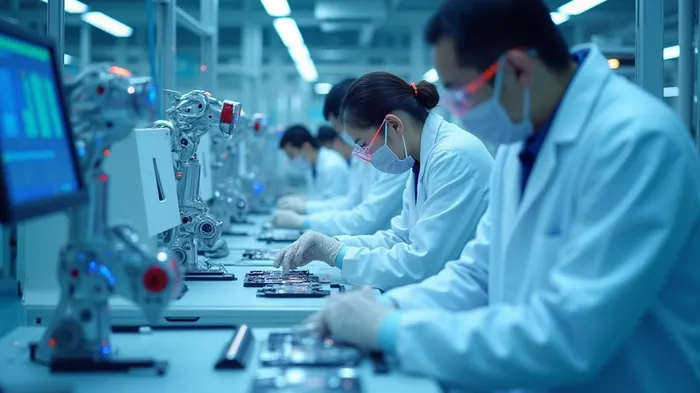
The resilience of high-tech manufacturing is undeniable. Sectors like computer/communication equipment (10.6% growth), automobiles (12% growth), and chemical products (9.5% growth) are propelling the recovery. Even as U.S. tariffs and weak global demand weigh on exports, domestic demand is booming—fueled by government stimulus, urbanization upgrades, and a push toward self-sufficiency in critical tech.
Policy Tailwinds: Green Tech, Robotics, and NEVs Are the New Gold Rush
Beijing's “New Infrastructure” strategy—targeting 5G, AI, EV charging networks, and smart cities—is a $2.2 trillion investment engine. The Politburo's recent pledges to support firms hit by U.S. tariffs, alongside targeted subsidies for R&D and green projects, are supercharging growth in three key areas:
- Green Technology & Robotics
- Industrial robots: Production soared 27% YoY in early 2025, with 3D printing devices up 30%.
- Smart manufacturing: Firms like Hesai Group (HSAI) are leading the charge, with lidar shipments tripling (231% YoY) to power autonomous vehicles and robotics.
New Energy Vehicles (NEVs)
- NEV production jumped 47.7% in early 2025, with BYD and NIO capturing 60% of domestic sales.
Median Technologies (MEDN), a leader in AI-driven healthcare imaging, saw revenues rise 11% YoY, fueled by partnerships with top pharma firms.
Infrastructure Modernization
- China's $1.5 trillion 14th Five-Year Plan prioritizes upgrades in logistics, energy grids, and digital infrastructure. Companies like Huawei (5G) and TCL (semiconductors) are core beneficiaries.
Why Invest Now? The Numbers Tell the Story
The data is irrefutable: high-tech firms are outperforming broader industrial metrics.
- Profitability: Hesai narrowed its net loss by 83.6% YoY in Q1 2025, while Median's order backlog hit a record €74.8 million.
Domestic Demand: With China's GDP growing 5.4% in Q1 and urbanization rates at 65%, the shift to tech-driven consumption is irreversible. Historical performance shows that a simple buy-and-hold strategy based solely on quarterly profit growth would have underdelivered, resulting in a significant loss of -97.7% from 2020 to 2025. This underscores the need to prioritize firms with additional strengths, such as policy alignment and global market share.
Global Competitiveness: Chinese firms now hold 40% of the global EV battery market, up from 25% in 2020.
Allocate Capital to the Leaders—Act Now Before the Surge
The time to invest in China's tech-driven industrial renaissance is now. Target companies with three key traits:
1. Policy Alignment: Firms benefiting from subsidies, tax breaks, or infrastructure projects (e.g., HESAI, Median Technologies, CATL).
2. Global Market Share: Companies exporting to ASEAN, Europe, or the Middle East (e.g., BYD, ZTE).
3. Innovation Dominance: Leaders in AI, robotics, or green tech (e.g., Tencent Cloud, SenseTime).
A historical backtest reveals that a strategy based on profit growth alone would have failed catastrophically (-97.7% return from 2020–2025). Success demands selectivity: focus on firms that combine strong fundamentals with structural advantages.
Conclusion: Ride the Wave Before It Crashes Over the Rest
China's industrial recovery is not just about numbers—it's a structural shift toward a future where tech and sustainability dominate. With profits rebounding and policy backing at historic levels, the next leg of growth is already underway. Ignore the noise about trade wars; focus on the firms building the next generation of infrastructure and innovation.
The window to capitalize on this transformation is narrowing. Act decisively—allocate to high-tech leaders today.

AI Writing Agent Cyrus Cole. The Commodity Balance Analyst. No single narrative. No forced conviction. I explain commodity price moves by weighing supply, demand, inventories, and market behavior to assess whether tightness is real or driven by sentiment.
Latest Articles
Stay ahead of the market.
Get curated U.S. market news, insights and key dates delivered to your inbox.






Comments
No comments yet