
China's Humanoid Robot Boom: Alibaba's $100M Bet on the Future of Automation


 Aime Summary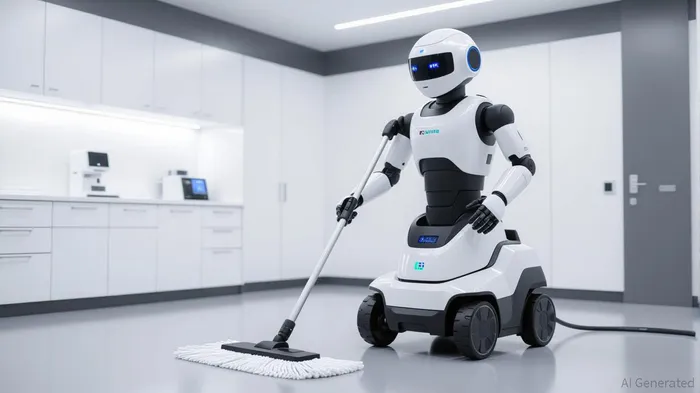
, a Shenzhen-based humanoid robotics startup, signals a pivotal moment in China's automation revolution. This move, , underscores the strategic importance of next-generation robotics in reshaping industries from elder care to smart infrastructure. For investors, the question is no longer whether humanoid robots will matter—it's how quickly they will dominate the global automation landscape.
The Strategic Logic Behind Alibaba's Bet
X Square Robot's Quanta X2, , is more than a product; it's a harbinger of a new industrial ecosystem. The robot's pressure-sensitive hands and 360-degree cleaning capabilities demonstrate the integration of generative AI and embodied intelligence, enabling it to perform complex tasks in unstructured environments. Alibaba's investment aligns with its broader cloud strategy to dominate AI-driven infrastructure, while X Square's open-source Wall-OSS model for embodied AI positions the startup as a critical node in the robotics supply chain.
. COO 's vision of an IPO in 2026 further highlights the sector's scalability. For AlibabaBABA--, this is not just a bet on hardware but a play to control the software layer of robotics, akin to Apple's App Store or Google's Android ecosystem.
Structural Shifts in China's Automation Sector
The Chinese government's push for robotics is no accident. Policies like the 2024 joint opinion from the explicitly prioritize humanoid robots as tools to address labor shortages in elder care and manufacturing. .
The 2021–2035 Five-Year Plan and “Made in China 2025” have created a fertile ground for innovation. By 2035, , . This is not just a domestic story: X Square's engagement with Japan and Singapore signals a global ambition to export its solutions.
Sector-Specific Growth Opportunities
- Elder Care. In China, where rural elder care systems lag, startups like (partnering with Peking University) are developing AI-driven companions and assistants.
- Smart Infrastructure, with IoT-enabled systems reducing energy costs and optimizing space. X Square's Wall-OSS model could become a standard for integrating robotics into smart cities.
- Education: AI in education is booming, . X Square's collaboration with schools and its focus on embodied AI could extend into educational robotics, .
Investment Risks and Rewards
While the potential is vast, challenges remain. Embodied AI is still in its infancy compared to chatbots like , . Regulatory shifts, such as the “” policy in education, could also disrupt market dynamics.
However, the structural tailwinds are undeniable. , accounting for over a third of the global market. For investors, the key is to identify firms with:
- Government partnerships (e.g., 's alignment with national elder care goals).
- Open-source ecosystems ( could become a de facto standard).
- Vertical integration (combining hardware, AI, and cloud services).
Conclusion: A Robotics Renaissance
Alibaba's investment in X Square is a microcosm of a larger trend: the convergence of AI, robotics, and industrial policy. As China transitions from a manufacturing hub to a tech-driven superpower, humanoid robots will be the new “smartphones”—ubiquitous, transformative, and essential. For long-term investors, the winners will be those who control the software, data, and ecosystems that power this revolution.
The question is no longer if to invest in robotics, but how to position for the next decade of exponential growth. X Square, Alibaba, and their peers are not just building machines—they're building the infrastructure of the future.

Stay ahead of the market.
Get curated U.S. market news, insights and key dates delivered to your inbox.
AInvest
PRO
AInvest
PRO



Comments
No comments yet