
China Holds Lending Rates Steady as Trade, Political Pressures Mount Ahead of IMF Meetings
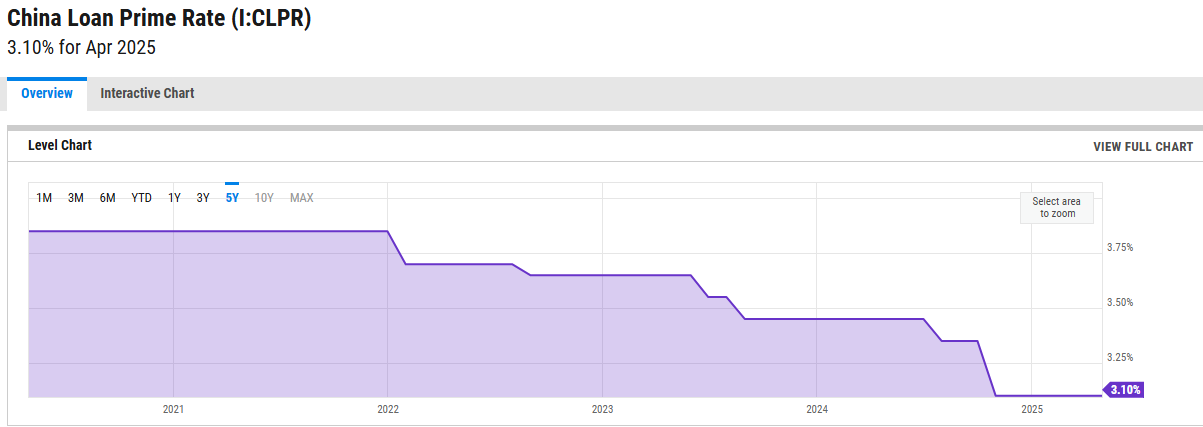
China’s central bank left its key lending rates unchanged on Monday, signaling a calibrated policy stance as the country navigates fragile economic momentum and intensifying geopolitical headwinds. The People’s Bank of China (PBoC) maintained its 1-year Loan Prime Rate (LPR) at 3.1% and the 5-year LPR at 3.6%, matching market expectations and marking the sixth consecutive month without a change. While the move suggests confidence in the country’s near-term growth trajectory, it also reveals a deeper strategy to preserve foreign capital inflows and avoid exacerbating tensions with the United States.
This decision comes at a critical moment in global financial diplomacy. With U.S. President Donald Trump ramping up pressure on Federal Reserve Chair Jerome Powell to cut rates, there had been speculation that China and the European Central Bank could seize the opportunity to ease policy preemptively. Such a move might have isolated Powell, fueling political discord and raising questions over the Fed’s independence. But Beijing stayed put, suggesting it views rate stability as a more prudent course amid the ongoing tariff standoff.
Analysts suggest China’s restraint is in part driven by capital market considerations. “Cutting rates further would risk narrowing the interest rate differential with the U.S., which could accelerate capital outflows,” one strategist noted. Instead, by keeping borrowing costs unchanged, Chinese officials are signaling that the country remains a viable destination for foreign investment—even as trade risks and diplomatic noise escalate. That positioning may be particularly important ahead of the International Monetary Fund (IMF) and World Bank Spring Meetings, where China is likely to present itself as a stable economic anchor in an increasingly fractious global system.
Source: Y-Charts
While the PBoC has historically leaned on rate cuts to stimulate growth, recent economic data suggest the central bank can afford to pause. China’s GDP rose 5.4% in Q1 2025, outpacing expectations thanks to a rebound in domestic consumption and targeted fiscal stimulus. With momentum recovering, Beijing appears to be shifting its stimulus strategy away from rate action and toward structural fiscal support, including subsidies for household goods and enhancements to the social safety net.
Nonetheless, the steady policy posture belies rising tensions with Washington. Recent moves by the Trump administration to expand tariffs on Chinese tech and industrial imports have drawn pointed responses from Beijing, including a vow to retaliate against countries that support U.S. trade positions. Against this backdrop, even a modest LPR cut might have been interpreted as a defensive response to U.S. pressure—something China likely wants to avoid as it works to attract foreign investment and demonstrate macroeconomic discipline.
From a global policy standpoint, the decision also helps sidestep what could have been a politically explosive alignment. Had both China and the ECB cut rates while Powell held steady, it would have amplified Trump’s narrative that the Fed is dragging its feet, potentially leading to renewed public attacks or attempts to interfere with central bank independence. In fact, Powell’s refusal to preemptively ease policy amid tariff-related uncertainty has already sparked frustration from the White House, which is reportedly exploring whether the president can remove him—a legal and constitutional minefield with potentially severe consequences for financial stability.
In short, China’s move to hold rates steady does more than signal economic confidence; it is also a strategic geopolitical play. By resisting the urge to ease, Beijing not only maintains monetary flexibility but also avoids stepping into a policy trap that could widen the rift between Washington and its own central bank. The message ahead of this week’s IMF and World Bank meetings is clear: China intends to chart its own course, and in doing so, may be banking on a more subtle form of leverage—discipline over drama.
As global markets digest this decision, attention will turn to upcoming comments from Chinese and U.S. officials in Washington. With tariffs, Fed independence, and capital flows all on the table, the stakes couldn’t be higher for policymakers on both sides of the Pacific.

Senior Analyst and trader with 20+ years experience with in-depth market coverage, economic trends, industry research, stock analysis, and investment ideas.
Latest Articles
Stay ahead of the market.
Get curated U.S. market news, insights and key dates delivered to your inbox.


AInvest
PRO
AInvest
PRO



Comments
No comments yet