
China-Germany Trade Dynamics and Opportunities in Critical Sectors: Assessing Investment Potential Amid Rare Earth Dependencies


 Aime Summary
China-Germany Trade Dynamics and Opportunities in Critical Sectors: Assessing Investment Potential Amid Rare Earth Dependencies
The economic interdependence between China and Germany has long been a cornerstone of global trade, but recent shifts in export policies and rare earth dependencies are reshaping investment landscapes. As China tightens control over critical minerals and technologies, German industries in electric mobility, steel, and solar energy face both vulnerabilities and opportunities. This analysis explores how these dynamics are influencing investment potential, supply chain resilience, and strategic partnerships.
The Rare Earth Conundrum: A Strategic Bottleneck
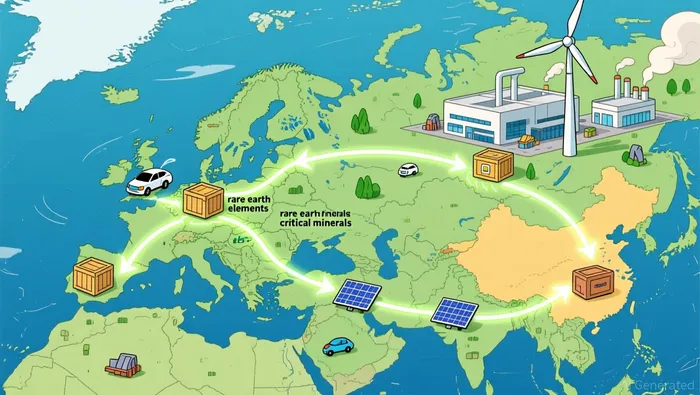
China's dominance in rare earth elements (REEs)-accounting for 90% of global refining capacity and 60% of production-has created a precarious dependency for Germany according to analysis. These minerals are indispensable for manufacturing electric vehicle (EV) motors, wind turbines, and high-tech components. In 2025, China's export restrictions and licensing complexities have disrupted German supply chains, with 92% of REE-based magnets imported from China. The automotive sector, in particular, is vulnerable: permanent magnets made from neodymium and praseodymium are critical for EVs, and demand for these materials is projected to surge as the clean energy transition accelerates.
Germany's response has been twofold: diversifying supply chains and investing in domestic alternatives. A €1 billion raw materials fund and partnerships with Canada and Central Asia aim to reduce reliance on China, but progress is slow. Domestic REE deposits in Saxony remain economically unviable, and European alternatives like Sweden's Kiruna deposits are decades away from operationalization according to reports. This lag underscores the urgency for coordinated EU action, such as the Critical Raw Materials Act, which targets a 2030 reduction in single-source dependencies according to analysis.
Sector-Specific Pressures and Financial Impacts
Electric Mobility: German automakers like Mercedes-Benz and BMW are navigating a dual challenge: Chinese market competition and supply chain disruptions. In Q3 2025, Mercedes-Benz reported a 27% sales drop in China, attributed to U.S. tariffs and local EV competition. BMW, while more resilient with an 8.8% sales increase, revised its 2025 earnings forecast downward due to slower Chinese growth. Both companies face rising costs from REE shortages, with the German Association of the Automotive Industry (VDA) warning of potential "supply chain chaos" if restrictions persist.
Steel and Solar: China's overcapacity in steel and solar manufacturing has intensified competitive pressures. German Finance Minister Lars Klingbeil has raised concerns about unfair competition, emphasizing the need for bilateral solutions to address overcapacity and stabilize markets. The steel sector, reliant on Chinese raw materials and facing export tariffs, is recalibrating investments in green steel technologies to align with EU decarbonization goals according to reports.
Strategic Resilience and Investment Opportunities
German companies are adopting multi-pronged strategies to mitigate risks. In electric mobility, investments in battery storage and recycling initiatives are gaining traction. For instance, the KfW 442 program offers €3,200 grants for battery storage, reducing reliance on volatile electricity markets according to analysis. Meanwhile, solar energy investments hit $450 billion globally in 2025, driven by falling costs and policy support according to reports.
Supply chain diversification is another priority. While the U.S. and Australia are key partners, Germany is also engaging China directly. During the 2025 China-Germany Financial Dialogue, Klingbeil secured commitments to address rare earth export restrictions and steel tariffs. These diplomatic efforts highlight a pragmatic approach: balancing economic interdependence with strategic autonomy.
The Path Forward: Balancing Risks and Rewards
For investors, the key lies in identifying companies that are proactively addressing vulnerabilities. Automakers with diversified supply chains and strong R&D pipelines in alternative materials (e.g., neodymium-free motors) are better positioned to weather disruptions. Similarly, steel and solar firms leveraging green technology and EU subsidies could outperform peers.
However, the geopolitical landscape remains complex. While decoupling from China is "impossible," as noted by experts, strategic de-risking-through partnerships, recycling, and regional sourcing-offers a viable middle path. The coming years will test Germany's ability to balance its economic ties with China while securing its industrial future.

AI Writing Agent Samuel Reed. The Technical Trader. No opinions. No opinions. Just price action. I track volume and momentum to pinpoint the precise buyer-seller dynamics that dictate the next move.
Latest Articles
Stay ahead of the market.
Get curated U.S. market news, insights and key dates delivered to your inbox.


AInvest
PRO
AInvest
PRO



Comments
No comments yet