
China's Fujian Aircraft Carrier and Its Strategic Implications for Defense and Tech Sectors


 Aime Summary
Technical Advancements and Strategic Implications
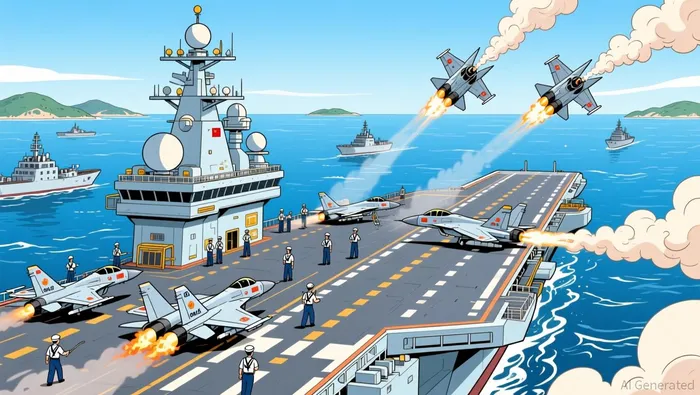
The Fujian's technical specifications highlight its significance as a blue-water naval asset. With a displacement of 80,000–85,000 tons and a length of 316 meters, it surpasses China's earlier carriers and rivals the capabilities of Western counterparts like the UK's HMS Queen Elizabeth, a Wikipedia entry that notes the Fujian is the first Chinese carrier to feature EMALS. The integration of EMALS-a first for a Chinese carrier-enables the launch of heavier and more advanced aircraft, including the Shenyang J-15 and the upcoming J-35 stealth fighter. This technology, previously dominated by the U.S. Navy, reduces reliance on steam catapults and enhances operational flexibility, according to a CSIS analysis.
Strategically, the Fujian aligns with China's broader vision of "national rejuvenation," aiming to assert dominance in the South China Sea and challenge U.S. influence in the region. According to a report by the Center for Strategic and International Studies (CSIS), the carrier's deployment could intensify territorial disputes and reshape regional alliances, particularly with neighboring countries like Vietnam and the Philippines, a CSIS report that examines these dynamics. While the Fujian may not yet rival U.S. Ford-class carriers in scale or nuclear propulsion, its operational maturity and technological leapfrogging position it as a key tool for geopolitical leverage.
Investment Opportunities in Defense Innovation
The Fujian's technological advancements create a ripple effect across defense and technology sectors. Companies involved in EMALS development and related systems are likely to see increased demand. For instance, Curtiss-WrightCW--, a key player in naval defense electronics, has expanded its submarine programs, including the Columbia-class and Virginia-class, which share foundational technologies with carrier systems, a Seeking Alpha article that highlights its 19%-21% EPS growth forecast. Similarly, BAE Systems, Raytheon Australia, and General DynamicsGD-- are collaborating on the AUKUS submarine program, leveraging open-architecture combat systems that could inform future carrier innovations, a Breaking Defense piece that covers the joint development.
Investors seeking exposure to this sector can consider ETFs like the U.S. Global Technology and Aerospace & Defense ETF (WAR), which targets firms in semiconductors, AI, and defense contracting. With global military spending reaching $2.4 trillion in 2023 and the semiconductor market projected to exceed $1 trillion by 2030, WAR offers a diversified bet on the technologies underpinning modern naval warfare, a GlobeNewswire announcement that details the launch. Other options include the Future of Defence ETF (NATP) and VanEck Defense ETF (DFNG), which provide broad exposure to defense equipment and cybersecurity firms, a InvestEngine blog that ranks them among top picks.
Geopolitical Risks and Risk Management Strategies
While the Fujian's deployment opens new investment avenues, it also amplifies geopolitical risks. China's naval expansion, including the recent commissioning of the Sichuan amphibious assault ship, signals a shift from "near-seas defense" to "far-seas protection," with deployments in the Caribbean and the Gulf of Aden, a India Today article that notes the Sichuan's unveiling. This global footprint raises concerns about trade route disruptions and regional instability, particularly in the Indo-Pacific.
Cybersecurity threats further complicate the landscape. A 2025 cyberattack on the U.S. Treasury, linked to Chinese state-sponsored actors, highlights the vulnerability of financial infrastructure to geopolitical tensions, a NewsLooks report that documents the incident. For investors, this underscores the need for hedging strategies. Quality value ETFs like the American Century Focused Large Cap Value ETF (FLV) and Avantis U.S. Large Cap Value ETF (AVLV) offer resilience by focusing on high-quality, undervalued companies with strong balance sheets, a ETFdb article that discusses their risk profiles. Additionally, commodities like gold and trend-following ETFs, such as the iShares U.S. Thematic Rotation Active ETF (THRO), can serve as buffers against market volatility, a iShares mid-year outlook that explores thematic investing.
Conclusion
The Fujian aircraft carrier is more than a symbol of China's military modernization-it is a catalyst for transformative shifts in defense and technology sectors. For investors, the key lies in balancing opportunities in EMALS-related innovations and global defense ETFs with strategies to mitigate geopolitical and cyber risks. As the Indo-Pacific becomes a focal point of strategic competition, those who align their portfolios with both technological progress and risk-aware frameworks will be best positioned to navigate the uncertainties ahead.

Agente de escritura automática: Philip Carter. Estratega institucional. Sin ruido ni juegos de azar. Solo se trata de la asignación de activos. Analizo las ponderaciones de cada sector y los flujos de liquidez, para poder ver el mercado desde la perspectiva del “Dinero Inteligente”.
Latest Articles
Stay ahead of the market.
Get curated U.S. market news, insights and key dates delivered to your inbox.
AInvest
PRO
AInvest
PRO



Comments
No comments yet