
China’s foreign minister meets Brazil president’s chief advisor
ByAinvest
Thursday, Sep 4, 2025 11:56 am ET2min read
China’s foreign minister meets Brazil president’s chief advisor
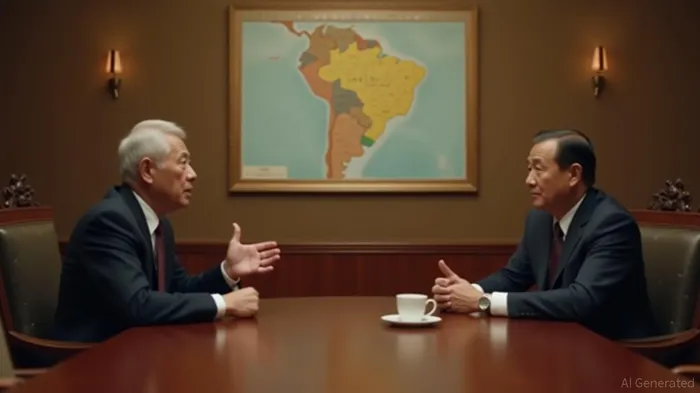
China’s foreign minister, Wang Yi, recently met with Brazil’s President Luiz Inácio Lula da Silva’s chief advisor, Ricardo Kotscho, to discuss a range of strategic and economic issues. The meeting comes at a time when Brazil is emerging as a significant player in the global nickel market and as a major destination for Chinese investments. This meeting underscores the growing geopolitical and economic ties between the two nations, which could have significant implications for the nickel market.Regulatory Scrutiny and Market Dynamics
Brazil’s competition watchdog, CADE, has launched a formal investigation into the $500 million sale of Anglo American’s Brazilian nickel operations to MMG, a subsidiary of China’s state-owned Minmetals Corp. [1]. The probe, which opened an Administrative Procedure for Investigating an Act of Economic Concentration, highlights the heightened regulatory caution surrounding the deal. Analysts warn that the sale could consolidate MMG’s regional dominance, potentially disadvantaging smaller players and industrial customers [1].
China’s Dominance and Global Supply Chain Vulnerabilities
China’s control over the global nickel supply chain has deepened, with the country controlling 75% of Indonesia’s refining capacity and 80% of battery-grade nickel output in the region [1]. The Anglo American-MMG deal adds to this dominance, as MMG gains its first operating nickel asset in Brazil. This acquisition aligns with China’s long-term strategy to secure access to critical resources [1].
The concentration of nickel production in China and Indonesia poses significant risks. Over 70% of global nickel sulfate production occurs in China, relying on intermediates from Indonesian sources [1]. Export restrictions, geopolitical tensions, or operational disruptions in either country could trigger price volatility, with a 40-50% spike in battery pack prices modeled in case of supply shocks [1].
Geopolitical Strategies: U.S. and EU Policy Responses
The U.S. and EU have accelerated efforts to diversify critical mineral supply chains, recognizing their reliance on China. A 2025 Framework Agreement between the two regions emphasizes reducing trade imbalances while fostering cooperation in defense and energy transition minerals [1]. The EU’s Critical Raw Minerals Act and ReArm Europe Plan allocate €800 billion to secure resources like rare earth elements, cobalt, and tungsten [1]. Meanwhile, the U.S. Inflation Reduction Act and Minerals Security Partnership aim to bolster domestic production and regional alliances, though implementation challenges persist [1].
Investment Risks and Opportunities
For investors, the Anglo American-MMG transaction exemplifies the dual-edged nature of nickel markets. Regulatory delays in Brazil could disrupt Anglo American’s restructuring plans, compounding recent setbacks like the failed $3.8 billion coal sale to Peabody Energy [1]. However, the deal underscores the growing importance of nickel in the EV and stainless steel industries, sectors projected to drive demand growth.
Opportunities lie in companies diversifying supply chains or leveraging geopolitical incentives. Firms securing nickel from regions outside China-Indonesia dominance—such as Canada, Australia, or the Democratic Republic of Congo—may benefit from policy-driven subsidies. Conversely, investors in Chinese-controlled assets face exposure to regulatory risks and market concentration, as seen in the CADE probe and U.S. scrutiny [1].
Conclusion
The meeting between China’s foreign minister and Brazil’s president’s chief advisor highlights the strategic importance of Brazil in the global nickel market. Regulatory scrutiny in Brazil, China’s supply chain dominance, and U.S.-EU policy shifts all point to a landscape where geopolitical considerations outweigh pure market dynamics. For investors, the path forward requires balancing short-term volatility with long-term trends: the energy transition’s demand for nickel will persist, but its supply chain will remain a battleground for economic and national security interests.
References
[1] https://www.ainvest.com/news/strategic-risks-opportunities-global-nickel-markets-regulatory-scrutiny-anglo-american-500m-brazil-sale-2509/
[2] https://www.reuters.com/business/autos-transportation/chinese-investment-doubles-brazil-jumping-no-3-destination-2025-09-04/
Stay ahead of the market.
Get curated U.S. market news, insights and key dates delivered to your inbox.


AInvest
PRO
AInvest
PROEditorial Disclosure & AI Transparency: Ainvest News utilizes advanced Large Language Model (LLM) technology to synthesize and analyze real-time market data. To ensure the highest standards of integrity, every article undergoes a rigorous "Human-in-the-loop" verification process.
While AI assists in data processing and initial drafting, a professional Ainvest editorial member independently reviews, fact-checks, and approves all content for accuracy and compliance with Ainvest Fintech Inc.’s editorial standards. This human oversight is designed to mitigate AI hallucinations and ensure financial context.
Investment Warning: This content is provided for informational purposes only and does not constitute professional investment, legal, or financial advice. Markets involve inherent risks. Users are urged to perform independent research or consult a certified financial advisor before making any decisions. Ainvest Fintech Inc. disclaims all liability for actions taken based on this information. Found an error?Report an Issue


ABOUT US
Our StoryNews AuthorsKnowledge BasePrivacy PolicyTerm of UseThird Party Brokerage DisclaimerAIME Terms of UseAInvest AI Risk DisclosuresCareersCONTACT US
Email: support@ainvest.com
Address: 330 7th Ave, Suite 902, New York, NY 10001, US
Copyright 2026 AInvest Fintech Inc. All rights reserved.


Comments
No comments yet