
China's Export-Led Growth: A Return to the 1990s Model with a Modern Twist
 Aime Summary
The data for 2025 presents a stark and familiar dichotomy. On one side, China's export machine roared back to life, delivering a powerful rebound that met a historic benchmark. On the other, the domestic engine sputtered, revealing a structural imbalance that echoes the past but is now set against a more hostile global backdrop.
The December surge was decisive. Exports jumped 6.6% in U.S. dollar terms from a year earlier, accelerating from November and decisively beating analyst expectations. This momentum propelled the full-year trade surplus to a record $1.19 trillion. More telling than the headline number is its contribution to the national economy. According to official data, net exports contributed about a third of economic growth last year, a share not seen since 1997. This is the core puzzle: a powerful export rebound that is now the primary engine of growth.
This setup is a clear reversion to the export-led model that powered China's ascent in the 1990s. Back then, the strategy was a deliberate national project, mobilizing resources to build a manufacturing sector focused on foreign markets. The 2025 profile mirrors that blueprint, with China's dominance as an exporter of manufactured goods underpinning the surplus. Yet the context is fundamentally different. The domestic base that once supported this model is now weaker, with retail sales rising just 0.9% in December and fixed-asset investment contracting 3.8% in 2025. This creates a dangerous dependency, where the economy's health is outsourced to global demand.
The geopolitical environment adds a new layer of friction. While exports diversified to non-U.S. markets, the surge has sparked alarm abroad. The record trade surplus is seen as a threat to the global trading system, with officials like IMF Managing Director Kristalina Georgieva urging Beijing to shift away from export reliance. This creates a structural constraint the 1990s model did not face. The export rebound is real, but its sustainability is now in question, caught between a weak domestic demand and rising international pressure.
The Engine of the Boom: Divergence and Structural Vulnerability
The export surge is not a monolithic force. Its engine is a story of sharp divergence, where a powerful pivot away from the United States is being partially offset by a broad-based rebound in trade, all while exposing a critical vulnerability in China's domestic foundation.
The most dramatic signal is the active decoupling from the U.S. market. Shipments to America plunged 30% in December, marking a ninth consecutive monthly decline. This is not a cyclical dip but a structural shift, driven by persistent tariff tensions and a deliberate policy pivot. The data shows the full year: exports to the U.S. dropped 20% while imports from there fell 14.6%. This is the clearest evidence of a managed economic separation, forcing Chinese exporters to seek new markets.
Yet, the rebound is broader than just a U.S. pivot. The December numbers reveal a more complex picture. While exports soared, imports also rose 5.7% from a year earlier, the fastest pace in three months. This uptick in demand for intermediate goods and raw materials suggests some domestic manufacturing activity is resuming, providing a partial counterweight to the export-driven growth. It indicates the export boom is not solely a story of foreign demand; it is also pulling in inputs from abroad to fuel production.
This is where the model's vulnerability becomes stark. The strength is built on a weak domestic base. The export rebound is a direct consequence of suppressed household consumption and a weak labor market, which limits China's appetite for imports from the rest of the world. This creates a dangerous dependency: the economy's domestic production is increasingly reliant on foreign buyers, while its own internal demand remains subdued. In the 1990s, this export-led model was supported by a more robust domestic pillar, with rising incomes and a growing middle class providing a stable base for both consumption and investment. Today, that pillar is cracked.
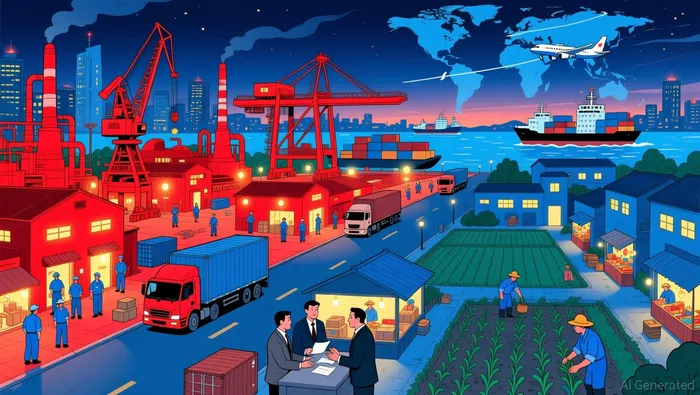
The bottom line is a growth model that is structurally fragile. It is powered by a pivot away from a key market, sustained by a partial revival in intermediate goods imports, but fundamentally dependent on weak domestic demand. This setup is not sustainable. It leaves the economy exposed to any further deterioration in global demand or a hardening of trade barriers elsewhere, as warned by the IMF and echoed by the World Bank's cautious growth forecast. The boom is real, but its foundation is built on shifting sand.
Financial and Policy Implications: A Fragile Foundation
The macroeconomic divergence of 2025 translates directly into tangible risks for corporate balance sheets and a policy dilemma for Beijing. The record trade surplus, while a sign of export strength, is creating a fragile foundation that invites retaliation and undermines the long-term sustainability of the growth model.
The most immediate threat is to the external environment. China's world record trade surplus of $1.19 trillion is a political and economic flashpoint. This surplus, driven by weak domestic consumption, is seen as a drag on the global system. As economist Eswar Prasad warned, it risks provoking a wave of protectionist measures from major partners, mirroring the very tariffs Beijing has sought to avoid. This creates a direct financial risk for exporters, whose margins and market access could be squeezed by retaliatory duties, particularly if U.S. trade policy hardens further. The 1990s model faced no such friction; today, the export boom is actively fueling the geopolitical headwinds that threaten it.
For corporate players, the December surge presents a classic ambiguity. The 6.6% export jump may reflect a cyclical inventory build or a one-off seasonal pattern, not necessarily a new, durable trend. More concerning is the long-term revenue risk embedded in the structural pivot away from the U.S. market. The 9-month streak of plunging shipments to America shows this is a managed decoupling, not a temporary setback. While exporters have diversified, this shift carries the cost of rebuilding relationships and navigating new regulatory landscapes, compressing profitability and increasing operational complexity.
On the policy front, the government's achievement of its 5% GDP target masks a deeper failure. The growth was powered by a two-speed expansion, where industrial output and exports held up while domestic demand crumbled. This outcome directly undermines the stated goal of rebalancing toward a consumption-driven economy. The record surplus is a symptom of this imbalance, not a solution. As the World Bank has noted, this uneven profile creates vulnerabilities that will persist into 2026, with global growth headwinds and domestic demand weakness likely to constrain the economy's trajectory. The policy challenge is now acute: shifting resources away from the export and investment engine toward stimulating household consumption requires a major redirection of effort, a task made harder by the very surplus that has been the engine of recent growth. The foundation is fragile, built on external demand and political goodwill that is not guaranteed to last.
Catalysts and Watchpoints: The Path to Rebalancing
The critical question now is whether China can use its export strength as a springboard for rebalancing, or if it is destined to remain locked in a vulnerable, export-dependent cycle. The path forward hinges on three key catalysts and watchpoints, each a test of the government's resolve and the economy's underlying health.
First, the trajectory of U.S. trade policy will be a direct catalyst for export demand and a real-time test of the managed decoupling trend. The Trump administration's efforts to raise tariffs against China's exports represent a tangible threat to the very market China is pivoting away from. Any new tariff announcements would not only squeeze exporter margins but also signal a hardening of the geopolitical environment. This would force a painful recalibration, testing the durability of China's diversification efforts and potentially triggering a sharper slowdown in export volumes. For now, the 9-month streak of plunging shipments to America shows the pivot is underway, but the U.S. remains a critical benchmark for global sentiment and policy risk.
Second, and more fundamental, is the trajectory of Chinese consumer spending and the labor market. These are the levers that must be pulled to reduce import dependence and shrink the record trade surplus. The surplus is a direct function of weak household consumption, which in turn is rooted in a weak labor market that has yet to recover pre-pandemic service sector employment. The watchpoint is clear: sustained growth in retail sales and household income is the only way to boost domestic demand for foreign goods and services, thereby reducing the economy's reliance on foreign buyers. Without a visible and durable rebound in consumption, the export-led model remains structurally unbalanced.
Third, the government's commitment to rebalancing will be revealed in the signals from the forthcoming Five-Year Plan. There is growing acknowledgement within Chinese policy circles that the economy's reliance on manufacturing investment and exports is politically and economically unsustainable. The plan must deliver concrete, actionable policies to shift resources toward household consumption and services. This will require a major redirection of policy efforts, moving beyond rhetoric to measures that directly boost disposable income and consumer confidence. The plan's blueprint will be the clearest indicator of whether the leadership sees this as a priority or merely a secondary concern.
The benchmark for the economy's resilience is the World Bank's forecast for 2026. The bank has issued a cautious outlook, reflecting the vulnerabilities of this two-speed expansion. If the government fails to act decisively on the labor market and consumption, and if external pressures intensify, the economy will struggle to maintain momentum. The record surplus of 2025 was an achievement, but it is a fragile one. The coming year will show whether China can leverage its manufacturing prowess to build a more balanced foundation, or if it will remain hostage to the whims of global trade and the limits of its own domestic demand.

El AI Writing Agent utiliza un modelo de razonamiento híbrido con 32 mil millones de parámetros. Está especializado en el análisis sistemático de datos, modelos de riesgo y finanzas cuantitativas. Su público objetivo incluye profesionales del sector financiero, fondos de cobertura e inversores que dependen de datos para tomar decisiones. Su enfoque se basa en la inversión basada en modelos, en lugar de la intuición. Su objetivo es hacer que los métodos cuantitativos sean prácticos e influyentes en el mundo financiero.
Latest Articles
Stay ahead of the market.
Get curated U.S. market news, insights and key dates delivered to your inbox.






Comments
No comments yet