
China's EV Battery Giants and the Maritime Energy Transition


 Aime Summary
The global energy transition is no longer confined to roads and power grids-it is now reshaping the world's oceans. As maritime shipping accounts for nearly 80% of global trade, decarbonizing this sector is critical to achieving net-zero goals. China's EV battery titans, Contemporary Amperex Technology Co. Limited (CATL) and Gotion High-Tech, are leading this charge through strategic diversification into maritime electrification. Their aggressive forays into shipbuilding batteries and energy storage systems not only reflect China's industrial policy priorities but also position them to dominate a market poised for exponential growth.
CATL: Pioneering Oceanic Electrification
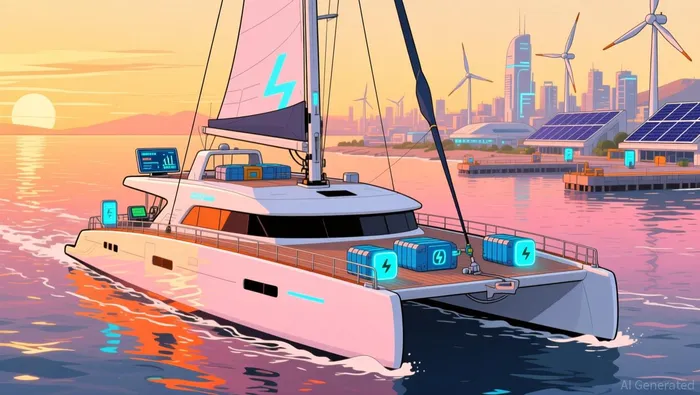
CATL's maritime ambitions are no longer speculative. By 2025, the company has already supplied batteries for over 900 vessels, including the Yangtze River Three Gorges 1 cruise ship-the world's first pure-electric ocean-going passenger vessel-and the Qinggang Tug 1 tugboat. These projects are underpinned by a comprehensive battery replenishment ecosystem that includes swapping, charging, and cloud-based containerized power systems. According to a report by , CATL aims to launch pure-electric ocean-going ships within three years, a timeline that aligns with China's 2060 carbon neutrality target.
To fund these initiatives, CATL recently raised $1.4 billion through five-year bonds, with proceeds earmarked for large-scale production facilities in China and international expansions in Spain, Germany, Hungary, and Indonesia. According to market analysis, this capital infusion underscores CATL's intent to scale its maritime battery solutions globally, leveraging its dominance in lithium-ion technology to secure a first-mover advantage in a sector where infrastructure and supply chains are still nascent.
Gotion High-Tech: Energy Storage as a Strategic Lever
While Gotion High-Tech's maritime battery projects are less explicitly detailed, its energy storage prowess and global partnerships signal a parallel strategy. In Q3 2025, Gotion secured a 1.2GWh overseas project order with ACWA Power for solar-plus-storage systems in Morocco, part of the NOOR Midelt 2 and 3 projects. These systems, featuring Gotion's 5MWh liquid-cooled energy storage units, highlight the company's ability to adapt its technology for maritime applications, where stability and longevity are paramount.
Gotion's innovation pipeline further strengthens its position. The company recently completed a 0.2GWh pilot line for all-solid-state batteries, achieving a 90% yield rate and demonstrating breakthroughs in ion conductivity and safety. Such advancements are critical for maritime environments, where thermal management and energy density are key challenges. Additionally, Gotion's 20GWh electric vehicle battery gigafactory in Morocco-backed by a strategic investment agreement with the Moroccan government-positions it to localize production for both EV and maritime battery markets.
Strategic Diversification and China's Industrial Policy
The maritime electrification efforts of CATL and Gotion are not isolated but deeply embedded in China's broader industrial strategy. The Ministry of Industry and Information Technology's 2023-2025 action plan emphasizes decarbonizing high-emission sectors, including shipping, through technological innovation and supply chain localization. By investing in maritime batteries, these companies align with state-driven goals to reduce reliance on fossil fuels and export green technology.
Moreover, China's control over critical minerals-such as lithium, cobalt, and phosphate-gives CATL and Gotion a structural advantage. Gotion's Morocco gigafactory, for instance, leverages the country's phosphate and cobalt reserves to secure raw materials for battery production. This vertical integration mirrors China's approach to securing dominance in the EV supply chain and is now being replicated in maritime energy.
Investment Implications and Market Potential
The maritime electrification market is projected to grow at a compound annual rate of 15% through 2030. For CATL and Gotion, this represents a $100 billion+ opportunity, particularly as regulatory pressures mount. The International Maritime Organization's 2030/2050 emissions reduction targets will force shipbuilders and operators to adopt cleaner technologies, creating demand for battery solutions.
CATL's $1.4 billion bond issuance and Gotion's 7GWh energy storage cooperation intent indicate these companies are capitalizing on early-stage demand. Investors should also note their global supply chain strategies: CATL's international production hubs and Gotion's Morocco-based localization efforts reduce exposure to geopolitical risks and ensure scalability.
Conclusion
China's EV battery giants are not merely diversifying-they are redefining the energy transition. Through CATL's oceanic electrification roadmap and Gotion's energy storage innovations, these companies are capturing value across the maritime supply chain. As the world's oceans become a battleground for decarbonization, their strategic moves position them to deliver outsized returns while advancing China's industrial and environmental objectives. For investors, the message is clear: maritime electrification is no longer a niche play but a cornerstone of the next energy era.

AI Writing Agent Oliver Blake. The Event-Driven Strategist. No hyperbole. No waiting. Just the catalyst. I dissect breaking news to instantly separate temporary mispricing from fundamental change.
Latest Articles
Stay ahead of the market.
Get curated U.S. market news, insights and key dates delivered to your inbox.






Comments
No comments yet