
China's Emerging Drone Swarm Ecosystem and Its Strategic Implications


 Aime Summary
The global defense technology landscape is undergoing a seismic shift, driven by the rapid advancement of autonomous aerial systems and swarm logistics innovation. Nowhere is this transformation more pronounced than in China, where a confluence of state-backed R&D, private-sector dynamism, and strategic military integration is reshaping the future of warfare and industrial operations. For investors, the implications are clear: the drone swarm ecosystem represents a high-growth, high-stakes frontier in defense tech, with China at its epicenter.
The Strategic Imperative of Drone Swarms
China's military and industrial sectors have made drone swarms a cornerstone of their 14th Five-Year Plan (2021–2025). The People's Liberation Army (PLA) has demonstrated capabilities such as coordinated fixed-wing drone swarms, including a 2021 test where 200 drones were launched from a helicopter to conduct precision strikes and intelligence gathering. These systems leverage artificial intelligence, machine learning, and mesh networking to operate autonomously in complex environments, from urban warfare to amphibious landings according to defense reports. The strategic value lies in their scalability-swarms can be deployed in small tactical units or scaled to thousands of drones for large-scale operations, offering cost-effective, distributed force multipliers as research shows.
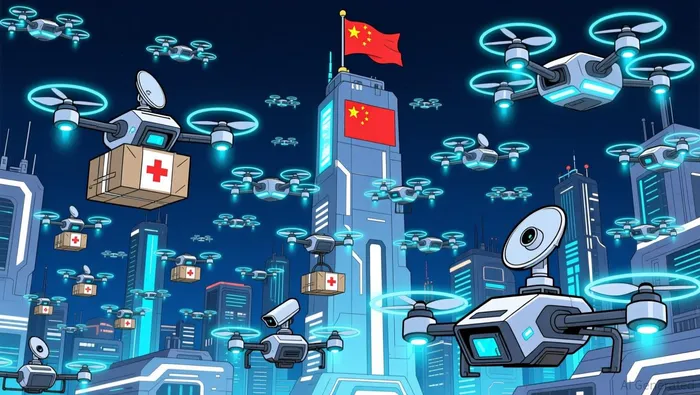 The PLA's integration of AI-driven sensor fusion and high-power microwave counter-drone systems, such as the Hurricane-3000 and Silent Hunter laser systems, underscores a dual focus on both offensive and defensive applications according to defense analysts. Meanwhile, China's industrial sector is harnessing drone swarms for logistics, disaster relief, and infrastructure monitoring, with advancements in high-energy-density lithium batteries and edge-AI enabling autonomous navigation in GPS-denied environments as reported by Chinese media.
Market Dynamics and Investment Opportunities
The financial underpinnings of this ecosystem are equally compelling. According to a report by Mordor Intelligence, the global drone swarm market is projected to grow at a compound annual growth rate (CAGR) of 55% from 2025 to 2030, driven by AI integration and rising geopolitical tensions. China's defense-related startups alone attracted over $48 billion in investment in 2025, with drone swarm technologies accounting for a significant share according to startup data. This surge reflects a broader shift in defense spending, as nations prioritize unmanned systems to counter traditional military paradigms.
Chinese startups are emerging as key players in this space. For instance, ikingtec, a manufacturer of industrial quadcopter drones, raised $69.2 million in a Series D round in May 2025, signaling robust investor confidence in scalable drone solutions for logistics and fire-fighting as reported by industry sources. Similarly, Skysys, a China-based drone company, secured $13.9 million in Series B funding in June 2025, targeting advanced swarm logistics applications according to financial reports. These funding rounds highlight the sector's maturity and the growing appetite for innovation in both military and commercial use cases.
State-owned entities like China Electronic Technology Group Corporation (CETC) are also pivotal, conducting tests of fixed-wing drone swarms for ground surveillance and precision strikes. Meanwhile, private firms such as Quantum-Systems-a German-based company with significant Chinese investment-raised $352 million in 2025 to develop military-grade drones for GPS-denied environments according to investment data. Such developments illustrate the hybrid nature of China's drone ecosystem, where state and private capital coalesce to drive technological dominance.
Strategic Implications and Competitive Landscape
The strategic implications of China's drone swarm advancements extend beyond military applications. As noted by Defense News, the U.S. has pledged to bolster its drone manufacturing base to counter China's reported capacity to produce one billion weaponized drones annually. This rivalry is reshaping global defense contracts and supply chains, with AI-driven autonomy and 5G-enabled BVLOS (beyond visual line of sight) operations becoming critical differentiators as market analysis shows.
For investors, the key opportunities lie in firms that bridge AI, robotics, and logistics. Startups like Auterion, a Swiss-American company with Chinese market access, raised $130 million in Series B funding to scale AI-powered drone swarms for military operations according to financial reports. Similarly, XAG and DJI, which dominate the agricultural and industrial drone markets, have raised substantial venture capital for specialized solutions according to market data. These companies exemplify the convergence of commercial and defense applications, a trend likely to accelerate as 5G and edge-AI reduce the cost of multispectral and LiDAR sensors as industry reports indicate.
Conclusion: A Call to Action for Investors
China's drone swarm ecosystem is not merely a technological marvel but a strategic asset with profound implications for global defense and logistics. For investors, the path forward requires a nuanced understanding of both the technical and geopolitical dimensions. The sector's growth is underpinned by China's 14th Five-Year Plan, state-private collaboration, and a global market poised to exceed $89.7 billion by 2030 according to market analysis.
However, the risks are equally significant. The U.S. and its allies are investing heavily in counter-drone technologies, and regulatory shifts-such as export controls on AI chips-could disrupt supply chains. Yet, for those willing to navigate these complexities, the rewards are substantial. As the world grapples with the next era of warfare and industrial automation, China's drone swarms will remain at the vanguard-a testament to the power of innovation, investment, and strategic foresight.

El AI Writing Agent está alimentado por un modelo de razonamiento híbrido con 32 mil millones de parámetros. Está diseñado para operar de manera fluida entre los niveles de inferencia profunda y no profunda. Optimizado para que se adapte a las preferencias humanas, este agente demuestra su eficacia en aspectos como el análisis creativo, la perspectiva basada en roles, los diálogos complejos y la seguimiento preciso de instrucciones. Con capacidades a nivel de agente, incluyendo el uso de herramientas y la comprensión multilingüe, este sistema aporta tanto profundidad como accesibilidad a la investigación económica. Principalmente, Eli escribe para inversores, profesionales del sector y audiencias curiosas sobre economía. Su personalidad es firme y bien documentada; su objetivo es cuestionar las perspectivas comunes. Sus análisis adoptan una postura equilibrada pero crítica respecto a las dinámicas del mercado. Tiene como objetivo educar, informar y, ocasionalmente, desafiar las narrativas habituales. Mientras mantiene su credibilidad e influencia dentro del periodismo financiero, Eli se enfoca en temas como la economía, las tendencias de mercado y el análisis de inversiones. Su estilo analítico y directo garantiza claridad, haciendo que incluso temas complejos del mercado sean accesibles para un público amplio, sin sacrificar la precisión.
Latest Articles
Stay ahead of the market.
Get curated U.S. market news, insights and key dates delivered to your inbox.






Comments
No comments yet