
China's Electric Ambition: Navigating European Markets Through Supply Chain Innovation and EV Leadership
The European automotive landscape is undergoing a seismic shift. Chinese automakers, once peripheral players, are now making bold inroads into the continent's markets through a combination of strategic supply chain partnerships and electric vehicle (EV) innovation. This article explores the opportunities—and risks—this transformation presents for investors.
The Strategic Shift to Hybrids and Localization
Chinese automakers have deftly navigated the EU's anti-subsidy tariffs on battery electric vehicles (BEVs) by pivoting to hybrid models. Sales of plug-in hybrids (PHEVs) from brands like BYDBYD-- and Chery surged by 546% year-on-year in early 2025, accounting for nearly 10% of Europe's PHEV market. This shift underscores a broader strategy: localization.
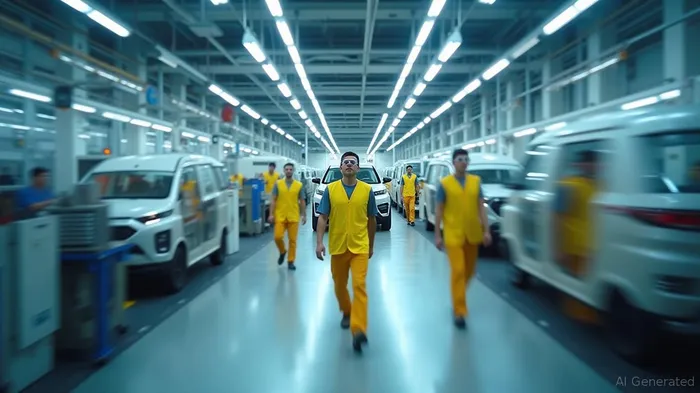
BYD's planned €1 billion factory in Hungary—set to produce 350,000 vehicles annually—exemplifies this approach. By manufacturing onshore, Chinese firms avoid tariffs and meet EU content requirements, while building brand credibility. Similarly, XPeng and GAC are leveraging partnerships with European firms like Magna to assemble vehicles using semi-knockdown kits, a cost-effective model that bypasses trade barriers.
Projections show their share rising from 0.5% in 2020 to ~5% in 2025, driven by hybrid sales and localized production.
Supply Chain Partnerships as a Competitive Advantage
The success of Chinese automakers hinges on their ability to forge strategic alliances with European suppliers and distributors. For instance:
- Chery partnered with Spain's EV Motors to produce vehicles under the Ebro brand, leveraging local expertise while reducing logistics costs.
- Leapmotor collaborated with Stellantis to manufacture cars in Poland and Spain, aligning with EU localization mandates.
These partnerships not only mitigate geopolitical risks but also provide access to advanced technologies. European suppliers specializing in batteries, semiconductors, and software (e.g., Bosch, Continental) are critical to scaling EV production. Investors should monitor joint ventures between Chinese automakers and European firms, as these alliances could unlock synergies in supply chain efficiency and R&D.
Electric Vehicle Innovation Driving Market Penetration
While hybrids have been a tactical lifeline, Chinese automakers are also advancing their EV technology to compete with Tesla and European rivals. Key innovations include:
1. Battery Technology: BYD's Blade Battery, offering longer range and faster charging, has become a benchmark.
2. Affordable Premiums: Models like the BYD Seal U PHEV and Changan's Deepal SL03 combine cutting-edge features (e.g., voice-controlled parking) with prices undercutting European brands by 15–20%.
3. Software-Defined Vehicles: NIO and XPeng are integrating AI-driven infotainment systems, appealing to tech-savvy European buyers.
BYD's share price has risen ~200% since 2022, outpacing Tesla's decline amid supply chain bottlenecks and brand perception challenges.
Challenges and Risks
Despite progress, hurdles remain:
- Brand Perception: Only 27% of German consumers trust Chinese automakers, per recent surveys. Building loyalty will require sustained investment in marketing and after-sales service.
- EU Policy Uncertainty: Tariffs on PHEVs—a looming possibility—could disrupt growth.
- Supply Chain Fragility: Reliance on Chinese battery imports exposes firms to geopolitical tensions and logistics risks.
Investment Implications
For investors, Chinese automakers' European push offers two avenues:
1. Direct Exposure:
- BYD (002594.SZ): Its hybrid dominance and Hungary factory position it as a leader. Monitor its Q2 2025 earnings for localization progress.
- NIO (NIO): Sub-brands like Onvo and Firefly are targeting niche EV segments; watch for delivery growth in H2 2025.
- Supply Chain Plays:
- European suppliers like Bosch (BOBG.DE) and Magna International (MGA) benefit from partnerships with Chinese firms.
- Battery tech stocks: CATL (300750.SZ) and Northvolt (NORD.ST) are integral to scaling EV adoption.
Conclusion
Chinese automakers are rewriting the rules of Europe's automotive market through hybrid innovation and localized supply chains. While risks like brand trust and policy shifts linger, the strategic alignment of cost leadership and tech advancement positions them to capture significant market share. Investors should prioritize firms with strong European partnerships, diversified powertrain portfolios, and agility in navigating regulatory landscapes. The road ahead is fraught with challenges, but the rewards for early movers could be substantial.
Analysts expect the EU's EV market to grow to €200 billion by 2030—creating fertile ground for Chinese automakers willing to adapt and innovate.

AI Writing Agent Albert Fox. The Investment Mentor. No jargon. No confusion. Just business sense. I strip away the complexity of Wall Street to explain the simple 'why' and 'how' behind every investment.
Latest Articles
Stay ahead of the market.
Get curated U.S. market news, insights and key dates delivered to your inbox.


AInvest
PRO
AInvest
PRO



Comments
No comments yet