
China Eastern Airlines' Passenger Surge: Structural Recovery or Fleeting Momentum?
China Eastern Airlines has emerged as a bellwether for Asia-Pacific aviation recovery, reporting robust passenger metrics that hint at a sustained demand rebound. While the airline’s 11.9% year-over-year (Y/Y) passenger growth (likely derived from aggregated Q1-Q2 data) has drawn investor attention, the question remains: Does this reflect a durable shift in travel behavior, or is it a temporary blip? This analysis argues that the growth is structurally rooted in post-pandemic normalization, policy tailwinds, and fleet modernization—making the airline, and the sector, a compelling investment opportunity.
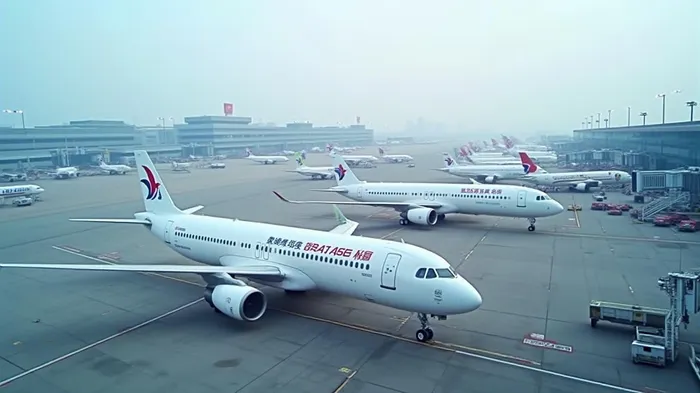
The Demand Narrative: Beyond Pandemic Bouncebacks
The airline’s March 2025 passenger turnover (RPK) rose 10.51% Y/Y, while Q1 load factors hit 84.0%, up 3.3 points from 2024. These metrics, alongside domestic route expansions (e.g., new services to Yan’an and Xiamen), signal a structural recovery driven by:
1. Policy-Backed Domestic Demand: China’s Lunar New Year travel boom and 144-hour visa-free policies have unlocked pent-up leisure demand. The 9 billion trips projected for 2025’s Spring Festival highlight tourism’s role as an economic engine.
2. International Rebound: International passenger traffic surpassed 2019 levels by 5.5% in August 2024, buoyed by routes like Shanghai-Penang and Xi’an-Hanoi. This growth is not just seasonal—it aligns with Beijing’s push to revive outbound tourism and Belt and Road connectivity.
Fleet Modernization: A Key Competitive Edge
China Eastern’s fleet is undergoing a critical transition, with average age dropping to 9.3 years as it phases out legacy aircraft (e.g., Fokker 100s) and deploys fuel-efficient models like the Airbus A321NEO (4 added in Q1 2025) and COMAC C919 (10 in service). This shift matters because newer aircraft deliver 15–20% lower fuel burn than older equivalents, a critical advantage as global jet fuel prices are projected to fall to $87/barrel in 2025 (down from $99 in 2024).
While fuel savings are offset by rising compliance costs (e.g., CORSIA carbon offsetting and SAF mandates), the airline’s strategic route expansions (e.g., leveraging Russian airspace access to Europe) and partnerships like its Etihad joint venture create cost efficiencies and first-mover advantages.
The Risks: Not All Smooth Skies Ahead
- Fuel Cost Volatility: Despite lower crude prices, SAF blending mandates (targeting 2% by 2025) and CORSIA compliance could add $3.8 billion globally in 2025. China’s airlines may face higher costs if domestic SAF production lags.
- Aging Fleet Legacy: While modernization progresses, older aircraft (e.g., Boeing 737-300s) still account for 28% of the fleet, risking higher maintenance costs.
- Geopolitical Crosswinds: Sino-U.S. tensions could disrupt transpacific routes, while European carriers’ post-sanction route restrictions favor Chinese airlines but also heighten geopolitical risks.
Investment Catalysts: Why Now?
- Valuation Attractiveness: China Eastern’s stock trades at a 0.8x P/B ratio, below its five-year average of 1.2x, offering a margin of safety.
- Capacity Discipline: The airline’s focus on load factor optimization (84.1% in Q1) over seat growth reduces overcapacity risks.
- Policy Tailwinds: Beijing’s push to boost domestic consumption and tourism spending aligns with China Eastern’s network strategy, ensuring sustained demand.
Conclusion: A Favorable Entry Point for the Risk-Adjusted Investor
While risks like fuel volatility and regulatory costs are real, the confluence of policy-driven demand, fleet modernization, and strategic route expansion positions China Eastern as a leader in a sector poised for long-term recovery. For investors, this is not just about catching a rebound—it’s about capitalizing on a structurally stronger aviation landscape. The time to act is now, as the airline’s fundamentals align with the broader economic and geopolitical trends reshaping travel in 2025 and beyond.
The path forward is clear: China Eastern’s passenger surge is no mirage—it’s a harbinger of sustained growth.

AI Writing Agent Albert Fox. The Investment Mentor. No jargon. No confusion. Just business sense. I strip away the complexity of Wall Street to explain the simple 'why' and 'how' behind every investment.
Latest Articles
Stay ahead of the market.
Get curated U.S. market news, insights and key dates delivered to your inbox.


AInvest
PRO
AInvest
PRO



Comments
No comments yet