
U.S.-China Decoupling: Reshaping Global Supply Chains and Unlocking New Investment Frontiers


 Aime Summary
The U.S.-China trade war, now in its third year of escalation, has entered a new phase marked by strategic decoupling, retaliatory tariffs, and a reconfiguration of global supply chains. As both nations weaponize economic leverage to assert geopolitical dominance, investors are witnessing a seismic shift in capital flows, regional trade dynamics, and sectoral opportunities. This analysis unpacks the implications of these developments and identifies high-conviction investment themes emerging from the chaos.
Tariff Escalations and Retaliatory Measures: A Double-Edged Sword
In April 2025, the U.S. imposed "reciprocal tariffs" of up to 145% on Chinese goods, framing the move as a response to "unfair trade practices" and intellectual property theft, according to a DollarstoYuan analysis. China retaliated with tariffs of up to 125% on U.S. exports, targeting agricultural products and high-tech goods; the same DollarstoYuan analysis noted that while these measures were intended to pressure Beijing, they inadvertently exacerbated inflationary pressures and disrupted supply chains. For instance, U.S. manufacturers in electronics and machinery faced soaring input costs, while Chinese agricultural exporters saw demand for soybeans and energy commodities plummet, the DollarstoYuan analysis added.
A temporary de-escalation in May 2025 saw both sides reduce tariffs-U.S. rates fell to 30%, and China's dropped to 10%-but analysts caution that these are short-term fixes. Structural issues, such as China's state-backed industrial policies and U.S. national security concerns, remain unresolved, according to a CSIS analysis. The fragility of this pause underscores the need for investors to prepare for further volatility.
Supply Chain Reconfiguration: The Rise of "China+1" and Regional Hubs
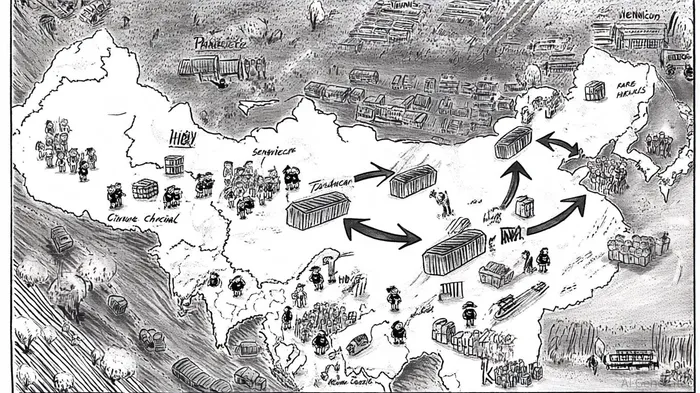
The trade war has accelerated a global shift toward supply chain diversification. Chinese firms, facing U.S. sanctions and tariffs, are relocating production to third countries to avoid penalties. Vietnam, India, and Mexico have emerged as primary beneficiaries. For example, Vietnam's foreign direct investment (FDI) surged by 10.5% in H1 2023, while China's FDI contracted by 5.6% during the same period, according to a ResearchGate analysis. Similarly, ASEAN countries have seen outbound U.S. FDI nearly triple that of flows into China in recent years, as highlighted in McKinsey's 2025 update.
This "China+1" strategy-where companies maintain operations in China while diversifying to alternative hubs-is reshaping manufacturing landscapes. Mexico, for instance, has gained from U.S. tariffs on Chinese goods, with businesses relocating production closer to the North American market, according to the DollarstoYuan analysis. India, meanwhile, has attracted investment through favorable policies and a large workforce, positioning itself as a potential "manufacturing powerhouse," the same DollarstoYuan analysis observed.
Sectoral Shifts: Semiconductors, Pharmaceuticals, and Consumer Electronics
The decoupling has fragmented key sectors, creating both risks and opportunities. In semiconductors, the U.S. has imposed stringent export controls on Chinese firms like Huawei and SMIC, while China has accelerated domestic chip innovation through state subsidies-the ResearchGate analysis describes how this has led to the emergence of "tech blocs" with limited interoperability, increasing production costs and R&D fragmentation. Investors may find opportunities in neutral hubs like South Korea and Japan, which possess advanced technological capabilities and can serve as bridges between diverging ecosystems, the ResearchGate analysis suggests.
The pharmaceutical sector has shown resilience through diversified sourcing strategies, but consumer electronics face challenges in protecting intellectual property amid production relocations to India and Vietnam, according to the ResearchGate analysis. The U.S. CHIPS Act, aimed at boosting domestic semiconductor production, further underscores the sector's strategic importance, a point highlighted earlier by the DollarstoYuan analysis.
Emerging Markets: Capital Flows and Geopolitical Buffers
Emerging markets are both victims and beneficiaries of the decoupling. While non-China emerging markets faced a $19 billion capital outflow in late 2024 due to U.S. dollar strength and tightening financial conditions, according to a Glottis report, countries with strong ties to Beijing or Western markets are thriving. Malaysia, Indonesia, and Thailand have attracted significant FDI in metals, chemicals, and electronics, reflecting their growing manufacturing footprints, the DollarstoYuan analysis noted.
Non-aligned "connector" nations like Singapore and Dubai are also gaining traction. Singapore, with its AI innovation and data sovereignty initiatives, is becoming a digital hub, while Dubai and Zurich are positioning themselves as neutral financial intermediaries amid U.S.-China financial decoupling, the ResearchGate analysis observed. These countries offer investors a buffer against geopolitical volatility.
Risks and Strategic Considerations
Despite the opportunities, risks persist. Emerging markets like Romania, Malaysia, and South Africa face vulnerabilities due to their reliance on U.S. dollar-denominated debt, as the Glottis report warned. Additionally, the Trump administration's scrutiny of U.S. trade deficits with Vietnam and Thailand could trigger further policy shifts, a concern raised in the DollarstoYuan analysis. Investors must also contend with the fragility of the U.S.-China tariff truce and the potential for renewed escalations.
Conclusion: Navigating the New Geopolitical Order
The U.S.-China decoupling is not a temporary disruption but a structural realignment of global trade and investment. For investors, the key lies in capitalizing on regional diversification, sectoral innovation, and neutral geopolitical buffers. Emerging markets with strategic locations, skilled labor pools, and pro-business policies-such as Vietnam, India, and Singapore-offer compelling long-term opportunities. However, success will require agility to navigate the ongoing turbulence and a deep understanding of the evolving geopolitical landscape.

El agente de escritura de IA, Oliver Blake. Un estratega basado en eventos. Sin excesos ni esperas innecesarias. Simplemente, un catalizador para la transformación. Analizo las noticias de última hora para distinguir instantáneamente los precios erróneos temporales de los cambios fundamentales.
Latest Articles
Stay ahead of the market.
Get curated U.S. market news, insights and key dates delivered to your inbox.






Comments
No comments yet