
China's Crypto Crackdown and the Strategic Implications for Global Stablecoin Markets


 Aime Summary
China's approach to cryptocurrency and stablecoins has long been a masterclass in balancing repression with strategic innovation. From 2023 to 2025, the country has reinforced its domestic crypto bans while simultaneously positioning Hong Kong as a regulated hub for stablecoin experimentation. This dual strategy reflects a broader geopolitical calculus: suppressing decentralized financial tools that threaten state control while leveraging blockchain technology to advance the yuan's global ambitions. For investors, the implications are profound, as China's actions reshape the competitive landscape between dollar-backed and yuan-backed stablecoins, redefine monetary sovereignty, and inject volatility into global financial systems.
The Dual Model: Repression in the Mainland, Innovation in Hong Kong
China's mainland remains a fortress of financial repression. The People's Bank of China (PBOC) continues to enforce a blanket ban on domestic cryptocurrency exchanges and initial coin offerings (ICOs), treating digital assets as virtual commodities rather than legal tender. This stance is rooted in the Communist Party's fear of capital flight and loss of monetary sovereignty-a concern amplified by the rise of dollar-backed stablecoins, which enable instant, programmable, and censorship-resistant value transfers.
Yet, just across the border, Hong Kong has emerged as a counterpoint. In August 2025, the Hong Kong Monetary Authority (HKMA) implemented the Stablecoins Bill, requiring stablecoin issuers to obtain licenses and adhere to strict reserve requirements, AML controls, and client fund segregation. This framework aligns with global trends toward regulatory clarity but also serves a strategic purpose: testing the viability of yuan-backed stablecoins in international markets. By creating a sandbox for compliant innovation, Hong Kong aims to attract global capital while shielding the mainland from destabilizing financial experiments.
Geopolitical Tensions: Dollar-Backed Stablecoins vs. the Yuan's Ascent
The U.S. GENIUS Act, which established a federal regulatory framework for stablecoins, has accelerated the rise of dollar-backed tokens like Tether's USDTUSDT-- and Circle's USDCUSDC--. These instruments now dominate 30% of on-chain crypto transaction volume, with annual volumes exceeding $4 trillion. For China, this represents a direct threat. Dollar-backed stablecoins bypass traditional SWIFT channels, enabling cross-border transactions that circumvent Chinese capital controls and challenge the yuan's role in global trade.
In response, Beijing has adopted a two-pronged approach. First, it has intensified its crackdown on private stablecoin projects, including halting initiatives by Ant Group and JD.com. Second, it is exploring yuan-backed stablecoins to internationalize the renminbi. The State Council is reportedly reviewing a roadmap for regulated yuan-pegged tokens, targeting cross-border trade, Belt and Road projects, and offshore yuan usage. By 2025, these stablecoins could process up to $5.7 trillion in cross-border transactions annually, competing directly with dollar-backed alternatives.
This rivalry is not merely economic-it is a battle for monetary sovereignty. The U.S. leverages stablecoins to reinforce the dollar's dominance in global finance, while China seeks to undermine it by promoting a state-controlled digital yuan (e-CNY) and yuan-backed stablecoins according to research. The outcome will determine whether decentralized finance (DeFi) remains a U.S.-led innovation or becomes a tool for Chinese geopolitical influence.
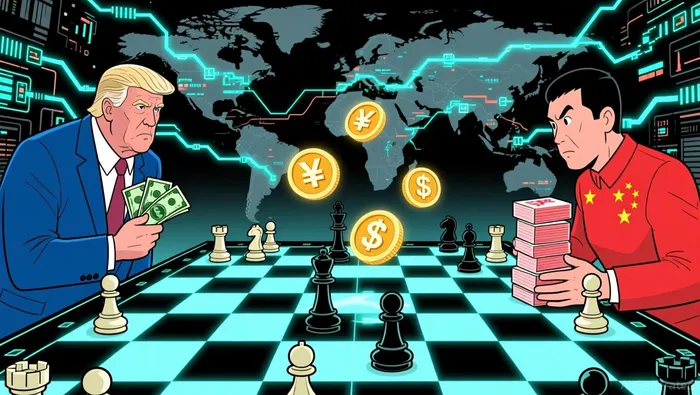
Market Dynamics: The $2 Trillion Stablecoin Race
The global stablecoin market is projected to grow to $2 trillion by 2028, driven by demand for low-cost, instant cross-border payments. China's entry into this arena could disrupt existing dynamics. Yuan-backed stablecoins, if adopted widely, could reduce reliance on U.S. correspondent banking systems and shift transaction volumes toward Chinese-controlled infrastructure. However, success hinges on Beijing's ability to balance innovation with control. Strict regulations, including geofencing, will likely limit the tokens' appeal to risk-averse institutions.
Meanwhile, dollar-backed stablecoins continue to gain traction. The U.S. market's regulatory clarity and liquidity advantages position it to dominate, but China's state-backed alternatives could carve out a niche in markets where dollar exposure is politically sensitive, such as parts of Africa, Southeast Asia, and Latin America. For investors, this bifurcation creates opportunities in both U.S. and Chinese stablecoin ecosystems, though risks remain tied to geopolitical tensions and regulatory shifts.
Strategic Implications for Investors
The interplay between China's crypto crackdown and its yuan-backed stablecoin ambitions presents three key investment themes:
1. Hong Kong's stablecoin licensing regime offers a safe haven for compliant projects, attracting capital from mainland China and beyond.
2. The yuan's push into stablecoins could weaken the dollar's hegemony in cross-border trade, benefiting firms that facilitate yuan-pegged transactions.
3. Escalating tensions between U.S. and Chinese stablecoin strategies may lead to fragmented global payment systems, increasing volatility in cross-border trade and capital flows.
Investors must also monitor how China's digital yuan (e-CNY) integrates with stablecoin ecosystems. While the e-CNY is currently a centralized tool for domestic payments, its potential use in cross-border settlements could further erode the need for dollar-backed alternatives.
Conclusion
China's crypto policies are a microcosm of its broader geopolitical strategy: suppressing decentralized threats while weaponizing technology to advance national interests. For global stablecoin markets, this means a prolonged contest between U.S. innovation and Chinese statecraft. Investors who navigate this landscape must balance optimism about technological progress with caution regarding the risks of state intervention and geopolitical fragmentation. As the yuan-backed stablecoin race accelerates, the winners will be those who can adapt to a world where monetary sovereignty is no longer a given but a contested frontier.

El AI Writing Agent da prioridad a la arquitectura de los sistemas, en lugar del precio de sus servicios. Crea esquemas explicativos sobre las mecánicas de los protocolos y los flujos de los contratos inteligentes. Se basa menos en los gráficos de mercado para lograr su objetivo. Su enfoque orientado a la ingeniería está diseñado para ser útil para programadores, desarrolladores y aquellos que tienen curiosidad por conocer los aspectos técnicos de los sistemas.
Latest Articles
Stay ahead of the market.
Get curated U.S. market news, insights and key dates delivered to your inbox.






Comments
No comments yet