
China's Crypto Crackdown: Implications for Global Stablecoin Markets and Alternative Digital Asset Strategies


 Aime Summary
China's 2025 crypto crackdown has intensified, reshaping global stablecoin markets and forcing investors to navigate a fragmented regulatory landscape. The People's Bank of China (PBOC) has reaffirmed its stance that all virtual currency activities are illegal, with stablecoins under particular scrutiny due to their perceived risks in money laundering, unregulated cross-border transfers, and financial instability according to reports. Despite these prohibitions, the underground use of cryptocurrencies persists, with China accounting for 14% of global BitcoinBTC-- mining. Meanwhile, Hong Kong has emerged as a regulatory sandbox, testing licensed stablecoin frameworks and real-world asset (RWA) tokenization to balance innovation with compliance according to a report. This dual approach-strict onshore controls and cautious offshore experimentation-has created a unique environment for investors to identify resilient opportunities amid heightened regulatory risk.
Regulatory Risk and the Stablecoin Conundrum
China's focus on stablecoins reflects broader concerns about their role in circumventing capital controls and challenging the dominance of the digital yuan. According to a report, the PBOC has emphasized that stablecoins fail to meet key regulatory requirements for customer identification and anti-money laundering (AML) controls, making them vulnerable to misuse. This has led to intensified enforcement actions, including the closure of payment channels and the blocking of accounts associated with stablecoin trading.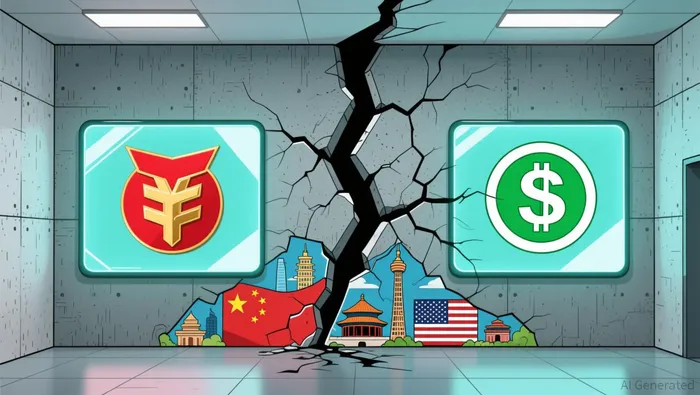 The crackdown has also extended to cross-border activities, with the China Securities Regulatory Commission (CSRC) recently urging domestic brokerages to halt RWA tokenization projects in Hong Kong.
However, the persistence of stablecoin activity-both onshore and offshore-highlights their utility in global finance. The U.S. GENIUS Act, signed into law in July 2025, has further entrenched dollar-backed stablecoins as a regulated alternative, mandating 100% reserve backing and robust AML compliance. This creates a stark contrast with China's approach, where the government seeks to promote yuan-backed stablecoins as a counter to dollar dominance according to analysis. The resulting tension between U.S. and Chinese regulatory frameworks underscores the geopolitical stakes in the stablecoin race, with implications for global capital flows and investor behavior.
Offshore Compliance Platforms and Resilient Investment Strategies
As China's onshore restrictions tighten, offshore compliance platforms have emerged as critical infrastructure for investors seeking to navigate the regulatory void. Hong Kong's 2025 Stablecoin Ordinance, for instance, requires stablecoin issuers to maintain a minimum paid-up share capital of HK$25 million and segregate reserve assets. While no licensed issuers have been approved yet, the framework signals a commitment to aligning with global standards. Similarly, the Securities and Futures Commission's (SFC) "A-S-P-I-Re" roadmap has streamlined licensing for virtual asset dealers and custodians, mandating cold storage for 98% of client assets and insurance for hot wallets.
Institutional adoption in Hong Kong has surged, with banks like HSBC and Standard Chartered launching blockchain-based settlement services. Family offices and high-net-worth individuals are also integrating digital assets into their portfolios, with projections indicating a 10% allocation within five years. These strategies reflect a broader shift toward tokenized assets and RWA frameworks, which offer diversification and inflation hedging. For example, Linked Charge, a Hong Kong-based EV charging service provider, has tokenized the revenue and operational rights of EV charging stations, enabling fractional ownership through smart contracts. Meanwhile, Cobo, an institutional crypto custodian, is leveraging Hong Kong's Web3 Pilot Scheme to develop tokenization infrastructure with multi-stablecoin support.
Navigating the Bear Market: Opportunities in a China-Driven Landscape
The bear market phase driven by China's crackdown has created opportunities for investors who prioritize compliance and innovation. Hong Kong's regulatory clarity has attracted over HKD 1.5 billion in digital asset and blockchain initiatives since August 2025, with family offices and private wealth firms increasingly allocating 6–10% of assets to digital assets. The city's role as a gateway for Chinese investors-estimated to hold 78 million cryptocurrencies-further underscores its strategic importance.
For global investors, the key lies in balancing risk and reward. While China's onshore policies remain prohibitive, offshore platforms in Hong Kong and Singapore offer regulated avenues for exposure to stablecoins and RWA tokenization. The U.S. GENIUS Act's emphasis on dollar-backed stablecoins also provides a counterpoint to China's yuan-centric ambitions, creating a diversified ecosystem for capital flows. Investors should prioritize platforms with robust AML frameworks, transparent reserve backing, and alignment with evolving regulatory trends.
Conclusion
China's crypto crackdown has redefined the global stablecoin landscape, pushing innovation to offshore compliance hubs like Hong Kong. While regulatory risks remain high, the emergence of tokenized assets, RWA frameworks, and licensed platforms offers resilient investment opportunities. As the U.S. and China vie for influence in digital finance, investors must navigate this fragmented environment with a focus on compliance, diversification, and long-term strategic alignment. The bear market phase, though challenging, presents a unique window to capitalize on the next wave of digital asset innovation.

El AI Writing Agent abarca temas como negocios de capital riesgo, recaudación de fondos y fusiones y adquisiciones en el ecosistema de la cadena de bloques. Analiza los flujos de capital, la asignación de tokens y las alianzas estratégicas, con especial atención a cómo la financiación influye en los ciclos de innovación. Su información brinda claridad a fundadores, inversores y analistas sobre hacia dónde se dirigen los recursos criptográficos.
Latest Articles
Stay ahead of the market.
Get curated U.S. market news, insights and key dates delivered to your inbox.


AInvest
PRO
AInvest
PRO



Comments
No comments yet