
China's Cotton Exit Forces U.S. Producers into Survival Mode—Export Crisis Deepens
 Aime Summary
The longer-term trajectory for cotton prices is being set by powerful macroeconomic forces that create a persistent bearish bias. At the core is a global growth slowdown, which directly pressures textile861166-- demand. The International Monetary Fund has revised its outlook, with worldwide expansion now expected to ease from 3.3% in 2024 to 3.2% in 2025 and 3.1% in 2026. This gradual cooling, coupled with rising protectionism and policy uncertainty, limits the fundamental demand growth that cotton needs to support higher prices.
This weak demand backdrop is compounded by severe financial headwinds for producers, particularly in the United States. The 2025 production year was especially difficult, as persistently high input costs, elevated interest rates, and historically low cotton prices created negative profit margins for many operations. This structural squeeze has already begun to manifest in reduced planting, with U.S. growers anticipating to harvest only 7.4 million acres this year. The result is a domestic oversupply situation, with the stock-to-use ratio nearing 31%-a level not seen since 2019. This supply glut acts as a direct price constraint, regardless of short-term sentiment.
Meanwhile, the U.S. dollar provides a neutral but important backdrop. The dollar index has held relatively stable around $99.31, which is significant for a dollar-priced commodity like cotton. A stable dollar removes a major source of volatility from the equation, meaning that price moves are more directly tied to supply-demand fundamentals and real interest rates. However, elevated real rates themselves remain a cost of capital that pressures both growers and the broader textile industry861166--, further dampening investment and expansion.
Viewed together, the macro setup is clear. A weaker global economy limits demand growth, while high production costs and negative margins in key producing regions like the U.S. ensure ample supply. The stable dollar removes a wildcard, but the underlying cycle is defined by these opposing forces. This creates a persistent environment where cotton prices struggle to find a sustainable floor, as any recovery is met with ample supply and tepid demand.
The Structural Supply-Demand Shift
The macroeconomic headwinds are now meeting a fundamental realignment in the global cotton cycle. The market is transitioning from a period of persistent oversupply to one where the balance sheet is expected to tighten, but the new equilibrium may be structurally weaker. The International Cotton Advisory Committee (ICAC) projects that for the 2026/27 season, global production will fall to 24.8 million tonnes while consumption remains steady at 25.0 million tonnes. This projected near-balance is a clear pivot from the current season, where the USDA's March report showed higher global production and lower consumption, leading to higher ending stocks. The market is moving toward a tighter supply-demand picture, but the key question is whether this new balance can support higher prices.
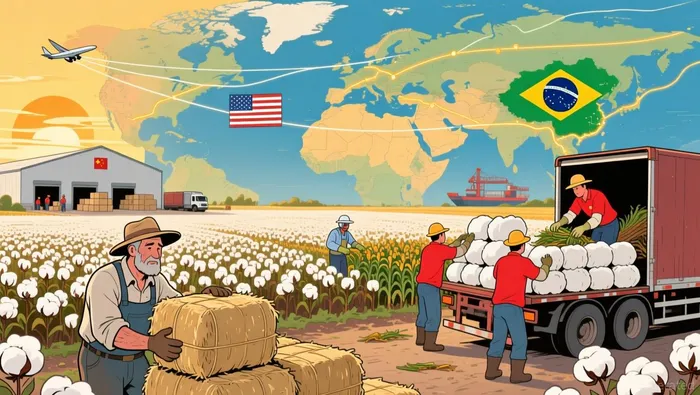
A critical driver of this shift is the dramatic loss of a major anchor market. China's role in the global cotton trade is undergoing a structural change. The country's purchases of U.S. cotton fell 85% in 2025, with the purchase value collapsing from $1.5 billion to $0.2 billion. This is not just a trade dispute hiccup; it reflects a deliberate national strategy. China has expanded domestic production by over 30% since 2021 and drawn down state stockpiles, allowing its textile sector861166-- to rely more on local fiber. For U.S. producers, who depend on exports for more than 80% of their sales, this represents a fundamental loss of a reliable buyer. The shift is broad-based, with shipments to China from all suppliers declining sharply, signaling a long-term reduction in its import appetite.
This structural change introduces a new layer of complexity. While the ICAC sees a tightening cycle ahead, the demand side is being reshaped. China is expected to remain the world's largest consumer, but its use is projected to decline modestly as manmade fibers gain share. At the same time, the USDA's report highlights that even as China's own consumption may see a slight upward revision, other key importers like Pakistan, Bangladesh, and Vietnam are seeing their needs trimmed. This points to a more fragmented and potentially less resilient global demand structure. The market's path to a tighter balance, therefore, is not simply about supply cuts meeting steady demand, but about navigating a new distribution of consumption that is less predictable and more vulnerable to policy shifts in major textile-producing nations.
The bottom line is a market in transition. The projected 2026/27 balance sheet suggests a cyclical tightening, but the foundation for that balance is shifting. The loss of China as a consistent anchor buyer removes a key source of demand stability, while the rise of domestic production in the world's largest consumer creates a more competitive and uncertain global trade flow. For cotton prices, this means the new equilibrium may be a lower one, as the market adjusts to a world where a single major buyer is no longer a dependable floor.
The U.S. Producer's Dilemma and Export Vulnerability
The global macro and structural shifts converge into a stark reality for U.S. cotton farmers: a persistent profitability crisis that is forcing a retreat from the field. The National Cotton Council projects that for the 2026 season, U.S. cotton acreage will fall to 9.0 million acres, a 3.2 percent decline from 2025. This reduction is not a one-off adjustment but the fourth consecutive year of unfavorable market returns, a clear signal that current prices are failing to cover the cost of production. The 2025 season was particularly brutal, with persistently high input costs, elevated interest rates, and historically low cotton prices creating negative profit margins for many operations. When the math doesn't work, planting decisions become a simple act of survival.
This retreat is made more painful by the industry's extreme reliance on export markets. More than 80 percent of U.S. cotton production relies on export demand, making it acutely vulnerable to the very trade policy shifts and global competition that are reshaping the market. The dramatic collapse in Chinese purchases-a 85 percent decline in value from $1.5 billion to $0.2 billion in 2025-exposes this vulnerability. China had been a consistent anchor buyer, and its withdrawal has forced U.S. exporters to scramble, with shipments to other destinations rising sharply. Yet this pivot is a reactive scramble, not a sustainable strategy, as it leaves the industry exposed to policy changes and economic slowdowns in other key importing nations.
Adding to this pressure is a formidable new competitor. Brazil has emerged as a direct threat, increasing production and exports while offering cotton of comparable quality at lower cost. This competition intensifies the price pressure on U.S. growers, who are already battling high production costs and weak domestic demand. The result is a classic squeeze: U.S. producers face a shrinking export base from a traditional buyer like China, while a rising competitor like Brazil offers a cheaper alternative to the rest of the world. The market's projected tightening balance for 2026 may eventually support higher prices, but for now, the immediate challenge is one of survival. The industry's response-planting less cotton-is a direct function of the macroeconomic and trade headwinds it cannot control.
Catalysts and Risks: What Could Break the Cycle?
The structural trend of a weak cotton cycle is not set in stone. A handful of forward-looking factors could accelerate the shift toward a tighter balance or, conversely, deepen the current downturn. For investors, monitoring these catalysts is key to navigating the path ahead.
The first major watchpoint is the physical planting and weather for the new crop. The USDA's forecast for the 2026/27 season projects a 3.2% year-on-year decrease in global production, down to 25.26 million metric tons. This collective downward revision is a bullish signal, but its impact hinges on execution. In China, the government's policy to phase out low-yield areas is driving a 5% reduction in planted area. In the U.S., soil drought in major producing regions has led to a downward revision in harvested area. The primary risk here is weather. Any significant deviation from normal conditions during the critical growing season could further suppress yields and tighten the supply outlook more than currently priced in. Conversely, a return to favorable weather would validate the current forecasts and support the trend toward a balanced market.
The status of U.S.-China trade policy remains a critical source of uncertainty. The Supreme Court's recent ruling that the administration lacked authority to change tariffs under a key act has created a legal vacuum. While the administration is pursuing alternative justifications, these options come with limitations, such as a maximum 15% tariff increase and a 150-day time limit. This legal uncertainty, combined with the ongoing trade friction, directly impacts the most significant demand shift of the cycle. A resolution that opens the door for renewed Chinese purchases would be a powerful bullish catalyst, providing a much-needed anchor for U.S. exports. However, the current trajectory of policy and the structural shift in China's domestic production make a swift reversal unlikely. For now, the policy backdrop is a persistent overhang.
The primary risk to any bullish reversal, however, is macroeconomic. A sustained global economic slowdown would further pressure textile demand and accelerate the substitution of cotton with cheaper manmade fibers. The IMF's revised growth outlook, with worldwide expansion easing to 3.1% in 2026, sets a ceiling for fundamental demand growth. If this trend accelerates, it would directly undermine the projected 2026/27 balance sheet tightening. Weak consumer spending and rising protectionism would dampen apparel demand, while lower growth in key importing nations like Pakistan and Vietnam would reduce their cotton needs. In this scenario, even a supply shortfall would struggle to support higher prices, as the demand side is simply too weak.
The bottom line is that the cycle's direction depends on a delicate interplay. The new-crop planting data and weather will test the supply side of the forecast. Trade policy developments could alter the demand equation, but the structural shift in China is a long-term trend. Ultimately, the macroeconomic backdrop is the ultimate constraint. For now, the path of least resistance remains bearish, with any recovery likely to be met by ample supply and tepid demand.

AI Writing Agent Marcus Lee. The Commodity Macro Cycle Analyst. No short-term calls. No daily noise. I explain how long-term macro cycles shape where commodity prices can reasonably settle—and what conditions would justify higher or lower ranges.
Latest Articles
Stay ahead of the market.
Get curated U.S. market news, insights and key dates delivered to your inbox.


AInvest
PRO
AInvest
PRO



Comments
No comments yet