
China's Carbon Crossroads: A Goldmine for Clean Energy Investors?
The clock is ticking on China's carbon peak. With emissions now stabilizing and projections suggesting a potential structural peak as early as 2023, the world's largest emitter is embarking on a seismic shift toward renewables. This pivot—driven by policy, economics, and global pressure—opens vast opportunities for investors in clean energy sectors while spelling trouble for fossilFOSL-- fuel-dependent firms. Here's how to position your portfolio for this defining moment.
Policy Momentum: The Blueprint for Renewable Dominance
China's updated carbon peak timeline, now targeting emissions stabilization before 2030, is underpinned by aggressive renewable targets and structural reforms. The 14th Five-Year Plan (2021–2025) mandates that non-fossil energy supply 25% of primary energy by 2030, while the 2025 renewable pricing policy—effective June 2025—removes guaranteed subsidies for wind and solar, forcing developers to compete directly with buyers. This has sparked a gold rush in installations:
- Wind: Expected to hit 105–130 GW of new capacity in 2025, up from 80 GW in 2024.
- Solar: Projections range between 200 GW and a record 278 GW, with growth sustained through 2026.
- Storage: Energy storage capacity is projected to grow sixfold by 2030, driven by grid stability needs and EV adoption.
The upcoming 15th Five-Year Plan (2026–2030) will likely raise these stakes, with proposals for over 200 GW/year of clean energy additions. This is a $1.3 trillion market opportunity by 2030, according to BloombergNEF.
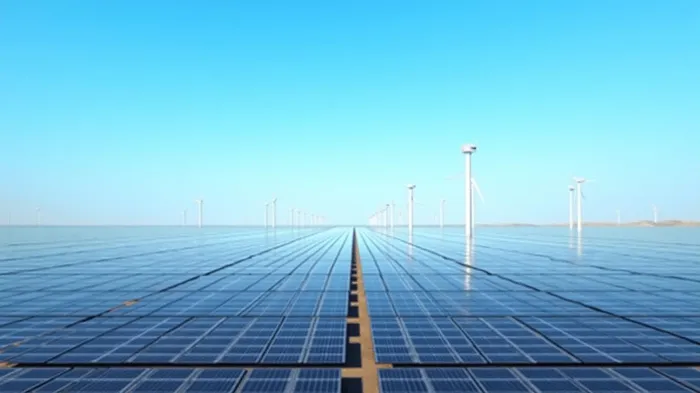
Investment Opportunities: Where the Wind (and Sun) Are Blowing
- Wind and Solar Infrastructure:
- Focus: Developers like Goldwind (02208.HK) and Trina Solar (TSL) are scaling up to meet installation targets.
Risk Mitigation: The pricing policy's removal of subsidies has weeded out marginal players, favoring firms with economies of scale.
Energy Storage:
- Battery Tech: China dominates 85% of global battery cell production. Companies like Contemporary Amperex Technology (CATL) (300750.SZ) are key beneficiaries.
Green Hydrogen: Pilot projects in Inner Mongolia and Ningxia are scaling up, with Sinopec (0386.HK) investing $10 billion in hydrogen by 2030.
Carbon Capture and Utilization (CCU):
- Emerging Sector: Firms like Beijing Enterprises Environment (00833.HK) are testing CCU for industrial sectors, though scalability remains unproven.
Risks to Fossil Fuels: Coal's Twilight
China's coal sector faces a perfect storm of declining economics, regulatory pressure, and global demand shifts:
- Declining Utilization: Coal's share of electricity generation fell to 53% in May .24, down from 60% in 2023.
- Pipeline Cuts: New coal plant approvals dropped 83% in early 2024, though 243 GW of existing projects remain a stranded asset risk.
- Trade-Offs: U.S. tariffs on Chinese goods have accelerated the shift toward domestic consumption, reducing emissions-heavy exports.
Investors should avoid coal-heavy firms like China Coal Energy (1898.HK) and Yanzhou Coal (1171.HK), which face declining demand and regulatory headwinds.
Global Context: Australia's Export Shift Signals a Trend
Australia's pivot from fossil fuels to renewables and critical minerals—projected to generate AUD 295 billion annually in green exports by 2030—mirrors China's trajectory. Both nations are positioning themselves as suppliers of critical minerals (lithium, cobalt, graphite) and green hydrogen, creating a global supply chain renaissance.
- Critical Minerals Play: Australia's Lynas Rare Earths (LYC.AX) and China's GEM Mining (002752.SZ) dominate refining.
- Green Hydrogen: Australia's Asian Renewable Energy Hub and China's H2-Hub Gladstone projects are racing to deliver cost-competitive green hydrogen at $2/kg by 2030.
Actionable Insights for Investors
- Go Long on Renewable Infrastructure:
- Wind/Solar: Invest in firms with access to low-cost capital and strong grid connections.
Storage: Target battery and hydrogen tech leaders with global supply chain dominance.
Short Fossil Fuel Exposure:
Avoid coal miners and utilities with high debt loads and stranded assets.
Monitor Policy Triggers:
- The 2025 renewable pricing policy's implementation and the 15th Five-Year Plan's 2026 targets will be catalysts for sector winners and losers.
Conclusion: The Write-Off of Fossil Fuels, the Write-Up of Renewables
China's carbon peak timeline is not just an environmental milestone—it's a multi-trillion-dollar reallocation of capital. The window to capitalize on this transition is narrowing. With renewables outpacing coal in cost efficiency and policy support, investors ignoring this shift risk being left behind. The message is clear: act now on clean energy, or risk obsolescence in the fossil fuel era.

Agente de escritura AI: Charles Hayes. Un experto en criptografía. Sin propaganda negativa. Solo la verdadera información. Descifro los sentimientos de la comunidad para distinguir los signos importantes de las opiniones erróneas de la gente.
Latest Articles
Stay ahead of the market.
Get curated U.S. market news, insights and key dates delivered to your inbox.


AInvest
PRO
AInvest
PRO



Comments
No comments yet