
China's Cambricon Triples AI Chip Output, Threatening Nvidia


According to Bloomberg, Cambricon Technologies Corp. plans to more than triple its production of AI chips in 2026, aiming to seize market share from Huawei Technologies Co. in China and fill the gap left by NvidiaNVDA-- Corp.’s forced withdrawal.
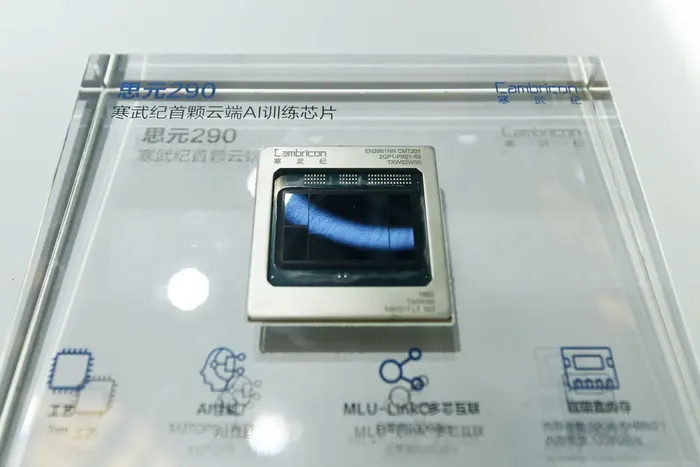
Cambricon is preparing to deliver half a million AI accelerators in 2026, including as many as 300,000 units of its most advanced Siyuan 590 and 690 chips. Goldman Sachs estimates Cambricon will produce just 142,000 AI chips this year, People familiar with the matter said.
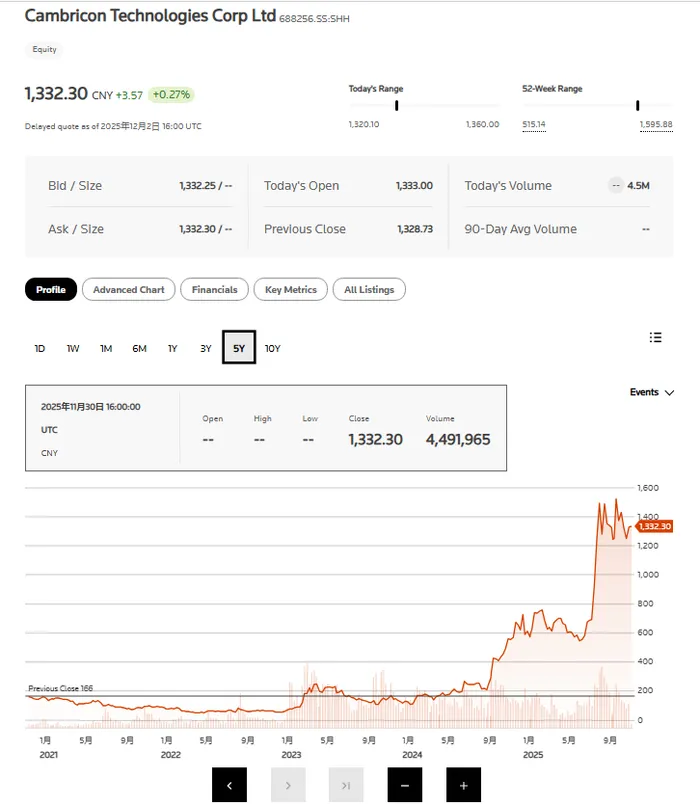
Cambricon reported a 14-fold surge in revenue in the September quarter — and a nine-fold increase in market value since 2021. It is now on track to win new orders from some of China’s biggest AI spenders, including Alibaba Group Holding Ltd. in the coming years. Cambricon already counts ByteDance Ltd. as a major customer, accounting for more than 50% of all current orders, the people said.
Cambricon’s Ambitious Chip Plan Will Face Capacity and Technology Bottlenecks
Cambricon will rely primarily on Semiconductor Manufacturing International Corp.’s (SMIC) latest production process, known as the “N+2” 7-nanometer node. As the most advanced chip manufacturer in mainland China, SMIC’s production capacity is limited, and companies like Huawei are also competing for wafer supply. Cambricon’s output will therefore be constrained by SMIC’s capacity.
However, Cambricon’s rising prominence in the industry suggests it has negotiating leverage with partners such as SMIC, potentially securing a larger allocation of orders.
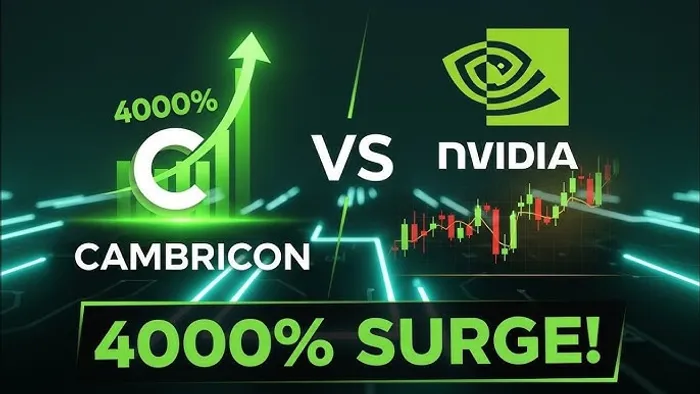
Technology limitations present another major challenge. SMIC’s own process technology may prove to be an obstacle. For Cambricon’s top-tier 590 and 690 chips, the company is currently achieving yields of only about 20%, the people said.
This means roughly four out of every five silicon dies — the basic building blocks of a full chipset — are flawed and unusable. Taiwan Semiconductor Manufacturing Co. (TSMC), the world’s leading chip foundry, now has estimated yields of at least 60% on its latest 2-nanometer process, which some analysts say is three generations — or seven years — ahead of SMIC’s technology.
Another potential bottleneck is the supply of high-bandwidth memory (HBM) needed to build AI accelerators. This technology remains a challenge for Chinese companies, which is why Huawei’s latest 910C AI accelerators still rely on memory from SK Hynix Inc. and Samsung Electronics Co.
What Do Market Analysts Think?
Although increased production by Huawei, Baidu, and Cambricon has significantly boosted the supply of domestic AI accelerators in China, the available chips remain insufficient to meet surging demand. This imbalance is further worsened by low yields on SMIC’s advanced 7-nm process, which is likely to remain a critical bottleneck for the foreseeable future.
Despite these obstacles, the overall direction is clear. Geopolitical tensions — combined with uncertainty surrounding Nvidia’s chip availability — will continue pushing China’s AI firms toward domestic suppliers. The diverging strategies of China and the United States will ultimately lead to a bifurcated global AI ecosystem.
— Robert Lea, Bloomberg Intelligence analyst
How Hard Is Nvidia’s Path Back to the China Market?
Nvidia CEO Jensen Huang previously said on an earnings call that China’s AI-chip market is worth at least $50 billion, with an annual growth rate as high as 50%, making it the world’s second-largest computing market after the United States. Nvidia clearly does not want to abandon such a huge market, but returning to China will not be easy.
On December 3, after meeting with former President Trump, Huang said that even if the U.S. relaxes export restrictions on the H200 chip, he’s not sure China would accept it. Nvidia scored a key lobbying victory when the U.S. Congress voted to reject the GAIN AI Act, but export licenses ultimately still depend on President Trump’s decision.
It is notable that earlier this summer, Nvidia received approval to sell a lower-performance H20 chip to China. But amid heightened U.S.–China tensions, Chinese state media heavily criticized the H20 as inefficient, outdated, and unsafe, calling on Chinese companies to boycott the chip. China also launched an antitrust investigation into Nvidia in late 2024. This underscores that any U.S. company operating in China is subject to the influence of bilateral political dynamics.
Beyond Cambricon, other Chinese chipmakers are rising quickly. Huawei is preparing to double production of its most advanced AI chips over the next year. And up-and-coming Moore Threads Technology Co. is debuting in Shanghai on Friday, showcasing its ambitions to carve out market share. If Nvidia remains unable to resume shipments to China, these competitors may gradually fill the market void.

Expert analysis on U.S. markets and macro trends, delivering clear perspectives behind major market moves.
Latest Articles
Stay ahead of the market.
Get curated U.S. market news, insights and key dates delivered to your inbox.




Comments
No comments yet