
Will China’s Bull Market Extend Into 2026? Smart Money Is Already Positioning
 Aime Summary
The hard truths about building wealth👇
As 2025 draws to a close, the MSCIMSCI-- China Index has performed strongly this year, delivering gains that surpassed the U.S., Europe, and Japan.
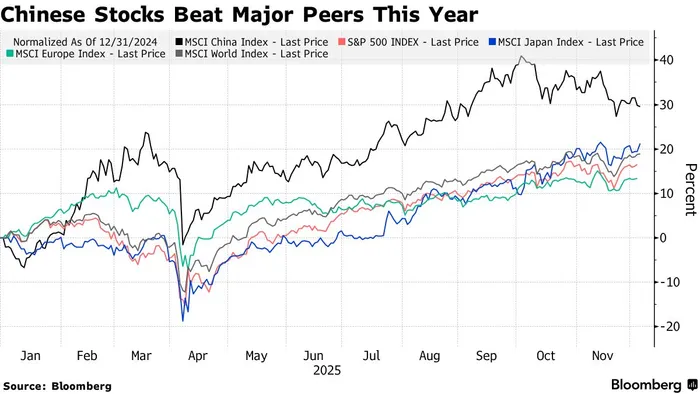
Looking ahead to 2026, many global institutions expect China’s bull market to continue. JPMorganJPM-- recently upgraded its view on Chinese equities, while BNP Paribas, Fidelity International, and Amundi SA have all expressed support. With concerns over stretched U.S. equity valuations lingering, investors are increasingly seeking diversification—and China stands out as one of the most attractive destinations.
China’s economy has shown greater resilience while offering diversified exposure and technological innovation. “For now, I am more inclined to buy Chinese assets on dips,” said George Efstathopoulos, Portfolio Manager at Fidelity International.
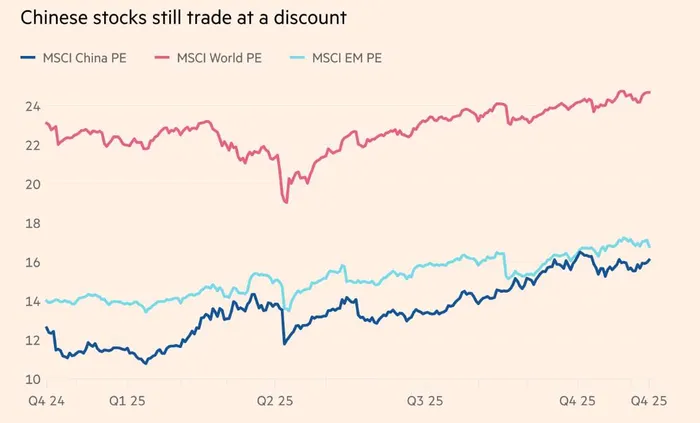
Jonathan Pines, Head of Asia at Federated HermesFHI--, noted, “In certain technology segments, China is the only real competitor to the United States. And Chinese equities trade at a significant discount to other regions, making valuations highly compelling.”
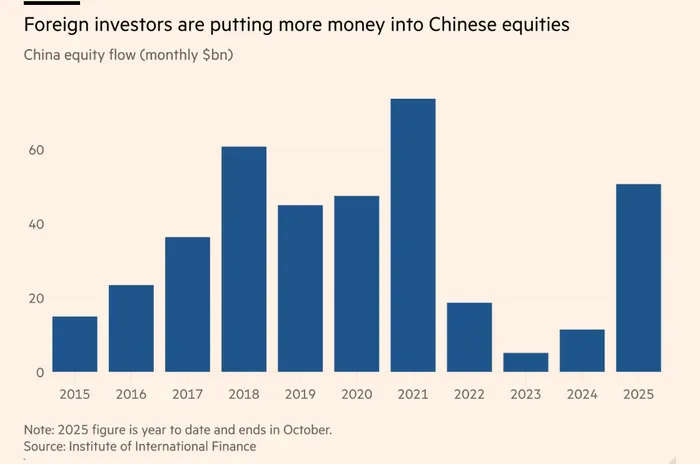
More importantly, foreign investors are backing their views with real capital. According to the Institute of International Finance (IIF), offshore inflows into China’s stock market (excluding U.S.-listed ADRs) reached US$50.6 billion from January to October this year—nearly five times the US$11.4 billion recorded in all of 2024.
Morgan Stanley data shows that as of November, long-term foreign funds (mainly ETFs) had purchased about US$10 billion worth of A-shares and Hong Kong equities, compared to a net outflow of US$17 billion in 2024. Citi noted that since the reciprocal tariff day in April, 55% of its clients have been net buyers of Chinese equities.
Andrew Swan, Head of Asia Equities at Man Group, said: “If reflation is China’s next phase, it contains tremendous opportunity.” Although foreign active funds have still recorded a net outflow of US$15 billion this year, improving confidence suggests a potential reversal into net inflows next year.
However, after a strong rally this year, expectations for next year’s returns should be moderated. Nomura forecasts a 9% rise in the MSCI China Index in 2026, while Morgan StanleyMS-- expects a 6% gain.
Besides foreign buying, the reallocation of household savings within China has also been a major driver of market strength. With deposit interest rates falling and the property market remaining sluggish, the stock market has become the only viable avenue for seeking returns.

Senior Research Analyst at Ainvest, formerly with Tiger Brokers for two years. Over 10 years of U.S. stock trading experience and 8 years in Futures and Forex. Graduate of University of South Wales.
Latest Articles
Stay ahead of the market.
Get curated U.S. market news, insights and key dates delivered to your inbox.
AInvest
PRO
AInvest
PRO



Comments
No comments yet