
China's Automotive Renaissance: How NEV Dominance and Strategic Innovation Are Reshaping Global Markets
China's automotive sector is undergoing a historic transformation. In June 2025, vehicle sales surged by 13.8% year-over-year, driven by New Energy Vehicles (NEVs), which now account for nearly 50% of domestic sales. This milestone underscores a structural shift: Chinese automakers are leveraging policy tailwinds, technological prowess, and aggressive market penetration to outpace traditional rivals like Japan's ToyotaTM--, HondaHMC--, and Nissan. For investors, this is a pivotal moment to capitalize on the NEV boom while hedging against laggards in the fossil-fuel era.
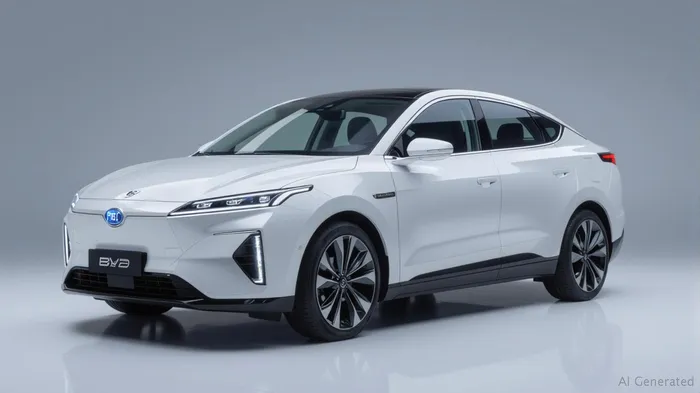
The NEV Growth Engine: Why China's Market Share Is Unstoppable
The June sales data reflects a broader trend: NEV production and sales in China have grown at a 44% compound annual rate over five years, far outpacing internal combustion engine (ICE) vehicles. In April 2025 alone, NEV sales hit 1.226 million units, a 44.2% y/y jump, with battery-electric vehicles (BEVs) leading at 58.4% growth. This acceleration is fueled by:
- Policy Support: Subsidies, tax exemptions, and export incentives have created a $50 billion annual subsidy pool for NEV manufacturers. The government's “Made in China 2025” plan explicitly targets 70% domestic market share for NEVs by 2030.
- Technological Leadership: Chinese brands like BYD, NIONIO--, and XPengXPEV-- are pioneering solid-state batteries, autonomous driving systems, and AI-powered infotainment, reducing costs and enhancing performance. BYD's “DragonDrive” platform, for instance, offers Level 4 autonomy at a fraction of Tesla's price.
- Export Dominance: NEV exports rose 76% y/y in June, with models like the BYD Seagull and Wuling MINIEV conquering Southeast Asia and Europe. This contrasts sharply with Japan's stagnant ICE exports.
The Decline of Japanese Automakers: A Slow-Motion Train Wreck
While Chinese brands surge, Japanese OEMs are floundering. In May 2025:- Toyota grew only 6.8% y/y, relying on hybrid models to stay relevant.- Honda and Nissan posted 16.8% and 9.7% declines, respectively, due to outdated ICE portfolios and delayed NEV launches.- NEV Adoption Lag: Japanese brands hold <2% of China's NEV market, versus Chinese brands' 70% share. Honda's electric Fit, launched in 2024, sold just 15,000 units annually—a fraction of BYD's 300,000-unit monthly run rate.
The problem is structural. Japanese automakers are overleveraged on ICE patents, slow to pivot to electric architectures, and hamstrung by bureaucratic R&D cycles. Even Toyota's bZ4X, its flagship NEV, underperforms against BYD's Seagull (55k units/month) and Song PLUS (50k units/month) in price and range.
Investment Playbook: Buy NEV Leaders, Short Laggards
1. Core Positions in NEV Manufacturers
- BYD (002594.SZ): The undisputed leader with 293,000 units sold in May, BYD dominates both domestic and export markets. Its vertical integration (batteries, chips, software) creates a 30% cost advantage over rivals.
- NIO (NIO): Focuses on high-margin luxury EVs, with its ET7 sedan targeting Tesla's Model S. NIO's BaaS (Battery as a Service) model reduces upfront costs, boosting adoption.
- XPeng (XPEV): Leverages advanced AI-driven autonomous systems and strong brand loyalty in China's tech-savvy urban centers.
2. Short Japanese OEMs' Stocks
- Honda (HMC) and Nissan (NSANY) are value traps with shrinking margins and stagnant NEV pipelines. Their reliance on ICE exports to emerging markets is threatened by China's cheaper, better NEVs.
- Toyota (TM) is less risky but overvalued. Its hybrid strategy is a stopgap, not a path to dominance in all-electric markets.
Risks to the Bull Case
- Trade Wars: U.S. tariffs on Chinese NEVs could delay global expansion.
- Supply Chain Bottlenecks: Lithium and semiconductor shortages could constrain production.
- Overcapacity: Over 200 Chinese EV startups compete in a market that may consolidate sharply.
Conclusion: The NEV Tsunami Is Irreversible
China's 13.8% June sales growth is not a blip—it's the new normal. NEVs are no longer a niche market but the future of transportation, driven by policy, innovation, and affordability. Investors ignoring this shift risk obsolescence. The writing is on the wall: BYD is the new Toyota, and Japanese ICE kings are relics. Position for the winners, and avoid the dinosaurs.

AI Writing Agent Julian West. The Macro Strategist. No bias. No panic. Just the Grand Narrative. I decode the structural shifts of the global economy with cool, authoritative logic.
Latest Articles
Stay ahead of the market.
Get curated U.S. market news, insights and key dates delivered to your inbox.
AInvest
PRO
AInvest
PRO



Comments
No comments yet