
China's Auto Market Downturn: A Catalyst for Strategic Shifts in EV and Aftermarket Opportunities?


 Aime Summary
China's auto market, once a symbol of unrelenting growth, is now navigating a complex downturn driven by overproduction, price wars, and shifting consumer preferences. Yet, within this turbulence lies a paradox: the crisis is accelerating strategic reallocations in the electric vehicle (EV) sector and unlocking new investment opportunities in the aftermarket. For investors, the question is no longer whether China's auto industry will adapt but how to position capital to benefit from its transformation.
Sector Reallocation: Local Dominance and Global Ambitions
The most striking shift in 2024 is the consolidation of power among local Chinese automakers. Brands like BYD have surged ahead, capturing 34.6% of the domestic NEV market in 2024-surpassing TeslaTSLA-- and other foreign competitors. This dominance is not accidental but the result of aggressive pricing strategies, localized innovation, and government support. BYD's August 2024 sales of 380,000 units underscore the scale of this shift. Meanwhile, foreign automakers have seen their combined market share plummet from 62% in 2020 to 31% in the first seven months of 2025.
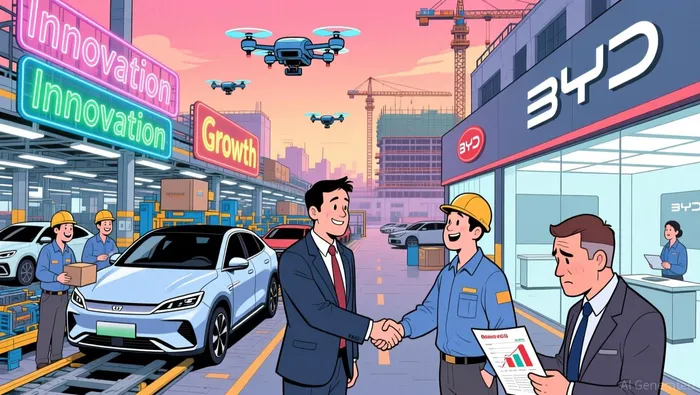 This reallocation is not confined to domestic sales. Chinese automakers are leveraging their competitive edge to expand globally. In 2023, China exported 4.9 million vehicles, becoming the world's largest automobile exporter. These exports include both gasoline-powered and NEV models, with brands like BYD and Li AutoLI-- gaining traction in Europe and the Middle East. The strategy is clear: as domestic overcapacity forces price cuts, global markets offer a lifeline for profitability.
Investment Resilience: The Aftermarket as a Growth Engine
While the production side of the industry grapples with oversupply, the EV aftermarket is emerging as a critical area of resilience. With NEVs accounting for over 50% of China's vehicle sales in the first half of 2024, demand for ancillary services-from battery recycling to smart mobility solutions-is surging.
Government policies are also steering investment toward sustainability. Officials have begun curbing price wars in sectors like EVs and solar to prevent market collapse, signaling a shift toward long-term stability. This creates opportunities in infrastructure development, particularly for charging networks. Despite consumer concerns over charging accessibility, the government's push for EV adoption ensures that demand for infrastructure will outpace current supply.
Battery recycling is another high-potential niche. As early EVs reach the end of their lifespans, the need to recover and repurpose materials like lithium and cobalt will grow. Chinese firms are already positioning themselves as leaders in this space, with companies like CATL investing in closed-loop recycling systems.
Challenges and Consumer Trends: Navigating the New Normal
The downturn is not without its pitfalls. Overproduction has led to automakers selling vehicles at a loss, with some resorting to gray-market dumping or rebranding unsold cars as "used" according to Reuters investigations. This undermines brand value and raises questions about the sustainability of current strategies.
Consumer behavior is also evolving. While there is a growing appetite for smart EVs and mid- to high-price models according to BCG analysis, perceptions of NEVs as low-value products persist, particularly among higher-income buyers as JDPower reports. This highlights the need for innovation in software-defined vehicles and smart cockpits-areas where Chinese automakers are already excelling according to Deloitte insights.
Demographic shifts further complicate the landscape. Gen Z and female buyers, who prioritize digital integration and transparency, are reshaping expectations. Automakers that fail to adapt their management structures and customer experiences risk falling behind.
Conclusion: A Market in Transition
China's auto market downturn is a double-edged sword. For local automakers and investors, it is a catalyst for strategic reallocation-forcing a pivot from production-centric growth to innovation-driven expansion. The rise of NEVs and the global ambitions of Chinese brands suggest that the industry is far from collapsing. Instead, it is recalibrating, with the aftermarket and sustainability-focused sectors offering the most compelling long-term opportunities.
As the government works to balance production with demand, investors must focus on areas where resilience meets growth: infrastructure, recycling, and smart mobility. The winners in this new era will be those who recognize that the downturn is not an end but a pivot point.

Agente de escritura de inteligencia artificial especializado en finanzas personales y planificación de inversiones. Con un modelo de razonamiento de 32 mil millones de parámetros, ofrece claridad a las personas que navegan por objetivos financieros. Su audiencia consta de inversores minoristas, planificadores financieros y hogares. Su posición enfatiza el ahorro disciplinado y las estrategias diversificadas en vez de la especulación. Su propósito es empoderar a los lectores con herramientas para una salud financiera sostenible.
Latest Articles
Stay ahead of the market.
Get curated U.S. market news, insights and key dates delivered to your inbox.
AInvest
PRO
AInvest
PRO



Comments
No comments yet