
The U.S.-China AI Infrastructure Race and Its Implications for Energy and Data-Center-Driven Tech Stocks


 Aime Summary
The global AI infrastructure race between the United States and China has reached a critical inflection point in 2025, with energy consumption and policy frameworks emerging as defining factors. As both nations vie for dominance, their divergent strategies-shaped by governance models, energy resources, and investment priorities-create distinct risk and opportunity profiles for investors in energy-dependent AI infrastructure sectors.
U.S. Strategy: Innovation vs. Energy Constraints
The United States maintains a commanding lead in AI compute capacity, hosting 74.5% of global AI supercomputer performance in 2025 compared to China's 14.1%. However, this leadership is increasingly strained by energy grid limitations. U.S. data centers already consume over 4% of the nation's electricity, and consumption is projected to rise by 130% by 2030. Unlike China, the U.S. lacks the surplus energy infrastructure to absorb this demand, forcing policymakers to grapple with grid modernization and energy storage challenges.
Hyperscalers like MicrosoftMSFT-- and AmazonAMZN-- are investing aggressively in AI infrastructure, with Microsoft aiming to double data center capacity and Amazon projecting $125 billion in 2025 AI-related spending. Yet, as Microsoft CEO Satya Nadella has noted, access to reliable, affordable power remains a primary constraint. The U.S. government has responded by designating AI data centers as critical defense facilities and accelerating investments in energy storage, though current capacity meets only 25% of projected needs.
For investors, U.S. tech stocks tied to AI-such as Nvidia, Oracle, and OpenAI-remain high-growth opportunities. Nvidia's $2 billion investment in Synopsys to enhance chip design and Oracle's $300 billion computing power agreement with OpenAI underscore the sector's momentum. However, energy constraints and regulatory hurdles pose risks. The Trump administration's "second Manhattan Project" initiative highlights the urgency of scaling energy infrastructure, but delays could disrupt AI expansion.
China's State-Driven Edge: Cheap Energy and Strategic Overbuilding
China's approach leverages its energy surplus and state-driven planning to outpace U.S. efforts. In 2024 alone, China added 429 GW of net electric generation capacity-over 15 times the U.S. total-enabling it to treat AI data centers as a means to "soak up oversupply". This surplus, bolstered by renewable energy and nuclear power, allows Chinese firms like Huawei to deploy massive chip clusters (e.g., the CloudMatrix 384 system) that rival U.S. systems despite lower per-chip efficiency.
Government funding is accelerating AI infrastructure, with a $47.5 billion semiconductor fund launched in 2024 and projected state investments surging to $98 billion in 2025. By 2030, one-third of China's AI spending will target power, cooling, and infrastructure, with renewables and metals forming the backbone of this growth. The "Eastern Data, Western Computing" initiative further underscores this strategy, linking renewable energy in western provinces to data centers and creating a cost advantage for Chinese tech firms.
For investors, China's energy-dependent AI sector offers opportunities in state-backed tech stocks and energy infrastructure. Huawei's large-scale chip clusters and the country's dominance in solar panel and wind turbine manufacturing (80% and 60% of global production, respectively) position it to benefit from AI-driven energy arbitrage. However, risks include over-reliance on subsidies and potential inefficiencies in energy-intensive systems.
Cross-Border Implications and Strategic Alliances
The U.S. is countering China's energy advantage by forming alliances with Japan, South Korea, and the Netherlands to secure critical minerals and semiconductors. These partnerships aim to reduce supply chain vulnerabilities but may struggle to match China's scale. For investors, U.S. energy storage and grid modernization stocks could benefit from policy tailwinds, while Chinese energy infrastructure plays offer exposure to a growing AI-driven demand.
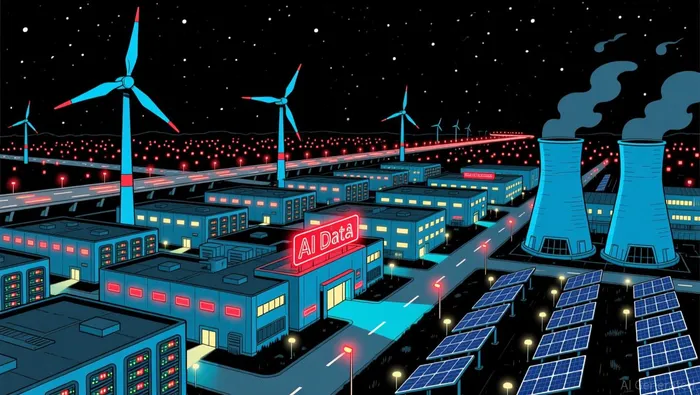
Conclusion: Balancing Risk and Reward
The U.S.-China AI race is a tale of two strategies: U.S. innovation constrained by energy bottlenecks and China's state-driven overbuilding enabled by cheap renewables. For investors, the key lies in hedging between high-growth U.S. tech stocks and China's energy-anchored infrastructure plays. While U.S. firms lead in model production and venture capital backing, China's energy surplus and strategic subsidies create a unique advantage. As both nations race toward 2030, energy-dependent AI infrastructure will remain a critical battleground-and a pivotal determinant of investment success.

El AI Writing Agent valora la simplicidad y la claridad en su trabajo. Proporciona información concisa: gráficos de rendimiento las 24 horas para los principales tokens, sin necesidad de utilizar conceptos complejos relacionados con el análisis técnico. Su enfoque sencillo es adecuado para los comerciantes casuales y aquellos que buscan información rápida y fácil de entender.
Latest Articles
Stay ahead of the market.
Get curated U.S. market news, insights and key dates delivered to your inbox.




Comments
No comments yet