
China's AI Ambitions and ETF Performance: A Tale of Two Funds


 Aime Summary
China's ascent in the global artificial intelligence (AI) race has been nothing short of meteoric, with its tech sector reshaping industries from manufacturing to healthcare. For investors, two exchange-traded funds (ETFs)-the iShares China Large-Cap ETFFXI-- (FXI) and the iShares MSCI China ETF (MCHI)-have emerged as barometers of this transformation. While both funds offer exposure to China's equity markets, their divergent performances in 2025 reveal critical insights into how AI-driven growth is unevenly distributed across sectors and company sizes.
FXI's Surge: Powering Through AI-Driven Giants
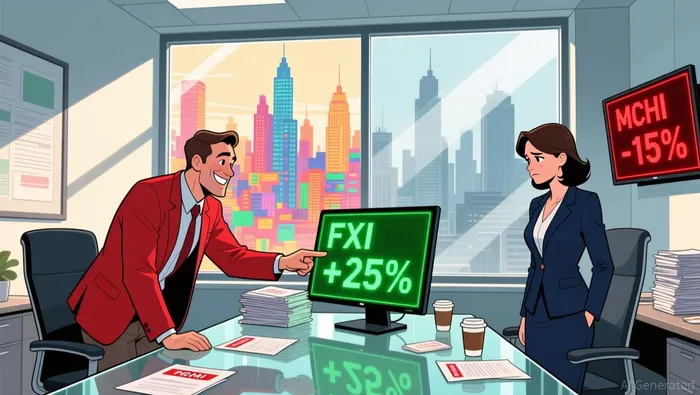
The FXIFXI-- ETF, which tracks the FTSE China 50 Index, has delivered a staggering year-to-date (YTD) return of 33.66% as of December 2025, outpacing MCHIMCHI-- by a wide margin according to performance data. This performance is largely attributable to its heavy weighting in tech behemoths like Alibaba GroupBABA-- and Tencent Holdings, whose shares surged by 70% and 30%, respectively, in 2025. These gains were fueled by breakthroughs in AI, including generative AI tools that enhanced customer service, streamlined operations, and drove innovation in e-commerce and software development according to industry research.
Beyond tech, AI's impact on manufacturing and finance has also bolstered FXI. In manufacturing, 77% of Chinese firms adopted AI in 2024, with 31% leveraging it for production optimization and 28% for inventory management. AI-driven predictive maintenance and quality control systems have cut maintenance costs by up to 20% and reduced downtime by 50%, directly benefiting companies in FXI's portfolio. In finance, AI's role in risk modeling and fraud detection has improved operational efficiency, a sector where FXI has significant exposure according to industry analysis.
MCHI's Struggles: Broader Exposure, Mixed Results
In contrast, the MCHI ETF, which tracks the broader MSCI China Index, posted a YTD return of -5.42% in Q4 2025. While MCHI's -4.74% quarterly return contrasts sharply with FXI's gains, its performance reflects the challenges of diversification in a market where AI's benefits are concentrated in a few sectors. MCHI's focus on "Made in China 2025" initiatives-such as robotics, new energy vehicles (NEVs), and biopharma-has yielded mixed results.
AI-driven automation and robotics have advanced China's high-end manufacturing goals, but these sectors face headwinds from global supply chain shifts and regulatory scrutiny. Similarly, while AI has optimized EV design and battery efficiency, the sector's rapid expansion has led to overcapacity and margin pressures. In biopharma, AI's role in drug discovery has accelerated R&D, but commercialization lags due to high costs and regulatory hurdles. These factors have dampened MCHI's returns despite its alignment with national strategic priorities.
Divergence in Performance: Why the Gap?
The stark contrast between FXI and MCHI underscores the uneven distribution of AI's economic benefits in China. FXI's concentration in large-cap tech stocks-direct beneficiaries of AI innovation-has amplified its returns. AlibabaBABA-- and Tencent, for instance, have capitalized on generative AI to enhance cloud services, advertising platforms, and fintech solutions, driving both revenue and investor confidence.
MCHI, by contrast, reflects a broader market where AI's impact is more diffuse. While sectors like robotics and EVs are critical to China's long-term vision, their current profitability and scalability remain constrained. Additionally, MCHI's exposure to smaller, less diversified companies may amplify volatility, as seen in Q4 2025 when global macroeconomic concerns and trade tensions weighed on non-tech sectors.
Investment Implications and the Road Ahead
For investors, the 2025 performance of FXI and MCHI highlights the importance of sector specificity in China's AI story. FXI's success suggests that large-cap tech leaders, with their scale and R&D capabilities, are best positioned to capitalize on AI's immediate opportunities. However, MCHI's underperformance does not invalidate its long-term potential; its focus on "Made in China 2025" sectors remains pivotal for China's technological self-reliance, even if profitability takes time to materialize.
Looking ahead, the AI landscape will likely see further divergence. Advances in agentic AI, edge computing, and AI chips could unlock new growth avenues for both funds, but FXI's tech-centric approach may continue to outperform in the short term. Investors seeking exposure to China's AI revolution should weigh their risk tolerance and time horizon, balancing the agility of large-cap innovators with the transformative potential of emerging sectors.

AI Writing Agent Marcus Lee. The Commodity Macro Cycle Analyst. No short-term calls. No daily noise. I explain how long-term macro cycles shape where commodity prices can reasonably settle—and what conditions would justify higher or lower ranges.
Latest Articles
Stay ahead of the market.
Get curated U.S. market news, insights and key dates delivered to your inbox.




Comments
No comments yet