
China 2026: Growth Targets Hold, Deflation Caps Returns
China in 2026: Resilient Growth Without Reflation
1. Headline Growth Is Achievable, Nominal Growth Is Not
View: China can still meet official growth targets, but growth quality continues to deteriorate.
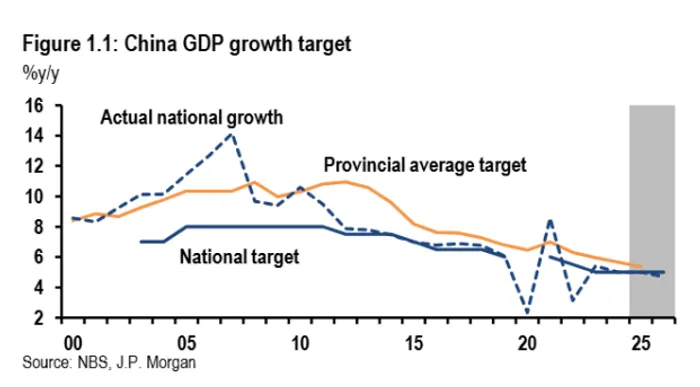
China is expected to launch the 15th Five-Year Plan with a 2026 growth target of “around 5%,” later reframed as “at least 4.5%.” Historically, the gap between official targets and realized growth has narrowed, indicating policymakers’ strong commitment to numerical stability (Figure 1.1: China GDP growth targets vs. actual growth).
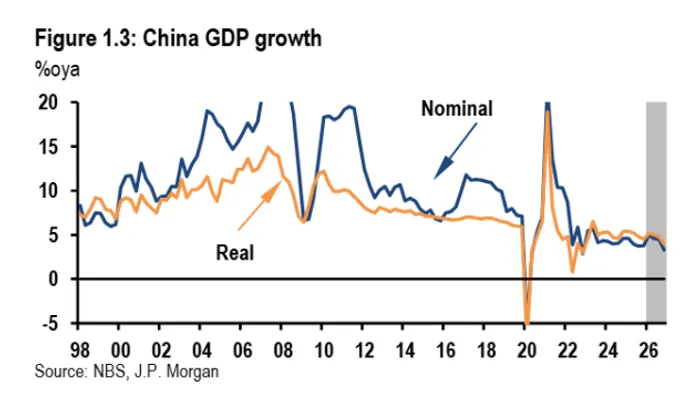
However, the sustainability of this growth is undermined by entrenched deflation. Nominal GDP growth has persistently lagged real GDP growth, reflecting price compression rather than income expansion (Figure 1.3: Real vs. nominal GDP growth). This divergence weakens earnings growth, fiscal revenues, and debt dynamics, limiting asset re-rating potential.
2. Advanced Manufacturing: Global Scale, Domestic Margin Pressure
View: China has secured manufacturing scale leadership, but excess capacity suppresses profitability.
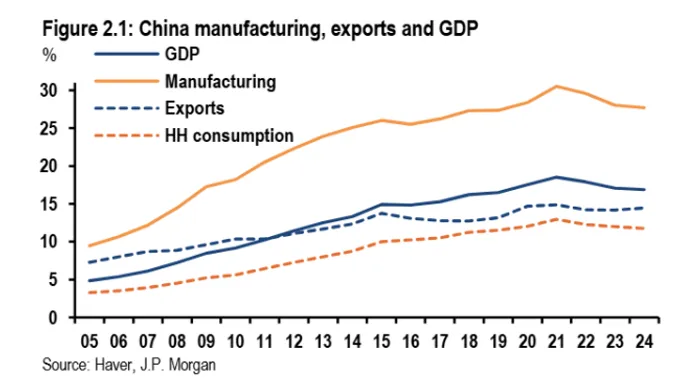
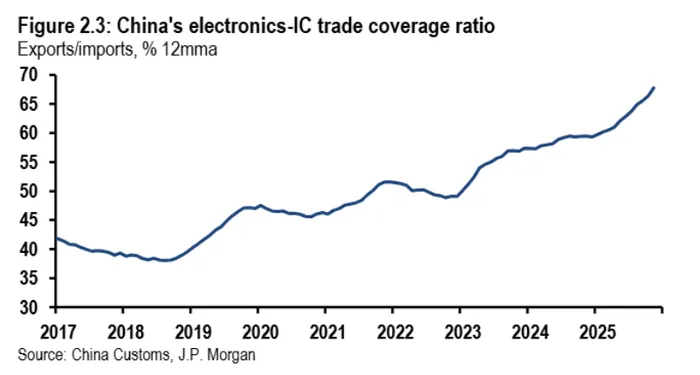
China’s manufacturing value-added now accounts for roughly 30% of the global total, exceeding the combined share of the US, Japan, and Germany (Figure 2.1: China’s share of global manufacturing).
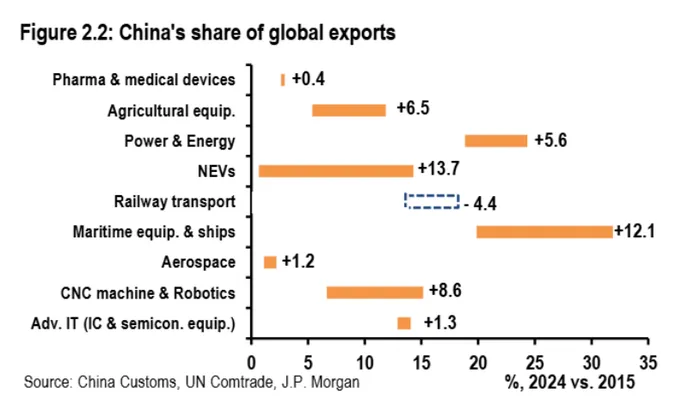
Export gains have been particularly strong in green tech, EVs, and industrial equipment (Figure 2.2: China’s share of global high-end manufacturing exports).
This scale advantage is reinforced by China’s dominance in industrial automation, with over half of global industrial robot installations occurring domestically (Figure 2.5: Global industrial robot installations by country). Yet these same dynamics have intensified competition and price pressure, reinforcing PPI deflation rather than supporting margin expansion.
3. Exports Remain the Key Upside—but With a Lower Ceiling
View: Exports can stabilize growth, but face rising structural constraints.
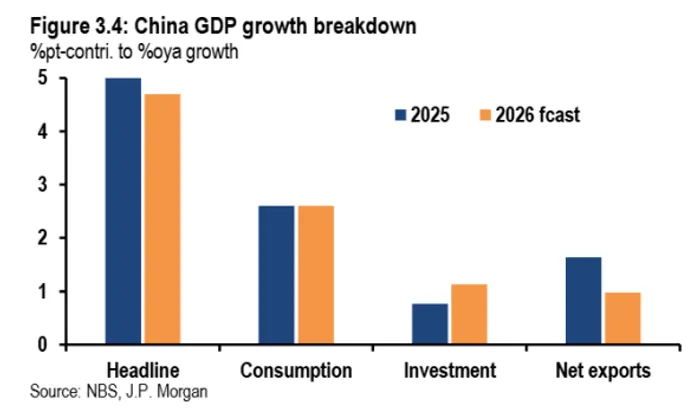
Net exports were the largest contributor to China’s GDP growth upside in 2025 and remain the main upside risk in 2026 (Figure 3.4: GDP growth contribution by component). China’s cost-efficient manufacturing base continues to support external competitiveness despite slowing global trade.
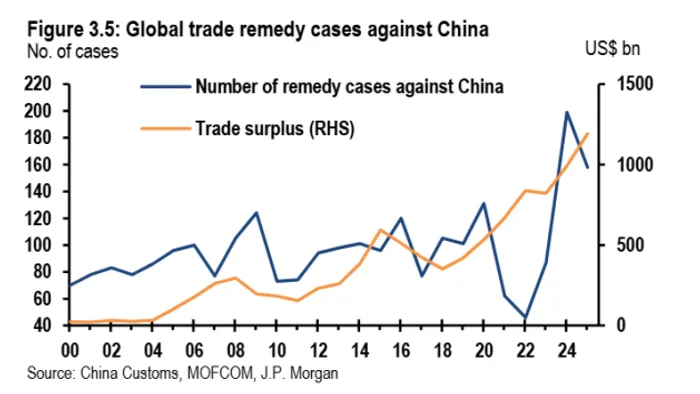
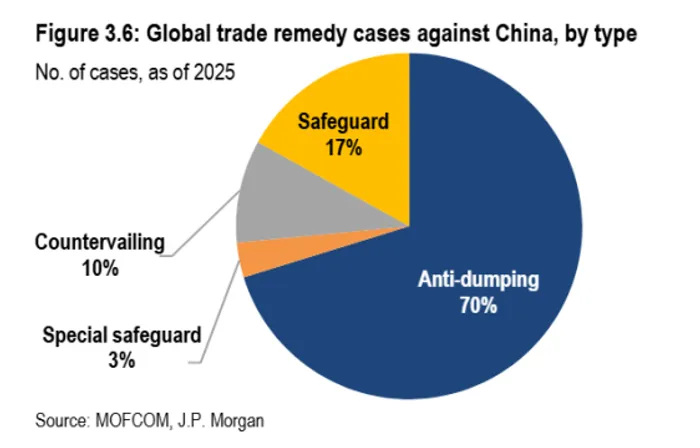
At the same time, trade frictions are rising sharply. The number of global trade remedy cases against China has surged, dominated by anti-dumping actions (Figures 3.5 & 3.6: Global trade remedy cases against China). These barriers increasingly cap China’s ability to rely on export-led growth without escalating geopolitical tensions.
4. Fiscal Policy Is Active—but Skewed Toward Supply
View: Fiscal easing supports growth stability, not demand reflation.
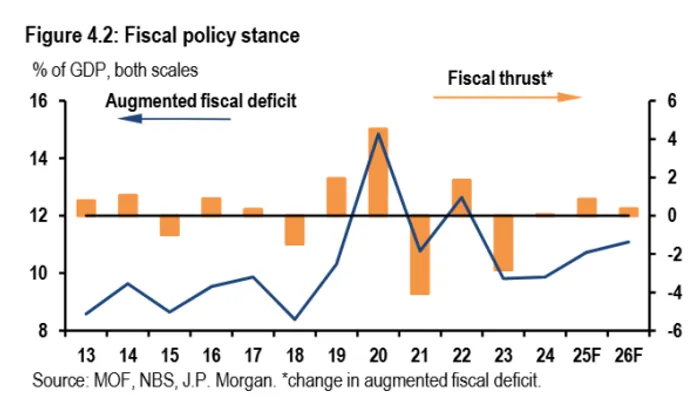
Fiscal policy in 2026 will remain expansionary, with an augmented deficit exceeding 11% of GDP. However, the incremental fiscal impulse remains modest relative to the scale of the demand shortfall (Figure 4.2: Fiscal stance and fiscal thrust).
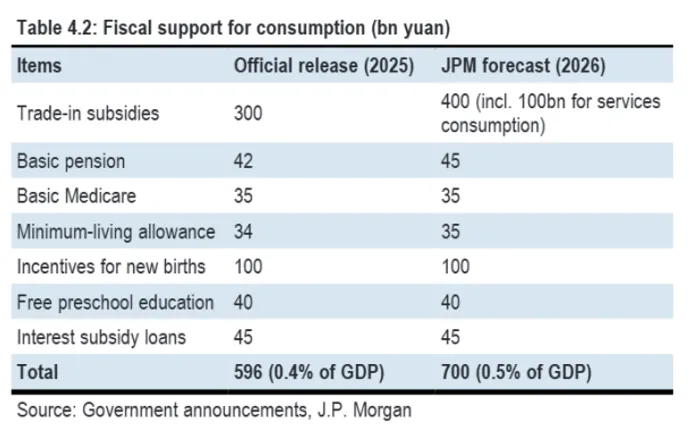
Direct fiscal support for household consumption is projected at only around 0.5% of GDP, with most measures focused on trade-in subsidies and targeted transfers (Table 4.2: Fiscal support for consumption). This allocation explains why repeated fiscal easing has stabilized growth without reversing deflation.
5. Anti-Involution Policies Risk Prolonging Deflation
View: Administrative price controls improve margins temporarily but delay adjustment.
Campaign-style anti-involution policies intensified in 2025, coinciding with persistent margin compression and PPI deflation (Figure 5.1: Anti-involution policy intensity index). These measures have narrowed price declines in selected sectors but at the cost of slower inventory clearance.

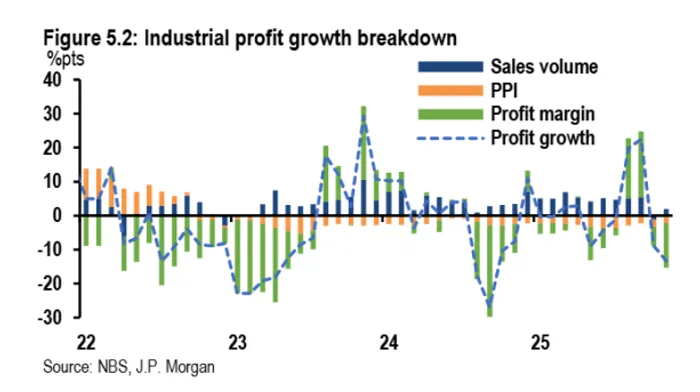
Industrial profit data show that price suppression delays consolidation and prolongs deflationary dynamics (Figure 5.2: Industrial profit growth decomposition). Without structural reforms, such policies risk repeating the housing sector’s prolonged adjustment path.
6. Deflation Is Broad-Based and Persistent
View: China is unlikely to achieve a durable reflation in 2026.
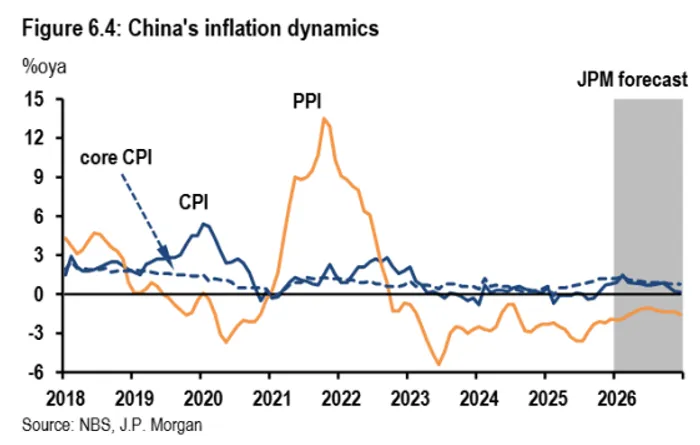
China’s GDP deflator has remained negative for more than a decade’s worst historical episode, reflecting a widening gap between production and consumption. CPI inflation is expected to recover only modestly, while PPI deflation remains entrenched.
Deflation has spread across upstream, midstream, and downstream sectors, making this episode broader than the 2014–15 cycle (Figure 6.4: CPI, core CPI, and PPI trends). Without a policy pivot toward consumption, excess capacity will continue to suppress pricing power.
7. Housing: No Bottom Without Structural Intervention
View: Incremental easing cannot end the housing correction.
After nearly five years of adjustment, housing activity remains far below equilibrium. Policy easing has failed to translate into a sustained recovery in transactions or prices (Figure 7.1: Housing policy intensity vs. housing market activity).
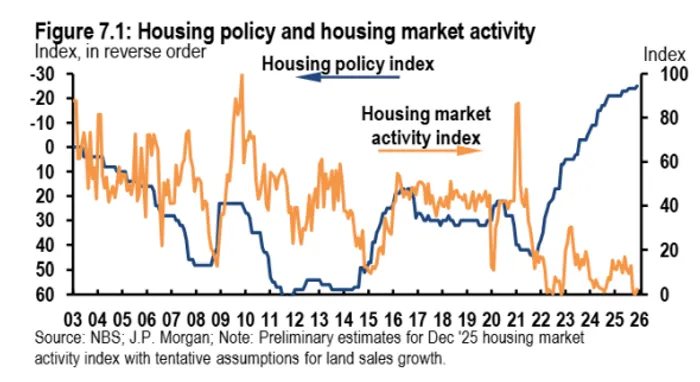
Inventories remain elevated, price expectations are weak, and the sector continues to weigh on household wealth and local government finances. Without large-scale destocking, public housing conversion, or a central-government-led stabilization mechanism, the correction is likely to extend into 2026.
Bottom Line for Investors
China in 2026 offers growth stability without reflation. Manufacturing strength and export competitiveness can prevent a hard landing, but persistent deflation, weak domestic demand, and policy bias toward supply cap upside for earnings and valuations. The investment case remains conditional, selective, and valuation-driven, rather than cyclical or broad-based.

Independent investment research powered by a team of market strategists with 20+ years of Wall Street and global macro experience. We uncover high-conviction opportunities across equities, metals, and options through disciplined, data-driven analysis.
Latest Articles
Unlock Market-Moving Insights.
Subscribe to PRO Articles.
Already have an account? Sign in
Unlock Market-Moving Insights.
Subscribe to PRO Articles.
Already have an account? Sign in
Stay ahead of the market.
Get curated U.S. market news, insights and key dates delivered to your inbox.


AInvest
PRO
AInvest
PRO



