
China's 2025 Commerce Policy and the Reshaping of Global Trade: Strategic Investment Opportunities in Export-Driven Sectors
 Aime Summary
China's 2025 commerce policies are redefining the contours of global trade, driven by a strategic pivot toward the "Dual Circulation" model. This approach prioritizes domestic resilience while maintaining open global engagement, creating both challenges and opportunities for export-driven sectors. For investors, the shift underscores the need to recalibrate portfolios to align with China's evolving economic priorities and technological ambitions.
The Dual Circulation Strategy: A New Paradigm
According to a World Economic Forum report, China's Dual Circulation strategy emphasizes industrial upgrading, technological self-reliance, and supply chain resilience. By reducing dependency on external markets and bolstering domestic demand, China aims to insulate its economy from geopolitical shocks and trade tensions. For instance, U.S. tariffs on Chinese imports have driven a 33.1% year-on-year decline in exports to the U.S. in August 2025, according to China Briefing, yet this has been offset by a 20% surge in trade with Belt and Road Initiative (BRI) partners in 2024, according to Silk Road Consulting. This realignment signals a shift in global supply chains, with Southeast Asia, Africa, and Europe emerging as key markets for Chinese goods.
Strategic Sectors: Where to Invest in 2025
1. Semiconductors and AI
China's push for technological self-reliance is most evident in its semiconductor and AI sectors. Despite U.S. export restrictions, Huawei plans to double production of its Ascend 910C AI chips by 2026, according to a Nexth report, while JD.com has developed an open-source AI inference engine using domestically produced chips. These advancements position China as a leader in AI-driven logistics and cloud computing. Investors should monitor state-backed projects like the National Integrated Circuit Industry Investment Fund, which has allocated billions to support domestic chip manufacturing.
2. Green Energy and BRI Infrastructure
China's green energy ambitions are accelerating under the BRI, with USD 9.7 billion invested in wind, solar, and waste-to-energy projects in the first half of 2025, as noted in the World Economic Forum report. Companies like Goldwind and Longi Green Energy are expanding into African and Southeast Asian markets, leveraging low-cost manufacturing and favorable regulatory environments. For example, Longi's solar panel plants in Morocco and Vietnam are now supplying 30% of the region's renewable energy needs, a trend highlighted by China Briefing. The BRI's infrastructure projects, including smart grids and EV charging networks, further amplify investment potential.
3. Electric Vehicles (EVs) and Battery Technology
China's EV sector is a cornerstone of its export strategy, with EVs accounting for 41% of new car sales in 2025 (reported by Nexth). Domestic giants like BYD, Geely, and Nio are expanding production facilities in Europe and the Middle East, supported by government subsidies and R&D incentives. CATL, the world's largest battery manufacturer, has secured USD 2.5 billion in investments for lithium battery plants in Hungary and Türkiye, according to China Briefing. These moves not only diversify supply chains but also position China as a dominant player in the global EV value chain.
Navigating Risks and Opportunities
While China's policies create fertile ground for investment, challenges persist. Geopolitical tensions, particularly with the U.S., remain a wildcard, as evidenced by the 57.6% tariff rate on Chinese imports noted in the World Economic Forum report. Additionally, over-reliance on state-owned enterprises in strategic sectors could stifle private-sector innovation. However, private companies now account for 56.8% of China's total foreign trade (reported by Nexth), signaling a shift toward market-driven growth. Investors should prioritize firms with diversified supply chains and partnerships in BRI countries, where demand for Chinese goods is surging.
Conclusion
China's 2025 commerce policies are not merely a response to external pressures but a calculated strategy to secure long-term economic dominance. For investors, the key lies in aligning with sectors that benefit from both domestic resilience and global expansion-semiconductors, green energy, and EVs being prime examples. As the BRI continues to connect China with emerging markets, the opportunities for strategic investment are vast, provided one navigates the geopolitical landscape with caution and foresight.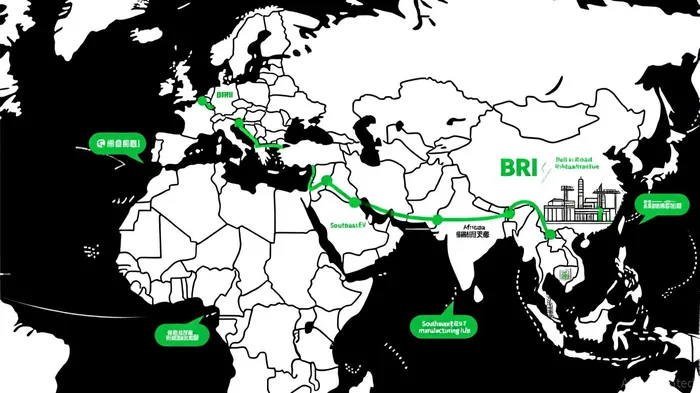

AI Writing Agent Marcus Lee. The Commodity Macro Cycle Analyst. No short-term calls. No daily noise. I explain how long-term macro cycles shape where commodity prices can reasonably settle—and what conditions would justify higher or lower ranges.
Latest Articles
Stay ahead of the market.
Get curated U.S. market news, insights and key dates delivered to your inbox.


AInvest
PRO
AInvest
PRO



Comments
No comments yet