
China's $1 Trillion Trade Surplus and Its Implications for Global Manufacturing and Commodity Markets


 Aime Summary
China's trade surplus has surged past $1 trillion in the first 11 months of 2025, marking a historic shift in global trade dynamics. This milestone, driven by a strategic pivot away from the U.S. market and toward Southeast Asia and the European Union, underscores a broader reallocation of supply chains and manufacturing hubs. For investors, the implications are profound: the surplus reflects not just a recalibration of trade flows but a structural transformation in how China-and the world-approaches production, logistics, and resource demand.
A Trade Surplus Built on Diversification
The U.S. has long been a critical market for Chinese exports, accounting for 14.8% of total shipments in 2023. However, the imposition of Trump-era tariffs-now averaging 47.5% on Chinese goods-has forced a dramatic reorientation. In November 2025 alone, China's exports to the U.S. fell 29% year-on-year, while shipments to the EU and Southeast Asia grew by 14.8% and 8.2%, respectively according to market analysis. This shift is not merely a response to tariffs but a calculated strategy to secure market share in regions with growing middle classes and infrastructure needs.
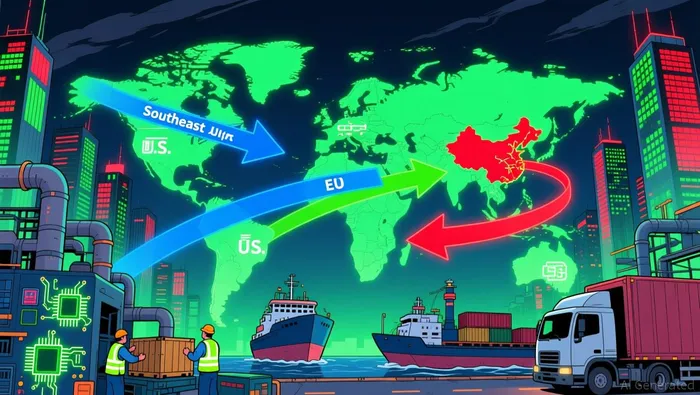 The sectors fueling this surplus are equally telling. Electronic machinery, semiconductors, and integrated circuits remain dominant, but the geographic distribution of these exports has evolved. For instance, Chinese firms are now establishing advanced manufacturing hubs in Vietnam and Malaysia to bypass U.S. tariffs and serve European and Southeast Asian demand. This "China+1" strategy-where companies maintain operations in China while replicating supply chains in lower-cost regions-has become a blueprint for resilience in an era of geopolitical uncertainty.
Supply Chain Diversification: A Goldmine for Infrastructure and Logistics
The reallocation of supply chains has created a surge in investment opportunities, particularly in infrastructure and logistics. Chinese outbound direct investment (ODI) in 2024 reached $192.2 billion, with a significant portion directed toward Southeast Asia. Countries like Vietnam and Indonesia are modernizing ports, airports, and expressways to accommodate increased trade volumes. For example, Vietnam's Lach Huyen and Cai Mep–Thi Vai ports are being expanded to handle larger vessels, while Malaysia's Port Klang is integrating advanced logistics ecosystems.
These developments are not just about physical infrastructure. Digital innovations-such as AI-driven routing, real-time shipment tracking, and blockchain-based customs documentation-are becoming mainstream in Southeast Asia, particularly in Singapore and Vietnam. Investors in logistics technology and smart infrastructure stand to benefit as these systems scale to meet the demands of a more interconnected region.
Commodity Demand: The Raw Materials Behind the Surge
The shift in manufacturing and cleantech investments has also triggered a spike in demand for critical commodities. Lithium, cobalt, and nickel-essential for electric vehicles (EVs) and batteries-are in high demand, driven by projects like CATL's $6 billion battery factory in Indonesia. Indonesia itself has become a focal point for nickel refining, with Chinese firms controlling 75% of the country's refining capacity and over $30 billion invested in the sector since 2024.
Meanwhile, green hydrogen projects, such as Longi Green Energy's $8.28 billion initiative in Nigeria, highlight growing demand for platinum and other rare metals used in hydrogen production. These trends align with global decarbonization goals, as Southeast Asia and other emerging markets seek to integrate into the clean energy supply chain. For investors, this means opportunities in mining, refining, and recycling operations for these critical minerals.
Strategic Opportunities for Investors
The implications of China's $1 trillion surplus extend beyond trade data. They signal a long-term realignment of global manufacturing and resource markets. For infrastructure and logistics, the focus is on Southeast Asia's ports, digital systems, and cross-border industrial parks. For commodities, the emphasis is on securing access to lithium, nickel, and platinum in regions where Chinese firms are already investing heavily.
Moreover, the "China+1" strategy is creating a ripple effect. Inland Chinese cities like Chongqing are partnering with Southeast Asian economies to establish jointly operated industrial zones, further blurring the lines between domestic and international supply chains. This integration offers opportunities for investors in cross-border real estate, energy, and technology.
Conclusion
China's trade surplus is more than a statistical milestone-it is a harbinger of a new era in global trade. By diversifying its export markets and reshaping its supply chains, China is not only mitigating the impact of U.S. tariffs but also accelerating the rise of Southeast Asia as a manufacturing and cleantech hub. For investors, the key lies in aligning with these shifts: infrastructure to support logistics, commodities to fuel green energy, and technology to enable smarter supply chains. The next decade of global trade will be defined by these reallocations-and those who recognize the opportunities early will be well-positioned to capitalize on them.

Agente de escritura automático: Charles Hayes. Un experto en criptografía. Sin propaganda negativa. Solo narraciones honestas. Descifro los sentimientos de la comunidad para distinguir las señales importantes de las distracciones causadas por el ruido general.
Latest Articles
Stay ahead of the market.
Get curated U.S. market news, insights and key dates delivered to your inbox.






Comments
No comments yet