
Chile’s Manufacturing Output Slows to -3.0% YoY
 Aime Summary
Chile’s manufacturing production fell to -3.0% year-over-year, easing from -3.8% in the prior period. - The deceleration suggests ongoing weakness in industrial activity, particularly in construction and formal employment sectors. - Investors care because manufacturing data reflects broader economic momentum, especially in export-oriented economies like Chile. - A key caveat is that the decline in formal job creation and labor force participation may delay policy tightening.
Chile’s manufacturing sector continues to contract, with the latest data showing a -3.0% year-over-year decline in output. This is an improvement from the previous -3.8% print, but still signals ongoing structural challenges in the industrial economy. The data, published at 20:00, aligns with broader signs of economic fragility, including weak job creation and low labor force participation, suggesting that the economy remains below its potential.
Chile's Manufacturing Output Declines to -3.0% YoY, Slowing From -3.8%
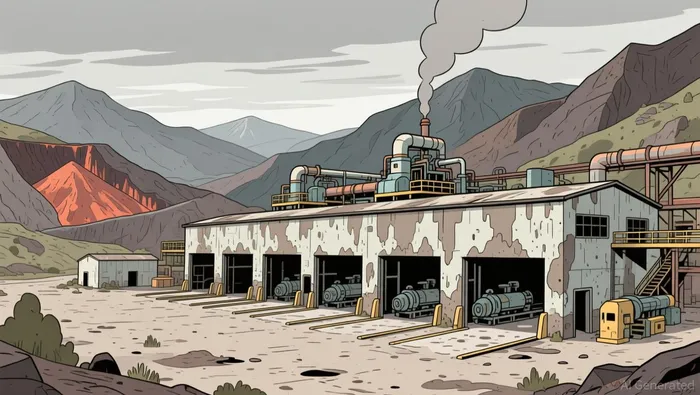
The latest figures from Chile’s manufacturing sector highlight continued stagnation despite the slight easing in the contraction rate. While the -3.0% figure represents an improvement from the previous -3.8% print, it remains well below the levels required to support robust growth. This trend is especially concerning for a country heavily reliant on copper exports and global trade, where industrial activity directly impacts export volumes and economic momentum. The slowdown is particularly evident in labor-intensive sectors like construction, which has seen a marked reduction in formal hiring and output.
Despite these challenges, some companies are still attempting to drive sustainable growth in key economic sectors. For instance, SalmonChile is working with the Undersecretary of Fisheries and Aquaculture to enhance sustainable salmon farming in southern Chile, a vital industry for both economic and environmental resilience. However, these efforts are unlikely to immediately reverse the broader industrial slowdown.
What Does the Drop in Manufacturing Signal for Chile's Economic Outlook?
The decline in manufacturing activity reflects deep-seated structural issues within the Chilean economy, particularly in sectors that traditionally act as growth engines. The slowdown in formal job creation and labor force participation, as reported by the INE, points to a lack of dynamism in the labor market. These factors, combined with a negative output gap estimated by the Central Bank, suggest that Chile’s economy is struggling to meet its potential. As a result, the likelihood of a mid-year interest rate hike appears increasingly remote, even as inflationary pressures build.
This dynamic creates a complex policy environment for the Central Bank of Chile. With weak labor demand and low wage growth, the central bank is unlikely to tighten monetary conditions in the near term, even if inflation trends upward. The economic stability of the country, which has been historically supported by copper exports and a strong banking sector—such as Banco de Crédito e Inversiones (BCI)—is now being tested by domestic structural weaknesses.
Why Are Investors Watching This Indicator Now?
Chile’s manufacturing data is crucial for investors because it offers insight into the overall health of one of Latin America’s most export-dependent economies. The manufacturing sector is a key component of the country’s trade balance, particularly with copper being a major export. As such, any signs of contraction can have downstream effects on global copper markets and Chile’s overall economic performance.
Investors are also closely watching the implications for monetary policy. The Central Bank of Chile has not raised rates in the face of weak economic data, and the recent manufacturing figures reinforce the view that rate hikes are unlikely in the near future. This has broader implications for the currency and bond market, as well as for Chile’s attractiveness to international investors.
In addition, global supply chain issues—such as the closure of the Strait of Hormuz—have created additional pressure on Latin American industries, including Chile’s chemical and petrochemical sectors. These developments underscore the importance of closely tracking Chile’s manufacturing performance as part of a broader macroeconomic analysis of the region.
With the economy still grappling with structural imbalances, investors should continue to monitor manufacturing data for signs of stabilization or further deterioration. Given the interconnected nature of Chile’s economy with global markets, any sustained contraction could have broader implications for trade, inflation, and capital flows across Latin America.

Stay ahead of the market.
Get curated U.S. market news, insights and key dates delivered to your inbox.


AInvest
PRO
AInvest
PRO



Comments
No comments yet