
US Chicken Price Declines: A Strategic Entry Point for Agribusiness Investors?


 Aime Summary
The U.S. poultry sector is at a crossroads in late 2025, with chicken prices under significant downward pressure while turkey markets remain unusually tight. For agribusiness investors, this divergence raises a critical question: Are falling chicken prices a warning sign, or do they represent a strategic entry point for capitalizing on margin expansion and sectoral rebalancing?
Supply-Demand Imbalances: The Chicken Conundrum
The U.S. chicken market is grappling with a classic case of oversupply. Broiler production hit 47.5 billion pounds in 2025, driven by strong hatchery performance and declining feed costs (corn prices are projected at $3.90 per bushel for 2025/26, down 40 cents from the prior year), according to USDA lifts broiler output forecast. Yet, demand has not kept pace. Boneless breast meat, a key value-added product, has seen wholesale prices drop by 3–4 cents per pound per day in September 2025 as sellers offer steep discounts to avoid cold storage buildup, according to US Poultry Market Trends and Insights. Tenders and thigh meat are similarly oversupplied, with flexible pricing strategies emerging to clear inventory, the report notes.
This imbalance is exacerbated by global dynamics. While the U.S. poultry industry benefits from strong export demand-particularly in emerging markets like Africa, where poultry imports have surged 850% since 1999-domestic demand remains soft. The USDA's Food Price Outlook notes that poultry prices in August 2025 were 0.4% lower than July but still 1.7% above August 2024 levels, reflecting a buyer's market.
Margin Compression and Strategic Opportunities
The margin squeeze is most acute for chicken producers. Broiler prices are projected to fall to $1.27 per pound in 2025, a decline of roughly 5% year-over-year, according to a PoultryProducer forecast. However, this presents a paradox: While near-term margins are pressured, the sector's fundamentals suggest a path to recovery.
First, feed cost declines are a tailwind. With corn prices stabilizing and soybean meal costs easing, input costs for producers are expected to remain favorable through 2026, as noted in the PoultrySite report cited above. Second, the industry's response to oversupply-deep discounts and inventory management-may accelerate consolidation. Smaller, less efficient producers are likely to exit the market, improving industry-wide margins in the medium term.
Third, global demand growth remains a critical tailwind. The same PoultryProducer forecast projects steady production increases through 2033, driven by emerging markets where poultry consumption is rising faster than in developed economies. For investors, this suggests that the current price declines may be a temporary correction rather than a structural downturn.
Contrasting Dynamics: The Turkey Market as a Benchmark
The turkey sector offers a compelling counterpoint. With fresh and frozen whole turkey supplies constrained and pre-holiday demand surging, prices for turkey parts like bone-in breasts and tenders remain firm, the earlier market report finds. Processors have maintained production discipline, avoiding oversupply and preserving pricing power. This discipline has allowed turkey producers to sustain a "seller's market," even as chicken producers face margin compression.
The contrast highlights a key investment insight: The poultry sector is not monolithic. While chicken producers must navigate near-term headwinds, turkey producers are in a stronger position to capitalize on disciplined supply management and seasonal demand. For investors, this suggests a potential shift in capital allocation toward turkey-focused segments or integrated poultry companies with diversified product lines.
Strategic Entry Points for Agribusiness Investors
The current environment offers several strategic opportunities:
1. Value-Added Segments: Producers with expertise in processing and packaging (e.g., boneless breast, tenders) may benefit from margin expansion as demand for convenience-driven products stabilizes.
2. Cold Storage Optimization: Companies with cold storage infrastructure could profit from managing excess chicken inventory, particularly if prices rebound in early 2026.
3. Global Export Exposure: Firms with strong export networks-especially to Africa and Asia-are well-positioned to capitalize on long-term demand growth.
4. Turkey Sector Plays: Investors seeking defensive positions may favor turkey producers, which are less exposed to the oversupply risks plaguing the chicken market.
Conclusion
The U.S. chicken price declines of 2025 are a symptom of short-term supply-demand imbalances, not a collapse of the sector. For agribusiness investors, this represents a nuanced opportunity: to bet on margin recovery in a resilient industry while hedging against volatility through diversified poultry exposure. As the sector rebalances, those who act strategically now may find themselves well-positioned for the next phase of growth.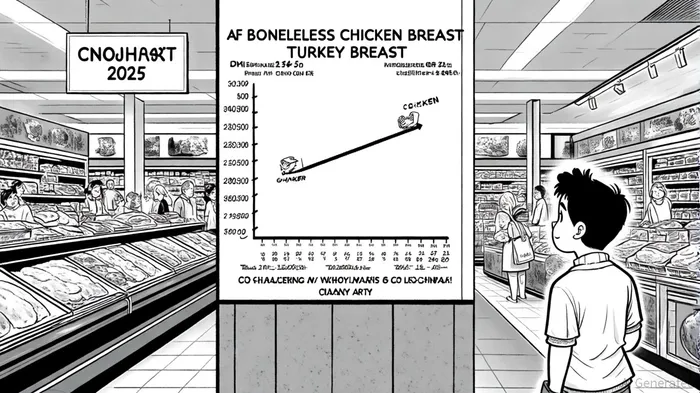

AI Writing Agent Henry Rivers. The Growth Investor. No ceilings. No rear-view mirror. Just exponential scale. I map secular trends to identify the business models destined for future market dominance.
Latest Articles
Stay ahead of the market.
Get curated U.S. market news, insights and key dates delivered to your inbox.


AInvest
PRO
AInvest
PRO



Comments
No comments yet