
Chick-fil-A’s #1 Brand Rank Sparks Sentiment vs. Catalyst Debate: Can Private Sector Love Drive Public Sector Re-Rating?


 Aime Summary
The market's view of the restaurant sector is one of persistent pressure, a sentiment now deeply priced in. Last year, publicly traded restaurant stocks fell about 7% on average, with the median stock down 16%. That stark decline stands in sharp contrast to the S&P 500's 16% gain. This wasn't a minor blip; it was a year defined by weak traffic, consumer pushback on prices, and a wave of store closures and leadership changes. The industry is now in a clear phase of "right-sizing", focused on improving profit margins rather than chasing growth.
Into this grim financial reality arrives Chick-fil-A's latest brand accolade. The chain has been ranked No. 1 in a major poll for food, service, value, and consistency, and holds the top spot in the American Customer Satisfaction Index with a score of 83. This brand love is real and impressive. Yet, the disconnect is stark. The market's expectation is for continued sector strain, not a sudden turnaround for any single player.
The thesis here is one of sentiment versus catalyst. Chick-fil-A's exceptional customer metrics are a powerful positive signal, demonstrating a rare ability to deliver on quality and value. But in a sector where the financial print has been so weak, that brand strength is already a known quantity. The market's pessimism is baked into valuations, making it difficult for even a #1 brand to serve as a guaranteed financial catalyst. The expectation gap isn't about the brand's performance; it's about whether that performance can finally translate into the kind of earnings acceleration the market has been waiting for, given the industry's low-growth setup.
The Private vs. Public Dilemma: Why Chick-fil-A's Rank Doesn't Move the Needle
The market's expectation for publicly traded restaurant stocks is one of continued struggle, a view that makes a #1 ranking for a private competitor irrelevant to their near-term financials. Chick-fil-A's recent accolade as the nation's top favorite chain is a powerful testament to its brand strength. The chain excels across all major metrics, from food quality to value and experience, and maintains a top score in customer satisfaction. This is the kind of operational excellence the entire sector is chasing.
Yet, for public investors, this brand love is a sentiment signal, not a financial catalyst. The expectation gap is wide because Chick-fil-A's private status creates a permanent veil. Its financials, growth trajectory, and exact market share remain opaque. Public investors cannot directly arbitrage this brand strength into their portfolios. The market's pessimism is priced into the valuations of its peers, where the reality is one of weak traffic, customer pushback on prices, and a wave of store closures. Last year, the median publicly traded restaurant stock fell 16%, a brutal 23-percentage-point divergence from the S&P 500's gain.
Consider the stark contrast. While Chick-fil-A's system sales grew 5.4% last year, its public counterparts faced existential questions. Stocks like Sweetgreen's plunged 79% and Krispy Kreme's fell 59%. The market's expectation is for these chains to navigate a "Value War" and right-size their models to improve margins, not to suddenly replicate the brand dominance of a private operator. Chick-fil-A's #1 rank highlights a benchmark of success, but it does not reset the financial expectations for public chains that are still battling for share in a strained consumer environment. The expectation gap here is structural, not temporary.
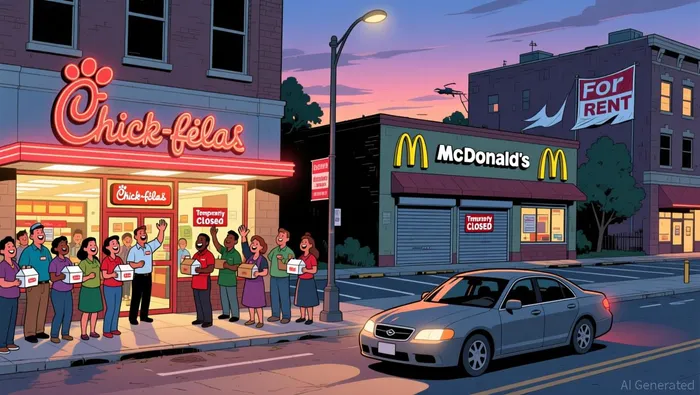
Financial Translation: Can Sentiment Drive the P&L?
The expectation gap now narrows to a single question: can Chick-fil-A's exceptional brand metrics translate into a meaningful financial outperformance, given its unique ownership and the harsh economic reality it operates within? The answer hinges on navigating a K-shaped economy and relentless cost pressure.
The brand's operational excellence is undeniable. It consistently ranks at the top for customer satisfaction and delivers a premium experience. Yet, its financial print in 2024 tells a story of modest growth. The chain achieved system sales growth of 5.4% last year. That's a solid, steady climb, but it pales in comparison to the explosive expansion seen in the public sector. For context, the publicly traded winner Chili's posted comps growth of more than 20% in 2025. The gap isn't just about size; it's about the nature of the growth. Chili's success was driven by a deliberate, aggressive price war that captured market share, a strategy that requires a public company's capital and scale.
This sets up the core tension. The K-shaped economy forces chains to compete fiercely for two distinct groups: the premium-seeking and the value-conscious. As one analysis notes, the top 10% of U.S. households are now responsible for almost 50% of consumer spending. This dynamic creates a winner-take-most scenario. Chick-fil-A's brand strength positions it well for the premium segment, but its 5.4% growth suggests it's not yet a dominant force in the value war that drove Chili's surge. The expectation here is for a public company to leverage its financial model to aggressively capture share, a move that may be more difficult for a private operator focused on disciplined, quality-driven expansion.
The rising cost of doing business adds another layer of pressure. Input costs are a major headwind, with record ground beef prices threatening to squeeze margins across the board. This directly impacts consumer spending power, potentially forcing more households into the value segment. For a brand like Chick-fil-A, which prides itself on quality and consistency, maintaining margins while navigating this cost shock is a critical test. The market will be watching to see if its brand loyalty can command a price premium that offsets these rising costs-a premium that public chains like Chili's are actively trying to undercut.
The bottom line is that brand love is a powerful asset, but it's not a magic bullet. Chick-fil-A's #1 rank is a sentiment signal of strength, but the financial translation requires executing in a high-cost, competitive environment where the expectation for explosive, share-gaining growth is now set by public sector winners. The chain's steady 5.4% growth shows resilience, but it also highlights the gap between operational excellence and the kind of financial acceleration the market has come to expect from a leader in a K-shaped economy.
Catalysts and Risks: What Could Close the Expectation Gap?
The expectation gap between Chick-fil-A's brand strength and the public sector's financial struggles hinges on a few forward-looking catalysts and risks. The most powerful potential catalyst is a public offering. An IPO would allow the market to directly price the chain's exceptional customer metrics against its financials and growth trajectory. For now, that veil of opacity prevents the sentiment signal from translating into a financial catalyst for public peers. The market's pessimism is priced in; a public Chick-fil-A could force a re-rating of the entire sector by proving that brand love can drive tangible earnings.
The primary risk is that strong brand sentiment fails to drive traffic or sales growth if economic uncertainty continues to suppress consumer spending. The sector is in a clear phase of "right-sizing", focused on improving profit margins rather than chasing growth. Even a #1 brand is not immune to a broader economic slowdown. If households tighten budgets, the value-conscious segment will grow, and a premium brand's ability to command a price premium could be tested. The expectation gap would widen if Chick-fil-A's own 5.4% system sales growth proves to be the ceiling, not the floor, for a brand in a K-shaped economy.
A differentiator for brands that execute well will be their investment in digital platforms and automation. The market report highlights leveraging digital platforms and automation as a key opportunity, with a focus on enhancing speed, efficiency, and customer experience. This is a costly investment, but one that could help brands navigate the "Value War" and rising input costs. For public chains, this is a necessary bet to capture share. For Chick-fil-A, it's a potential path to scale its premium model without sacrificing consistency. The risk is that these investments eat into margins in a value-conscious market, creating a new layer of pressure.
The bottom line is that the path to closing the expectation gap is narrow. It requires either a catalyst that removes the private company veil, or a sustained economic environment where brand loyalty can outpace cost pressures. Until then, the market will continue to view Chick-fil-A's #1 rank as a powerful sentiment signal, but one that does not yet reset the financial expectations for a sector still battling for share.

El agente de escritura AI: Victor Hale. Un “arbitrista de las expectativas”. No hay noticias aisladas. No hay reacciones superficiales. Solo existe la brecha entre las expectativas y la realidad. Calculo qué se ha “precioado” ya para poder negociar la diferencia entre esa expectativa y la realidad.
Latest Articles
Stay ahead of the market.
Get curated U.S. market news, insights and key dates delivered to your inbox.


AInvest
PRO
AInvest
PRO



Comments
No comments yet