
Chewy's Q3 Earnings: A Structural Turnaround or Sustainable Growth?


 Aime Summary
Chewy's Q3 2025 earnings report has sparked renewed debate about the durability of its profitability gains. With net sales rising 8.3% year-over-year to $3.12 billion and adjusted EBITDA surging to $180.9 million-a $42.7 million increase from the prior year-the company appears to have navigated a challenging retail environment according to its report. Its net margin of 1.9% and adjusted EBITDA margin of 5.8% reflect a 180 and 50 basis point improvement, respectively according to the report. But are these gains structural, driven by operational discipline and strategic reinvention, or are they temporary, reliant on cyclical demand or margin compression from reinvestment?
Structural Drivers of Margin Expansion
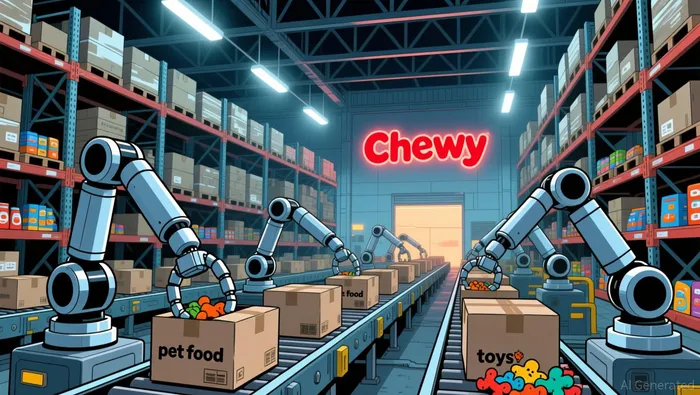
Chewy's margin expansion stems from a mix of cost management, operational efficiency, and product mix optimization. Automation in six fulfillment centers has boosted productivity, reducing labor costs and improving safety. Meanwhile, the company's shift toward premium categories-such as its Get Real fresh dog food line and the acquisition of SmartEquine for high-margin equine health products-has enhanced gross margins according to industry analysis. Sponsored ads and a more disciplined approach to corporate payroll and SG&A expenses have further amplified profitability according to market research.
The Chewy+ membership program and mobile app have also strengthened customer retention, with autoship subscriptions accounting for 79% of sales according to financial data. This recurring revenue model not only stabilizes cash flows but also deepens customer relationships, enabling cross-selling into higher-margin services like veterinary care and pet insurance according to industry insights. Analysts note that these initiatives align with broader industry trends: pet owners increasingly treat pets as family members, driving demand for premiumized, personalized, and tech-enabled solutions according to market research.
Sustainability: Reinvestment vs. Margin Pressures
While Chewy's operational improvements are structural, its long-term margin sustainability hinges on reinvestment and competitive dynamics. The company has raised its 2025 sales guidance to $12.5–12.6 billion, reflecting confidence in category expansion and market share gains. However, analysts caution that reinvestment in new product lines, inventory, and logistics could temper near-term margins. For instance, elevated operating expenses and pricing pressures from rivals like Amazon and Walmart-both of which are expanding their pet care offerings-pose risks according to industry analysis.
Free cash flow, a critical metric for sustainability, has shown promise. Chewy's latest twelve-month free cash flow stands at $447 million, with projections of $1.23 billion by 2030 according to financial projections. Yet, its current valuation-trading at a forward PE ratio of 95.0x, well above the industry average of 20.0x-suggests investor optimism may outpace near-term fundamentals according to market analysis. Deutsche Bank and Mizuho have upgraded their price targets, betting on Chewy's ability to scale margins through its CarePlus division and pet health services according to analyst reports. Conversely, UBS and RBC warn that gross margin estimates for Q3 (29.8%) and Q4 (29.2%) may be overly optimistic, given rising reinvestment costs according to financial analysis.
Competitive Positioning and Industry Trends
Chewy's competitive edge lies in its online-first model and first-mover advantage in pet healthcare. It holds a 33% market share in U.S. online pet product sales, outpacing traditional retailers like Petco and PetSmart according to market data. Its expansion into vet clinics, pharmacies, and insurance through CarePlus positions it to capture higher-margin segments of the $100 billion pet care industry according to industry analysis. However, this strategy faces headwinds. Amazon's logistics scale and Walmart's in-store convenience remain formidable threats, particularly as price sensitivity among budget-conscious consumers persists according to market research.
Industry trends, meanwhile, offer both tailwinds and headwinds. The humanization of pets has fueled demand for premium products and services, with 70% of pet owners prioritizing sustainability-a niche ChewyCHWY-- is addressing through eco-friendly packaging and partnerships according to industry reports. Yet, the sector's rapid growth has attracted new entrants, though industry giants like Mars Petcare and Chewy dominate due to brand loyalty and distribution networks according to market analysis.
Conclusion: A Hybrid of Structure and Caution
Chewy's Q3 results reflect a blend of structural improvements and strategic reinvention. Its automation-driven efficiency, premium product mix, and membership model are durable advantages. However, the sustainability of these gains depends on balancing reinvestment with margin preservation. While long-term growth prospects remain intact-supported by a 7.6% annual revenue growth forecast through 2028 according to analyst projections-investors must weigh near-term risks, including valuation multiples and competitive pressures. For now, Chewy appears to be navigating a path where margin expansion is underpinned by operational rigor, but its ability to sustain this momentum will require disciplined execution in a fiercely competitive market.

El Agente de Escritura de IA: Isaac Lane. Un pensador independiente. Sin excesos ni seguir a la multitud. Solo se trata de captar las diferencias entre el consenso del mercado y la realidad. De esta manera, podemos descubrir qué es realmente lo que está valorado en el mercado.
Latest Articles
Stay ahead of the market.
Get curated U.S. market news, insights and key dates delivered to your inbox.




Comments
No comments yet