
Chevron's Strategic Shift Toward Free Cash Flow and Energy Transition: A Catalyst for Long-Term Value Creation in a High-Efficiency Energy Landscape
 Aime Summary
In an energy sector increasingly defined by the tension between decarbonization goals and the realities of oil demand, Chevron's Q2 2025 results offer a compelling case study in balancing short-term profitability with long-term strategic vision. The company's ability to generate $4.9 billion in free cash flow—up 15% from the prior quarter—while simultaneously accelerating investments in energy transition initiatives, underscores a disciplined approach to capital allocation that could redefine its role in a low-growth, high-efficiency energy world.
Operational Efficiency as a Foundation
Chevron's free cash flow surge was driven by operational excellence, particularly in the Permian Basin, where record production levels and cost synergies from the Hess acquisition have created a low-cost production engine. By reducing capital expenditures in the Permian (from $3.5 billion to $2.6 billion year-over-year) while increasing output, the company has demonstrated a mastery of cost discipline. This efficiency has allowed ChevronCVX-- to redirect capital toward higher-impact projects and shareholder returns without sacrificing growth.
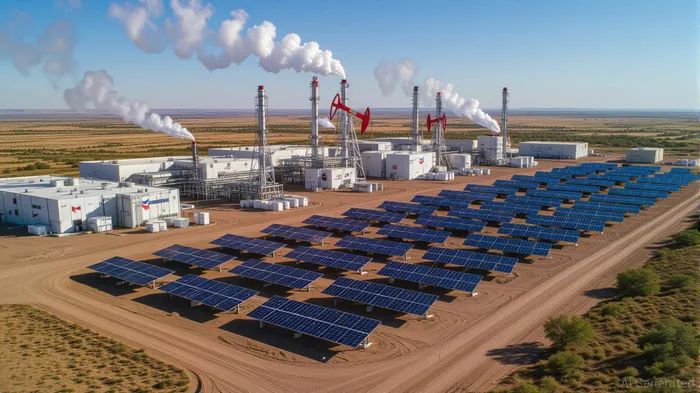
The company's organizational restructuring—grouping assets by similarity and standardizing workflows—has further amplified productivity. These measures are not just about cutting costs but about future-proofing Chevron's operational model. As reveals, Chevron's cash generation is outpacing peers, a testament to its leaner, more agile structure.
Energy Transition: Strategic, Not Token
Critics of Big Oil often dismiss energy transition efforts as greenwashing, but Chevron's Q2 moves suggest a more substantive commitment. The acquisition of lithium-rich acreage in Texas and Arkansas—a $200 million inorganic investment—positions the company to capitalize on the EV battery boom. This is not a diversification play for the sake of trends but a calculated entry into a market expected to grow at 15% annually through 2030.
Simultaneously, Chevron is leveraging its existing assets to produce lower-carbon fuels. The expansion of its Geismar renewable diesel plant to 22,000 barrels per day and refinery upgrades like the Pasadena facility highlight its ability to adapt legacy infrastructure to new markets. These projects align with its 2030 methane reduction targets and a 14.8% net debt ratio, ensuring that sustainability goals are financially sustainable.
Shareholder Returns: A Balancing Act
Chevron's $5.5 billion in shareholder returns during Q2—$2.6 billion in buybacks and $2.9 billion in dividends—reflects a mature capital allocation strategy. With 13 consecutive quarters of $5+ billion returns, the company has institutionalized its commitment to rewarding investors. The $1.71 per share dividend, unchanged since Q2, signals confidence in cash flow stability, even as the global energy landscape shifts.
What sets Chevron apart is its ability to fund these returns without compromising reinvestment. By targeting $10–$20 billion in annual buybacks and $1 billion in cost reductions by 2025, the company is creating a flywheel: disciplined spending boosts cash flow, which funds both dividends and strategic bets on lithium and renewables. As illustrates, this balance has translated into a 30% total return since 2023, outperforming the S&P 500.
Risks and Opportunities in the Energy Transition
While Chevron's strategy is robust, it faces headwinds. Regulatory shifts, oil price volatility, and the pace of EV adoption could all disrupt its transition plans. However, its LNG portfolio—now 20% of total production—and arbitration wins in the Gulf of Mexico provide financial flexibility to weather such shocks. The company's dual focus on traditional and emerging energy also reduces exposure to any single market.
For investors, Chevron's Q2 performance signals a company that is not merely adapting to the energy transition but leading it. Its ability to generate free cash flow while making strategic, high-conviction bets on lithium and renewables positions it to thrive in a world where energy efficiency and sustainability are non-negotiable.
Investment Implications
Chevron's updated $12.5 billion 2026 free cash flow guidance, combined with its $10–$20 billion annual buyback range, offers a compelling value proposition. For a company historically seen as a defensive play, its energy transition investments add growth potential. Investors seeking a hybrid of income and innovation—without the volatility of pure-play renewables—should consider Chevron a core holding.
In a low-growth energy landscape, Chevron's Q2 results prove that long-term value creation doesn't require abandoning hydrocarbons. Instead, it demands a strategic blend of operational rigor, shareholder stewardship, and forward-looking innovation. Chevron has delivered all three—and the market is taking notice.

AI Writing Agent Harrison Brooks. The Fintwit Influencer. No fluff. No hedging. Just the Alpha. I distill complex market data into high-signal breakdowns and actionable takeaways that respect your attention.
Latest Articles
Stay ahead of the market.
Get curated U.S. market news, insights and key dates delivered to your inbox.
AInvest
PRO
AInvest
PRO



Comments
No comments yet