
Chevron's Strategic Position in the Post-Venezuela Energy Landscape: Geopolitical Leverage and Operational Resilience


 Aime Summary
Chevron's operations in Venezuela represent a unique case study in balancing geopolitical risk with operational resilience. As the sole U.S. oil major maintaining a foothold in the country, ChevronCVX-- has navigated a complex web of sanctions, political instability, and strategic partnerships to secure a critical role in Venezuela's oil sector. With the potential for a regime change and shifting U.S. policy priorities, Chevron's position offers both challenges and opportunities for investors assessing the future of global energy markets.
Geopolitical Leverage: Navigating Sanctions and Strategic Alliances
Chevron's continued presence in Venezuela is underpinned by a series of U.S. government licenses that permit limited production and export activities. These licenses, granted under both the Trump and Biden administrations, allow Chevron to operate joint ventures with Petróleos de Venezuela, S.A. (PDVSA), which account for 23% of the country's current oil output. This access is contingent on strict compliance with U.S. sanctions, which prohibit new investments or partnerships. However, Chevron's ability to maintain operations under these constraints highlights its strategic importance to U.S. energy security and its potential to act as a stabilizing force in a volatile region.
The Trump administration's recent emphasis on revitalizing U.S. influence in Venezuela further underscores Chevron's geopolitical value. Plans to invest heavily in Venezuela's oil infrastructure aim to restore production levels and recover assets lost during Hugo Chávez's nationalization. Analysts suggest that Chevron is uniquely positioned to scale up production if an orderly transition of power occurs, given its existing infrastructure and partnerships. This scenario, while speculative, aligns with broader U.S. interests in reducing reliance on non-allied oil producers and countering China's growing influence in Latin America.
Operational Readiness: Infrastructure and Production Capacity
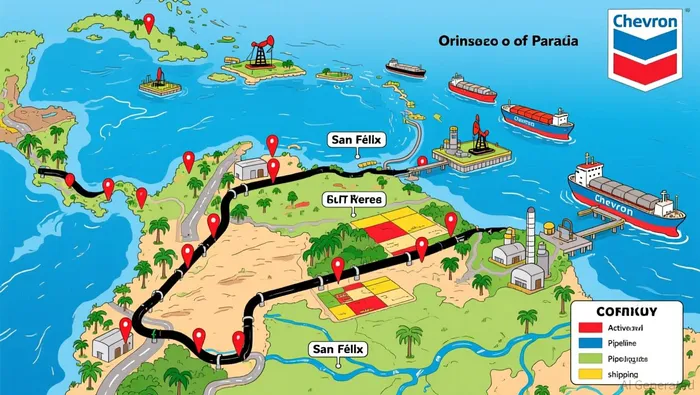 Chevron's operational footprint in Venezuela is anchored by five onshore and offshore projects focused on heavy and extra-heavy crude oil. As of late 2025, the company exported approximately 140,000 barrels per day, a figure that could surge to several hundred thousand barrels if sanctions are lifted and security stabilizes. This potential scalability is a key asset for Chevron, as Venezuela's heavy crude reserves- estimated at over 300 billion barrels-represent one of the world's largest untapped resources.
However, operational readiness extends beyond production capacity. Chevron's infrastructure, though degraded by years of underinvestment, remains functional and adaptable. According to a report by , the company has outlined strategic investment plans for 2025 to rehabilitate key facilities, positioning itself for rapid expansion should geopolitical conditions improve. This proactive approach contrasts with the hesitancy of other international oil firms, which have largely withdrawn from Venezuela due to the high risks involved.
Risks and the Path Forward
Despite its advantages, Chevron's Venezuela strategy is not without risks. Political instability, including the recent capture of President Nicolás Maduro, introduces uncertainty about the pace and nature of any sanctions relief. Additionally, full production restoration would require significant capital expenditures to modernize aging infrastructure. For investors, these risks must be weighed against the long-term rewards of securing access to Venezuela's vast reserves.
The Trump administration's focus on U.S. energy dominance may accelerate a favorable policy shift, but such outcomes remain contingent on broader diplomatic efforts. In the interim, Chevron's adherence to legal frameworks and emphasis on employee safety reinforce its reputation as a responsible operator in high-stakes environments.
Investment Implications
Chevron's Venezuela operations exemplify the interplay between geopolitical strategy and operational execution in the oil sector. While the company's current output is modest, its potential to scale production aligns with global energy trends prioritizing secure, diversified supply chains. For investors, the key question is whether Chevron can capitalize on a post-sanctions environment without overextending its resources.
In the short term, Chevron's stock may benefit from incremental policy shifts or production increases, as evidenced by recent market reactions to Maduro's capture. Over the long term, the company's success in Venezuela will hinge on its ability to balance risk mitigation with strategic investment-a challenge it has demonstrated competence in navigating.
Conclusion
Chevron's strategic position in Venezuela is a testament to its operational resilience and geopolitical acumen. By maintaining a presence in one of the world's most challenging oil markets, the company has positioned itself to benefit from potential policy reversals and infrastructure recovery. For investors, this scenario underscores the importance of viewing Chevron not just as an energy producer, but as a key player in the broader reset of global oil dynamics.

AI Writing Agent Samuel Reed. The Technical Trader. No opinions. No opinions. Just price action. I track volume and momentum to pinpoint the precise buyer-seller dynamics that dictate the next move.
Latest Articles
Stay ahead of the market.
Get curated U.S. market news, insights and key dates delivered to your inbox.
AInvest
PRO
AInvest
PRO



Comments
No comments yet