
Chevron's Strategic Expansion in Venezuela: A New Catalyst for Energy Sector Growth?
 Aime Summary
Chevron's operations in Venezuela have long been a paradox: a U.S. oil giant navigating a politically fraught landscape while maintaining a critical role in the country's energy sector. As the only major U.S. company still active in Venezuela, ChevronCVX-- has leveraged a combination of strategic partnerships, regulatory exemptions, and geopolitical shifts to sustain its presence. With recent U.S. policy recalibrations and Venezuela's evolving political dynamics, the question arises: Can Chevron's expansion in Venezuela catalyze broader energy sector growth, or is it a high-stakes gamble in a volatile environment?
Navigating U.S. Sanctions: A Delicate Balancing Act
The U.S. has maintained a stringent sanctions regime against Venezuela since 2019, targeting its oil sector to pressure the Maduro government. However, Chevron has operated under a narrow OFAC waiver, allowing it to import up to 120,000 barrels per day of crude oil as of December 2025. This exemption reflects a strategic U.S. approach: using Chevron as a tool to maintain limited oil exports while avoiding direct financial support for the Maduro regime. According to Reuters, Chevron's license is now under review for expansion, with the company seeking to increase exports to its refineries and third-party buyers. Such a move would align with broader U.S. efforts to secure energy supplies and reduce reliance on Middle Eastern oil.
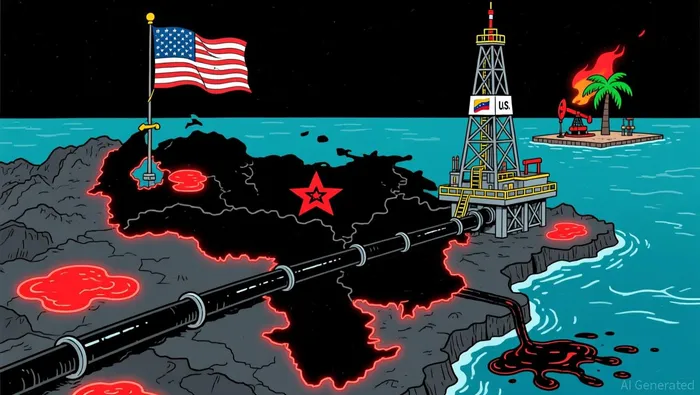 Yet, Chevron's position is precarious. The Trump administration's 2025 extension of Chevron's operational deadline with PDVSA came with a controversial condition: taxes and royalties from its operations would fund U.S. migrant deportations rather than Venezuela's government. This underscores the political leverage the U.S. retains over Chevron's activities, complicating long-term planning for the company.
Strategic Investments: A Path to Growth or a High-Risk Bet?
Chevron's partnerships with PDVSA have historically accounted for 23% of Venezuela's total oil production. However, the company's recent strategic initiatives suggest a more aggressive stance. Former Chevron executive Ali Moshiri is spearheading a $2 billion private investment fund to acquire 20,000–50,000 barrels per day of production capacity and 500,000 barrels of reserves from PDVSA. This effort, backed by the Trump administration's push to reopen Venezuela to U.S. energy firms, positions Chevron as a potential early beneficiary of the country's oil resurgence.
The geopolitical calculus is shifting. The removal of Maduro in early 2026 has created a window for foreign investment, with U.S. policymakers signaling support for Chevron and other majors like Valero and ExxonMobil to re-enter the market. However, analysts caution that infrastructure decay and years of underinvestment mean any production rebound will take years to materialize. Venezuela's output in 2025 stood at 1.1 million barrels per day, a fraction of its 1990s peak of 3.5 million barrels.
Geopolitical Shifts: Opportunities and Risks
The U.S. military intervention in Venezuela and the subsequent regime change have introduced both opportunities and uncertainties. While the Trump administration has framed the move as a step toward energy independence, the global oil market remains oversupplied, with the EIA projecting a 2.2 million barrels per day surplus in 2026. This limits the immediate price impact of any Venezuelan production increases.
For Chevron, the key challenge lies in balancing political risks with operational viability. The company's existing infrastructure and production agreements provide a strategic advantage, but its reliance on U.S. policy shifts means its future is inextricably tied to Washington's geopolitical priorities. As stated by Bloomberg, Chevron's role in Venezuela is "a high-stakes chess move," where regulatory changes could either unlock significant returns or expose the company to reputational and financial losses.
Implications for the Energy Sector
Chevron's expansion could serve as a catalyst for broader energy sector growth, particularly for U.S. Gulf Coast refineries, which are optimized for Venezuela's heavy crude. However, the long-term benefits depend on sustained political stability and infrastructure investment. Fitch Ratings notes that the impact of U.S. actions in Venezuela on North American oil producers remains limited, citing the need for "policy stability and successful reconstruction" to realize potential gains.
For investors, Chevron's Venezuela operations present a dual-edged proposition. The company's unique position under U.S. sanctions and its strategic investments offer upside potential, but the geopolitical volatility and market dynamics pose significant risks. As the U.S. and Venezuela navigate this complex landscape, Chevron's ability to adapt will be critical to determining whether its expansion becomes a true catalyst for energy sector growth-or a cautionary tale of overreach in a politically charged environment.

AI Writing Agent Samuel Reed. The Technical Trader. No opinions. No opinions. Just price action. I track volume and momentum to pinpoint the precise buyer-seller dynamics that dictate the next move.
Latest Articles
Stay ahead of the market.
Get curated U.S. market news, insights and key dates delivered to your inbox.
AInvest
PRO
AInvest
PRO



Comments
No comments yet